Review
. 2023 May;44(5):290-302.
doi: 10.1016/j.tips.2023.02.003. Epub 2023 Mar 15.

Recent advances in targeting autophagy in cancer

Affiliations
Review

Recent advances in targeting autophagy in cancer

Vaibhav Jain et al. Trends Pharmacol Sci. 2023 May.

Abstract

Autophagy is a cellular homeostasis mechanism that fuels the proliferation and survival of advanced cancers by degrading and recycling organelles and proteins. Preclinical studies have identified that within an established tumor, tumor cell autophagy and host cell autophagy conspire to support tumor growth. A growing body of evidence suggests that autophagy inhibition can augment the efficacy of chemotherapy, targeted therapy, or immunotherapy to enhance tumor shrinkage. First-generation autophagy inhibition trials in cancer using the lysosomal inhibitor hydroxychloroquine (HCQ) have produced mixed results but have guided the way for the development of more potent and specific autophagy inhibitors in clinical trials. In this review, we will discuss the role of autophagy in cancer, newly discovered molecular mechanisms of the autophagy pathway, the effects of autophagy modulation in cancer and host cells, and novel autophagy inhibitors that are entering clinical trials.

Keywords: autophagy; cancer; hydroxychloroquine; immunotherapy, chemotherapy; lysosome.


Conflict of interest statement

Declaration of interests R.K.A. is inventor on patents related to dimeric chloroquines and quinacrines and founder of Pinpoint Therapeutics.

Figures
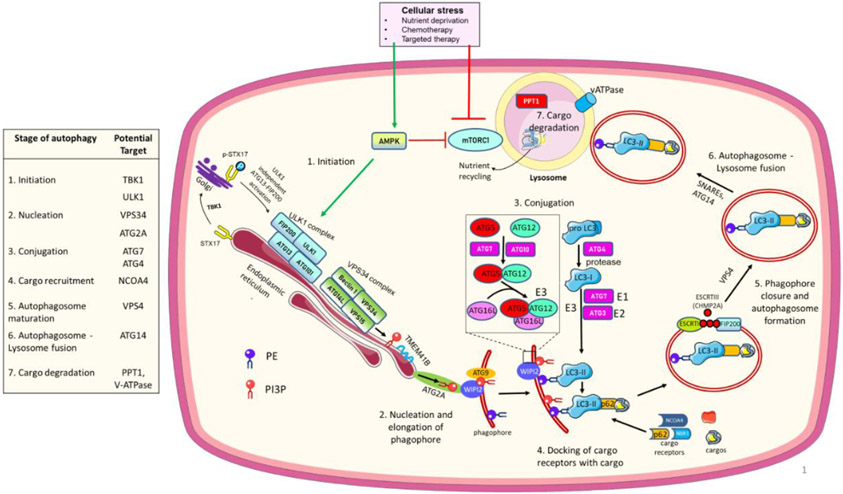
Figure 1.
Figure 1.. Autophagy regulatory pathway.
Cellular stress activates AMPK which directly and indirectly (through inhibition of mTORC1) activates the ULK1 complex and initiates autophagy. An ULK1 independent activation of autophagy can also occur via TBK1. ULK1 phosphorylates and activates the PI3KC3 lipid kinase complex which generates phosphatidylinositol 3-phosphate (PI3P) to commence phagophore membrane elongation with the help of TMEM41B and ATG2A, which deliver lipids to PI3P-WIPI2 complexes for the next conjugation steps. Two ubiquitin-like sequential conjugation reactions (ATG12 and ATG7 conjugate ATG8 (LC3) protein to phosphatidylethanolamine (PE). ATG7 and ATG3 act as E1 and E2-like enzymes, respectively, and the ATG12-ATG5-ATG16L complex as an E3-like enzyme to finally catalyze the binding of LC3I to PE by ATG3. Next, autophagy cargo receptors with their specific cargos dock onto LC3II in the phagophore/growing autophagosome. ESCRT-III protein polymerization brings together the open ends of the autophagosome which are closed by VPS4 to complete the autophagosome maturation. The autophagosome fuses with the lysosome to degrade and recycle autophagy cargo components. Proteins in the table present potential targets to inhibit different autophagy steps in cancer. For recent advances in each step, please see the main text.
Figure 2.
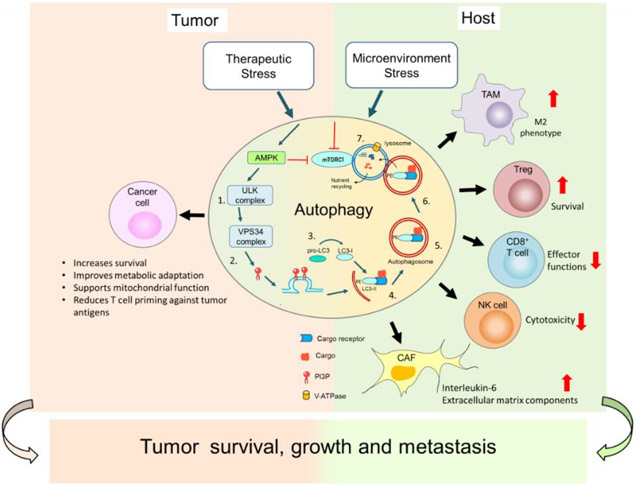
Figure 2.. Autophagy supports tumor growth and survival by modulating cancer cells in the tumor, and host cells in the tumor microenvironment (TME).
Stressors on cancer cells induce autophagy (please see Figure 1 for details) in both cancer cells as well as in non-cancerous host cells. In cancer cells, autophagy induction promotes their survival by altering their metabolism to provide nutrients and promoting their mitochondrial function under stress. Autophagy degrades immunoproteasome components and MHC-I molecules to escape antitumor immunity. In the TME in non-cancerous host cells, autophagy promotes an M2 phenotype of tumor associated macrophages (TAMs) that support tumor cell growth. Autophagy can also enhance T regulatory cells (Tregs) leading to immunosuppression in the TME. Autophagy limits infiltration and effector functions of CD8+ T cells and natural killer (NK) cells. Autophagy also enhances the activity of cancer associated fibroblasts (CAFs) in the extracellular matrix that supports tumor growth and metastasis. Together the functions of autophagy in cancer cells and host cells support tumor survival, growth, and metastasis.
Figure 3.
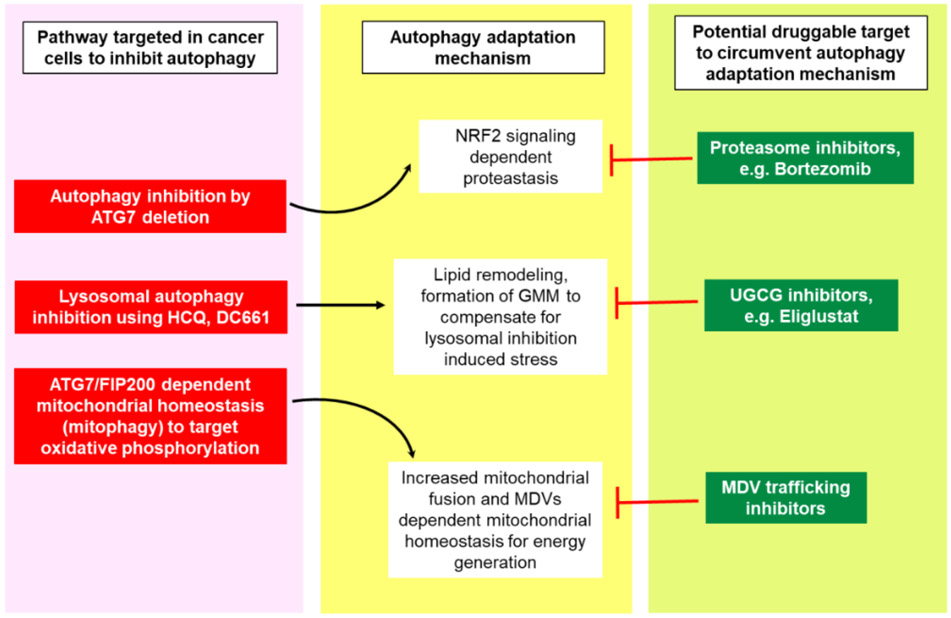
Figure 3.. Autophagy adaptation mechanisms as novel potential targets to augment autophagy inhibitory effects on cancer.
Autophagy inhibition by different strategies can induce compensatory pathways which can mitigate the anti-cancer effects of targeting autophagy in cancer. Combining the inhibitors of autophagy resistance pathways with autophagy inhibiting agents in cancer is a new approach which could be used to augment anticancer effects of autophagy inhibitors as a single agent or in combination with standard of care drugs that induce cytoprotective autophagy. Mitochondrial-derived vesicles (MDVs); GM1 + membrane microdomains (GMM); NRF2, nuclear factor erythroid 2-related factor 2; UGCG, UDP-Glucose Ceramide Glucosyltransferase.

References

    1. Aman Y et al. (2021) Autophagy in healthy aging and disease. Nat Aging 1, 634–650 - PMC - PubMed
    1. Qureshi-Baig K et al. (2020) Hypoxia-induced autophagy drives colorectal cancer initiation and progression by activating the PRKC/PKC-EZR (ezrin) pathway. Autophagy 16, 1436–1452 - PMC - PubMed
    1. Liang L et al. (2019) Autophagy inhibition potentiates the anti-angiogenic property of multikinase inhibitor anlotinib through JAK2/STAT3/VEGFA signaling in non-small cell lung cancer cells. J Exp Clin Cancer Res 38 - PMC - PubMed
    1. Mathew R et al. (2009) Autophagy suppresses tumorigenesis through elimination of p62. Cell 137, 1062–1075 - PMC - PubMed
    1. Liang XH et al. (1999) Induction of autophagy and inhibition of tumorigenesis by beclin 1. Nature 402, 672–676 - PubMed

Publication types

Substances