


Virulence analysis and antibiotic resistance of Klebsiella pneumoniae isolates from hospitalised patients in Poland
- PMID: 36932105
- PMCID: PMC10023695
- DOI: 10.1038/s41598-023-31086-w
Virulence analysis and antibiotic resistance of Klebsiella pneumoniae isolates from hospitalised patients in Poland
Abstract
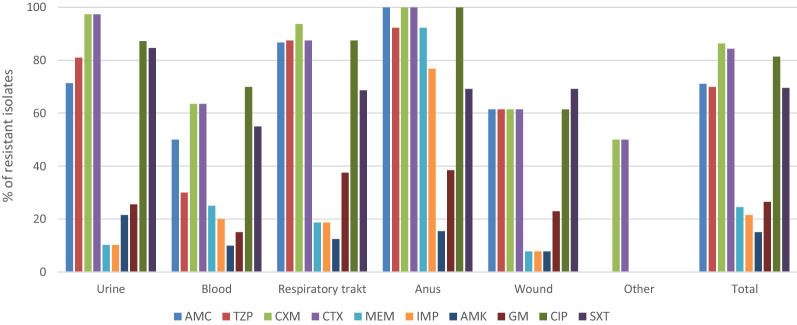
Klebsiella pneumoniae (KP) is a nosocomial pathogen causing difficult-to-treat infections. The presence of virulence genes and antibiotic resistance of 109 KP isolates from hospitalized patients were investigated. Among them, 68.8% were multi-drug resistant (MDR) and 59.6% produced extended-spectrum beta-lactamases (ESBLs). Metallo-β-lactamases (MBLs) were produced by 22% of isolates (mainly from anus), including 16.5% of isolates producing New Delhi metallo-β-lactamase (NDM-1). The genes encoding adhesins (fimH-91.7%, mrkD-96.3%), enterobactin (entB-100%) and yersiniabactin (irp-1-88%) were frequently identified. The genes encoding salmochelin (iroD-9.2%, iroN-7.3%) and colibactin (clbA, clbB-0.9%) were identified rarely. Iron acquisition system-related kfu gene and wcaG gene involved in capsule production were identified in 6.4% and 11% of isolates, respectively. The rmpA gene associated with hypermucoviscosity was present in 6.4% of isolates. In 19.2% of isolates magA gene was detected, specific for K1 capsule serotype, while 22.9% of isolates showed K2 capsule serotype. The rmpA, iroD or iroN genes being diagnostic biomarkers for hypervirulent KP (hvKP) were detected in 16.5% of isolates. We found that 55.5% of hvKP were MDR and produced ESBLs, thus hospital KP isolates pose a serious threat to the healthcare system.
© 2023. The Author(s).
Conflict of interest statement
The authors declare no competing interests.
Figures
References
-
- Tsay RW, Siu LK, Fung CP, Chang FY. Characteristics of bacteremia between community-acquired and nosocomial Klebsiella pneumoniae infection: Risk factor for mortality and the impact of capsular serotypes as a herald for community-acquired infection. Arch. Intern. Med. 2002;162:1021–1027. doi: 10.1001/archinte.162.9.1021. - DOI - PubMed
Publication types
MeSH terms
Substances
LinkOut - more resources
Full Text Sources
