


Minimally invasive approaches for the early detection of endometrial cancer
- PMID: 36932368
- PMCID: PMC10022290
- DOI: 10.1186/s12943-023-01757-3
Minimally invasive approaches for the early detection of endometrial cancer
Erratum in
-
Correction: minimally invasive approaches for the early detection of endometrial cancer.Mol Cancer. 2023 Apr 26;22(1):76. doi: 10.1186/s12943-023-01777-z. Mol Cancer. 2023. PMID: 37101282 Free PMC article. No abstract available.
Abstract
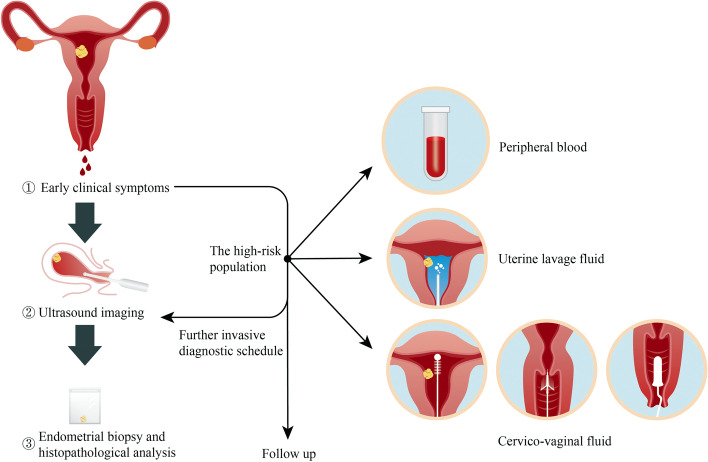
Endometrial cancer (EC) is one of the most common gynecologic cancers and its incidence is rising globally. Although advanced EC has a poor prognosis; diagnosing EC at an earlier stage could improve long-term patient outcomes. However, there is no consensus on the early detection strategies for EC and the current diagnostic practices such as transvaginal ultrasound, hysteroscopy and endometrial biopsy are invasive, costly and low in specificity. Thus, accurate and less invasive screening tests that detect EC in women with early stages of the disease are needed. Current research has revolutionized novel EC early detection methodologies in many aspects. This review aims to comprehensively characterizes minimally invasive screening techniques that can be applied to EC in the future, and fully demonstrate their potential in the early detection of EC.
Keywords: Biofluid; Biomarkers; Early diagnosis; Endometrial cancer; Minimally invasive.
© 2023. The Author(s).
Conflict of interest statement
Not applicable.
Figures
References
-
- Siegel RL, Miller KD, Fuchs HE, Jemal A. Cancer statistics, 2022. CA Cancer J Clin. 2022;72(1):7–33. - PubMed
-
- Sung H, Ferlay J, Siegel RL, Laversanne M, Soerjomataram I, Jemal A, Bray F. Global Cancer Statistics 2020: GLOBOCAN Estimates of Incidence and Mortality Worldwide for 36 Cancers in 185 Countries. CA: Cancer J. Clin. 2021;71:209–249. - PubMed
Publication types
MeSH terms
LinkOut - more resources
Full Text Sources
