


An integrated approach of network pharmacology, molecular docking, and experimental verification uncovers kaempferol as the effective modulator of HSD17B1 for treatment of endometrial cancer
- PMID: 36932403
- PMCID: PMC10022092
- DOI: 10.1186/s12967-023-04048-z
An integrated approach of network pharmacology, molecular docking, and experimental verification uncovers kaempferol as the effective modulator of HSD17B1 for treatment of endometrial cancer
Erratum in
-
Correction to: An integrated approach of network pharmacology, molecular docking, and experimental verification uncovers kaempferol as the effective modulator of HSD17B1 for treatment of endometrial cancer.J Transl Med. 2026 Feb 13;24(1):186. doi: 10.1186/s12967-026-07698-x. J Transl Med. 2026. PMID: 41689082 Free PMC article. No abstract available.
Abstract
Background: Endometrial cancer (EC) is one of the most common gynecological malignancies globally, and the development of innovative, effective drugs against EC remains a key issue. Phytoestrogen kaempferol exhibits anti-cancer effects, but the action mechanisms are still unclear.
Method: MTT assays, colony-forming assays, flow cytometry, scratch healing, and transwell assays were used to evaluate the proliferation, apoptosis, cell cycle, migration, and invasion of both ER-subtype EC cells. Xenograft experiments were used to assess the effects of kaempferol inhibition on tumor growth. Next-generation RNA sequencing was used to compare the gene expression levels in vehicle-treated versus kaempferol-treated Ishikawa and HEC-1-A cells. A network pharmacology and molecular docking technique were applied to identify the anti-cancer mechanism of kaempferol, including the building of target-pathway network. GO analysis and KEGG pathway enrichment analysis were used to identify cancer-related targets. Finally, the study validated the mRNA and protein expression using real-time quantitative PCR, western blotting, and immunohistochemical analysis.
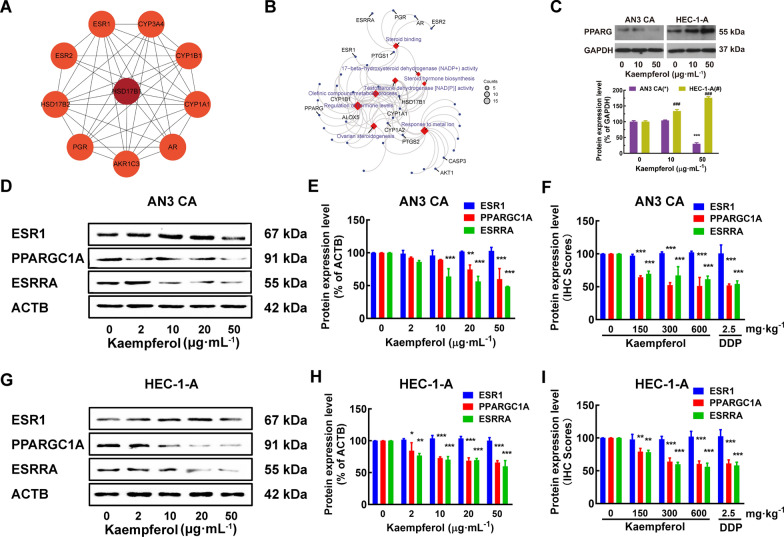
Results: Kaempferol was found to suppress the proliferation, promote apoptosis, and limit the tumor-forming, scratch healing, invasion, and migration capacities of EC cells. Kaempferol inhibited tumor growth and promotes apoptosis in a human endometrial cancer xenograft mouse model. No significant toxicity of kaempferol was found in human monocytes and normal cell lines at non-cytotoxic concentrations. No adverse effects or significant changes in body weight or organ coefficients were observed in 3-7 weeks' kaempferol-treated animals. The RNA sequencing, network pharmacology, and molecular docking approaches identified the overall survival-related differentially expressed gene HSD17B1. Interestingly, kaempferol upregulated HSD17B1 expression and sensitivity in ER-negative EC cells. Kaempferol differentially regulated PPARG expression in EC cells of different ER subtypes, independent of its effect on ESR1. HSD17B1 and HSD17B1-associated genes, such as ESR1, ESRRA, PPARG, AKT1, and AKR1C1\2\3, were involved in several estrogen metabolism pathways, such as steroid binding, 17-beta-hydroxysteroid dehydrogenase (NADP+) activity, steroid hormone biosynthesis, and regulation of hormone levels. The molecular basis of the effects of kaempferol treatment was evaluated.
Conclusions: Kaempferol is a novel therapeutic candidate for EC via HSD17B1-related estrogen metabolism pathways. These results provide new insights into the efficiency of the medical translation of phytoestrogens.
Keywords: Estrogen receptor α; HSD17B1; Human endometrial cancer; Kaempferol; Nude mice.
© 2023. The Author(s).
Conflict of interest statement
The authors declare that they have no competing interests.
Figures



References
-
- Sung H, Ferlay J, Siegel RL, Laversanne M, Soerjomataram I, Jemal A, Bray F. Global cancer statistics 2020: GLOBOCAN estimates of incidence and mortality worldwide for 36 cancers in 185 Countries. CA Cancer J Clin. 2021;71:209–49. - PubMed
-
- Siegel RL, Miller KD, Jemal A. Cancer statistics, 2020. CA Cancer J Clin. 2020;70:7–30. - PubMed
-
- Brooks RA, Fleming GF, Lastra RR, Lee NK, Moroney JW, Son CH, Tatebe K, Veneris JL. Current recommendations and recent progress in endometrial cancer. CA Cancer J Clin. 2019;69:258–79. - PubMed
Publication types
MeSH terms
Substances
LinkOut - more resources
Full Text Sources
Research Materials
Miscellaneous
