. 2023 Jun;20(3):284-292.
doi: 10.1177/17407745231160556. Epub 2023 Mar 17.

Covariate-constrained randomization with cluster selection and substitution

Affiliations

Covariate-constrained randomization with cluster selection and substitution

Amy M Crisp et al. Clin Trials. 2023 Jun.

Abstract

Background: An ongoing cluster-randomized trial for the prevention of arboviral diseases utilizes covariate-constrained randomization to balance two treatment arms across four specified covariates and geographic sector. Each cluster is within a census tract of the city of Mérida, Mexico, and there were 133 eligible tracts from which to select 50. As some selected clusters may have been subsequently found unsuitable in the field, we desired a strategy to substitute new clusters while maintaining covariate balance.

Methods: We developed an algorithm that successfully identified a subset of clusters that maximized the average minimum pairwise distance between clusters in order to reduce contamination and balanced the specified covariates both before and after substitutions were made.

Simulations: Simulations were performed to explore some limitations of this algorithm. The number of selected clusters and eligible clusters were varied along with the method of selecting the final allocation pattern.

Conclusion: The algorithm is presented here as a series of optional steps that can be added to the standard covariate-constrained randomization process in order to achieve spatial dispersion, cluster subsampling, and cluster substitution. Simulation results indicate that these extensions can be used without loss of statistical validity, given a sufficient number of clusters included in the trial.

Keywords: Clinical trial design; cluster-randomized; constrained randomization.


Figures

Figure 1.
Figure 1.
An illustration of the trial area showing the eligible region and an example of a set of 50 selected tracts. Also shown in the top right is an image of the fried egg approach as used in this trial, where the entire 5×5 block area is treated, but only the inner blue 3×3 block area is included in the primary analysis.
Figure 2.
Figure 2.
The final randomization scheme for the TIRS trial. The 50 selected tracts are highlighted in red. The yellow highlighted tracts were found to be unusable by the field team after initial selection. The circled tracts were found to be suitable substitutions.
Figure 3.
Figure 3.
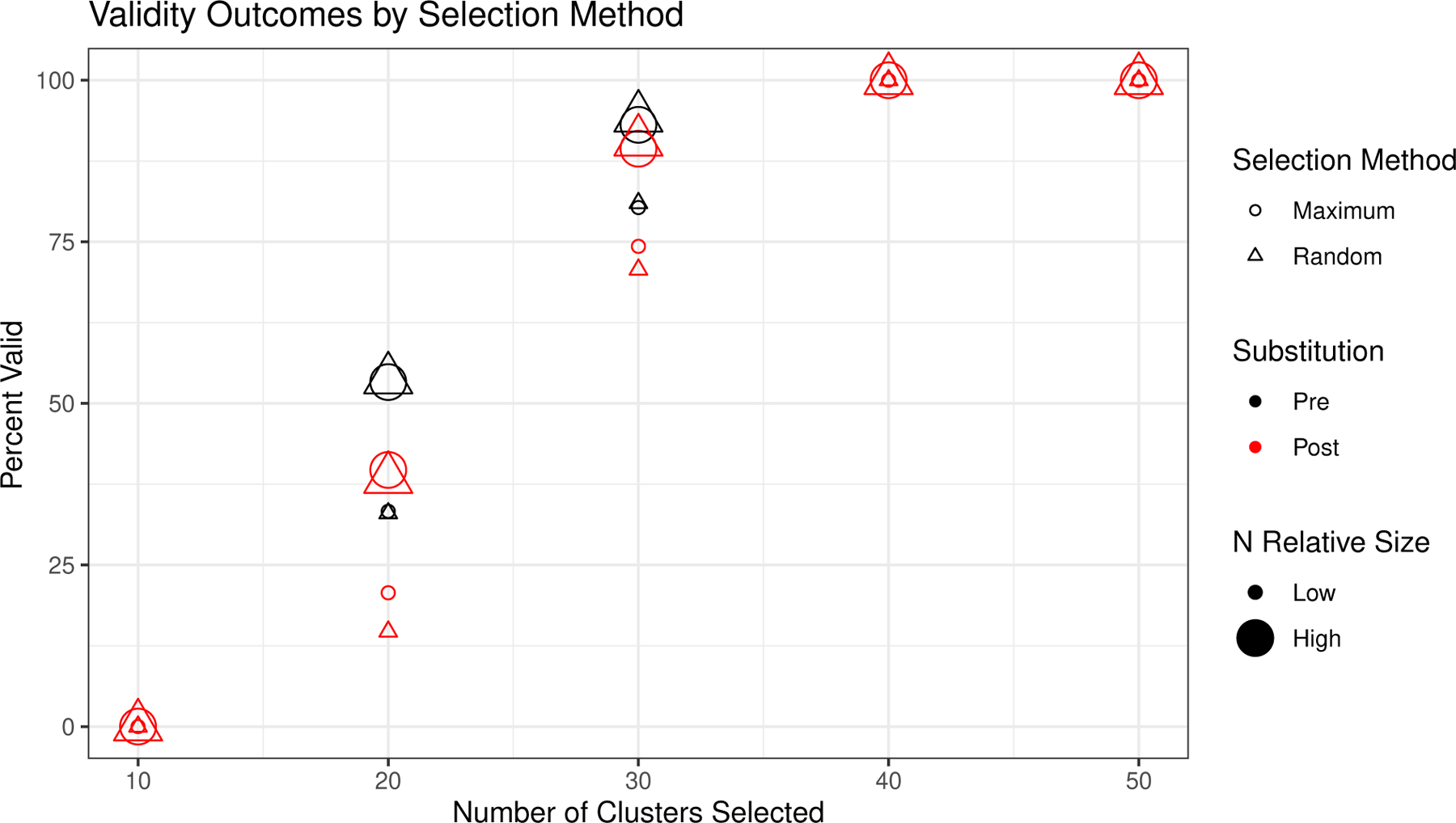
Validity Outcomes from Simulations Selecting s Clusters from N Clusters. The shape of the point indicates the method used for selecting the set of clusters, and the color indicates whether the outcome is prior to or after performing substitutions. The smaller points indicate the simulations for which N was smaller, and the larger points indicate those for which N was 60 or 100.
Figure 4.
Figure 4.
Visualization of selected clusters (in red) when selecting sets based on adjacency and distance metrics. The clusters highlighted here are census tracts on the map of the city of Mérida, Mexico. By selecting sets based on minimizing adjacency and maximizing average minimum pairwise distance (upper left quadrant), greater spatial dispersion is achieved, and there are fewer shared borders between clusters.

References

    1. Moulton LH. Covariate-based constrained randomization of group-randomized trials. Clinical Trials 2004; 1: 297–305. - PubMed
    1. Jr LJR, Simberkoff MS, Bessesen MT et al. N95 respirators vs medical masks for preventing influenza among health care personnel a randomized clinical trial. JAMA 2019; 322(9): 824–833. - PMC - PubMed
    1. Humphrey JH, Mbuya MNN, Ntozini R et al. Independent and combined effects of improved water, sanitation, and hygiene, and improved complementary feeding, on child stunting and anaemia in rural zimbabwe: a cluster-randomised trial. Lancet Glob Health 2019; 7: 132–147. - PMC - PubMed
    1. Diallo A, Diop OM, Diop D et al. Effectiveness of seasonal influenza vaccination in children in senegal during a year of vaccine mismatch: A cluster-randomized trial. Clinical Infectious Diseases 2019; 69: 1780–1788. - PMC - PubMed
    1. Raab GM and Butcher I. Balance in cluster randomized trials. Stat Med 2001; 20: 351–365. - PubMed

Publication types