


Using trunk kinematics to predict kinetic asymmetries during double-leg jump-landings in collegiate athletes following anterior cruciate ligament reconstruction
- PMID: 36934474
- PMCID: PMC10148905
- DOI: 10.1016/j.gaitpost.2023.03.003
Using trunk kinematics to predict kinetic asymmetries during double-leg jump-landings in collegiate athletes following anterior cruciate ligament reconstruction
Abstract
Background: Bilateral vertical ground reaction force (VGRF) and knee extension moment asymmetries are commonly observed during jumping and landing tasks following anterior cruciate ligament (ACL) reconstructions (ACLR) in collegiate athletes. Kinetic asymmetries during landings are associated with increased ACL re-injury risk. Efforts have been made to predict bilateral kinetic asymmetries using trunk kinematics during squats but not during jump-landings.
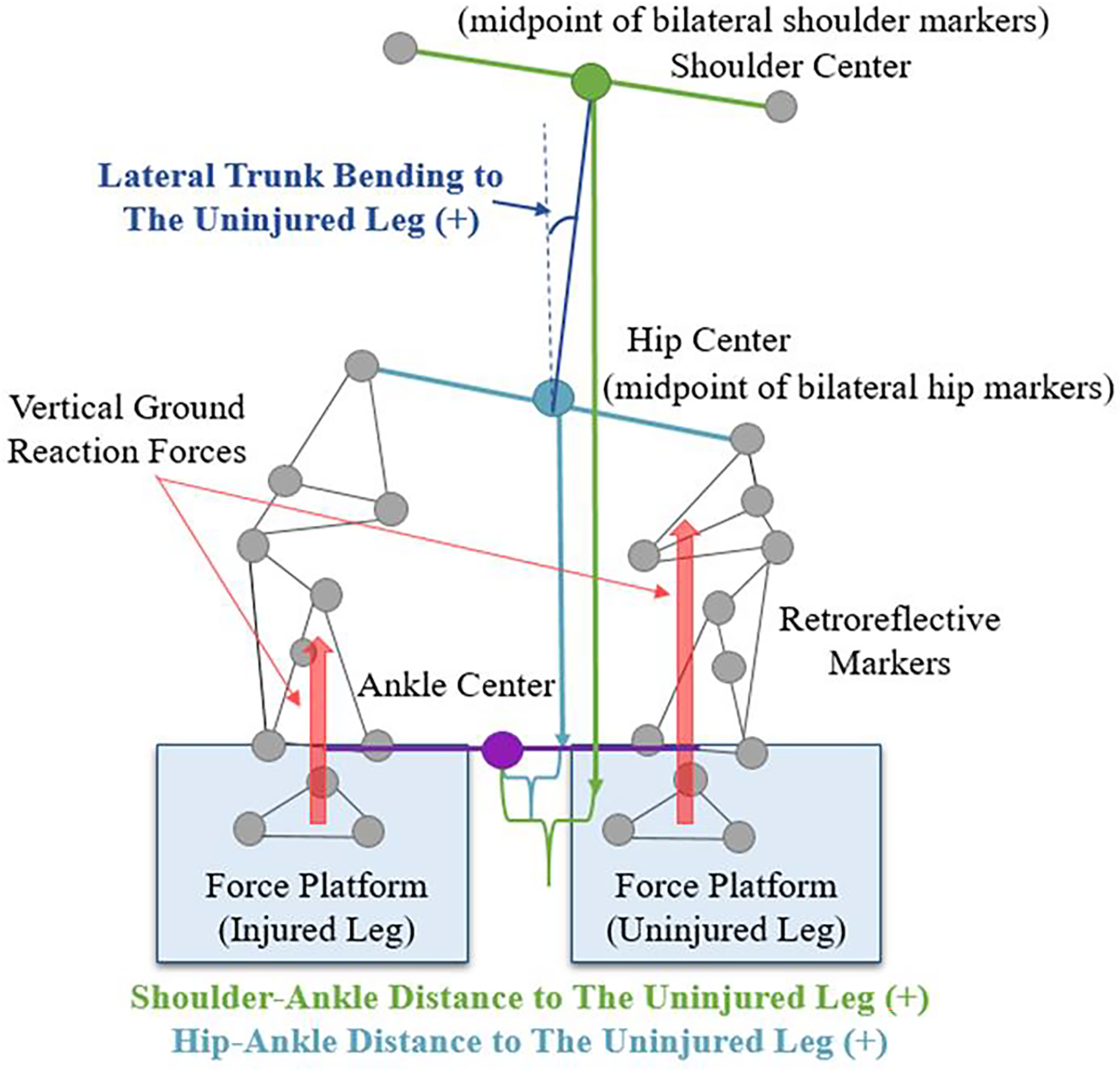
Research question: To determine the correlations between trunk kinematics (medial-lateral shoulder positions, medial-lateral hip positions, and lateral trunk bending angles) and bilateral kinetic asymmetries (VGRF and knee extension moments) during double-leg jump-landings in collegiate athletes following ACLR.
Methods: Fifteen National Collegiate Athletic Association Division I athletes who had ACLR in the past 24 months participated. Eleven of them performed two assessments over the study period for a total of 26 assessments for data analyses. Athletes performed three double-leg countermovement jumps. Kinematics and kinetics data were collected. Medial-lateral shoulder and hip positions relative to ankle positions, lateral trunk bending angles, and kinetic asymmetries were calculated during the jumping (the lowest hip position until takeoff) and landing (the first 100 ms after initial contact) phases.
Results: Medial-lateral shoulder positions correlated with VGRF (r = 0.63, p < 0.001) and knee moment asymmetries (r = 0.53, p = 0.006) in the jumping phase. Medial-lateral hip positions correlated with VGRF (r = 0.61, p < 0.001; r = 0.52, p = 0.006) and knee moment asymmetries (r = 0.55, p = 0.004; r = 0.61, p < 0.001) in both jumping and landing phases.
Significance: Medial-lateral hip positions correlated with kinetic asymmetries during double-leg jump-landings in collegiate athletes following ACLR. A 2D assessment using a standard video camera might be used as a low-cost and clinically applicable tool to assess bilateral kinetic asymmetries by quantifying medial-lateral hip positions during jump-landings following ACLR.
Keywords: ACL; Bilateral asymmetry; Hip positions; Kinematics; Re-injury; Trunk.
Copyright © 2023 Elsevier B.V. All rights reserved.
Conflict of interest statement
Conflict of interest statement The authors have no financial or personal conflicts of interest to declare.
Figures

References
-
- McCullough KA, Phelps KD, Spindler KP, Matava MJ, Dunn WR, Parker RD, Moon Group, Reinke EK. Return to high school–and college-level football after anterior cruciate ligament reconstruction: a Multicenter Orthopaedic Outcomes Network (MOON) cohort study. Am J Sports Med 2012;4011:2523–9. - PMC - PubMed
-
- Poulsen E, Goncalves GH, Bricca A, Roos EM, Thorlund JB, Juhl CB. Knee osteoarthritis risk is increased 4–6 fold after knee injury - a systematic review and meta-analysis. Br J Sports Med 2019;5323:1454–63. - PubMed
Publication types
MeSH terms
Grants and funding
LinkOut - more resources
Full Text Sources
Medical
Miscellaneous
