


Residual β-cell function in Brazilian Type 1 diabetes after 3 years of diagnosis: prevalence and association with low presence of nephropathy
- PMID: 36935525
- PMCID: PMC10026390
- DOI: 10.1186/s13098-023-01014-z
Residual β-cell function in Brazilian Type 1 diabetes after 3 years of diagnosis: prevalence and association with low presence of nephropathy
Abstract
Background: Persistence of β cell-function in Type 1 diabetes (T1D) is associated with glycaemia stability and lower prevalence of microvascular complications. We aimed to assess the prevalence of residual C- peptide secretion in long-term Brazilian childhood onset T1D receiving usual diabetes care and its association to clinical, metabolic variables and microvascular complications.
Methods: A cross-sectional observational study with 138 T1D adults with ≥ 3 years from the diagnosis by routine diabetes care. Clinical, metabolic variables and microvascular complications were compared between positive ultra-sensitive fasting serum C-peptide (FCP +) and negative (FCP-) participants.
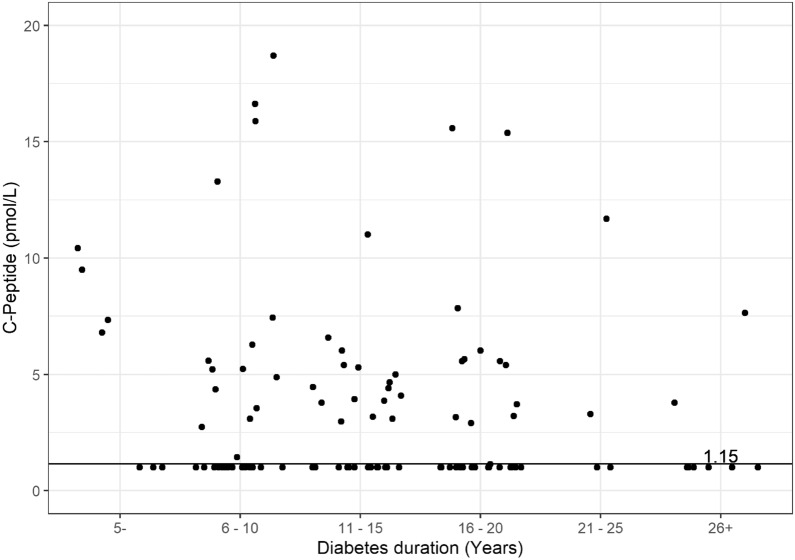
Results: T1D studied had ≥ 3 yrs. of diagnosis and 60% had FCP > 1.15 pmol/L. FCP + T1D were older at diagnosis (10 vs 8 y.o; p = 0.03) and had less duration of diabetes (11 vs 15 y.o; p = 0.002). There was no association between the FCP + and other clinical and metabolic variable but there was inversely association with microalbuminuria (28.6% vs 13.4%, p = 0.03), regardless of HbA1c. FCP > 47 pmol/L were associated with nephropathy protection but were not related to others microvascular complications.
Conclusion: Residual insulin secretion is present in 60% of T1D with ≥ 3 years of diagnosis in routine diabetes care. FCP + was positively associated with age of diagnosis and negatively with duration of disease and microalbuminuria, regardless of HbA1c.
Keywords: C-peptide; Microvascular complications; Type 1 diabetes.
© 2023. The Author(s).
Conflict of interest statement
No author has a competing interest related to the work described in this paper.
Figures
References
-
- The DCCT Research Group Effects of age, duration, and treatment of insulin-dependent diabetes mellitus on residual beta-cell function: observations during eligibility testing for the Diabetes Control and Complications Trial (DCCT) J Clin Endocrinol Metab. 1987;65:30–36. doi: 10.1210/jcem-65-1-30. - DOI - PubMed
LinkOut - more resources
Full Text Sources
Miscellaneous
