Review
. 2023 Mar 1:6:100475.
doi: 10.1016/j.crfs.2023.100475. eCollection 2023.

Valorization of coffee pulp as bioactive food ingredient by sustainable extraction methodologies

Affiliations
Review

Valorization of coffee pulp as bioactive food ingredient by sustainable extraction methodologies

Shuai Hu et al. Curr Res Food Sci. .

Abstract

Coffee pulp is an underutilized by-product of coffee industrial production rich in bioactive compounds such as phenolic compounds, caffeine, and dietary fiber. The widely known antioxidant, anti-inflammatory, anti-aging, antimicrobial and hepatoprotective health-promoting properties attributed to mentioned compounds enhance the use of coffee pulp as a bioactive food ingredient. Furthermore, the application of green sustainable extraction techniques pursuing highly efficient and selective extraction processes promotes this by-product exploitation in food science. Hence, this review gathers the available information relative to the impact of the extraction processes on the bioactive compound's recovery from coffee pulp, providing an overview of the most recent advances. An in-depth comparison workout between conventional and alternative extraction methods was performed to identify the most suitable techniques for coffee pulp valorization as functional ingredient until date. A critical discussion focused on advantages and drawbacks of the extraction methods applied to coffee pulp was included together a prospective of emerging extraction techniques.

Keywords: Advanced extraction techniques; Coffee pulp; Green solvents; Phenolic compounds; Sustainable valorization.


Conflict of interest statement

The authors declare that they have no known competing financial interests or personal relationships that could have appeared to influence the work reported in this paper.

Figures
Image 1
Graphical abstract
Fig. 1
Fig. 1
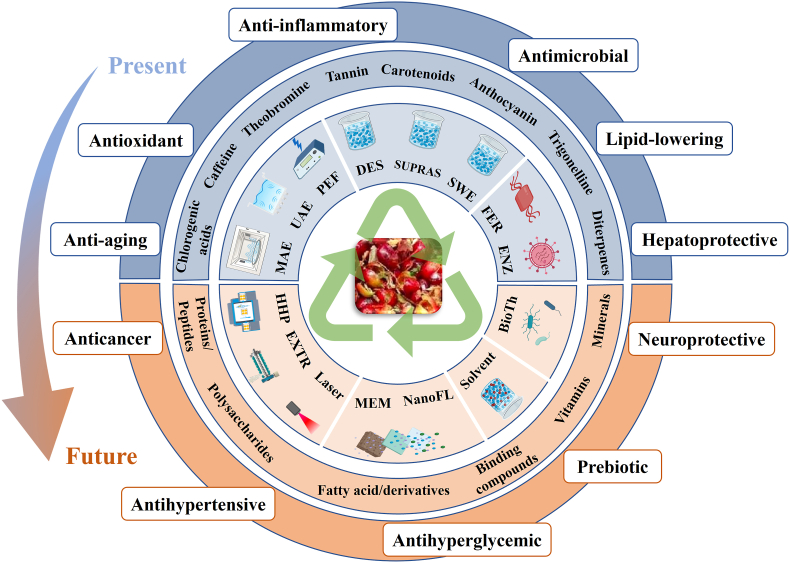
Representation of those advanced and sustainable extraction techniques explored until date to obtain enriched-bioactive fractions from coffee pulp (the upper half). It includes the bioactivities studies until date and the compounds pointed as responsible of such properties. Moreover, non-explored extraction techniques, bioactive compounds and health-promoting activities are proposed (the lower half). MAE: Microwave-Assisted Extraction, UAE: Ultrasound-Assisted Extraction, PEF: Pulsed Electric Field-Assisted Extraction, DES: Deep Eutectic Solvent, SUPRAS: Supramolecular Solvent, SWE: Subcritical Water Extraction, FER: Fermentation, ENZ: Enzymatic Treatment, HHP: High Hydrostatic Pressure; EXTR: Extrusion, MEM: Membrane, NanoFL: Nanofiltration, BioTh: Biotechnology.
Fig. 2
Fig. 2
Schematic summary of solvent extraction techniques used for coffee pulp (CP) valorization in food science including the fundamentals of the extraction model and the main factors to be considered together with their respective advantages and disadvantages. S-L extraction: Solid-Liquid extraction, S-L ratio: Solid-Liquid ratio, MAE: Microwave-Assisted Extraction, UAE: Ultrasound-Assisted Extraction, PEF: Pulsed Electric Field-Assisted Extraction, DES: Deep Eutectic Solvent, SUPRAS: Supramolecular Solvent, SWE: Subcritical Water Extraction, T: Temperature, t: Time.
Fig. 3
Fig. 3
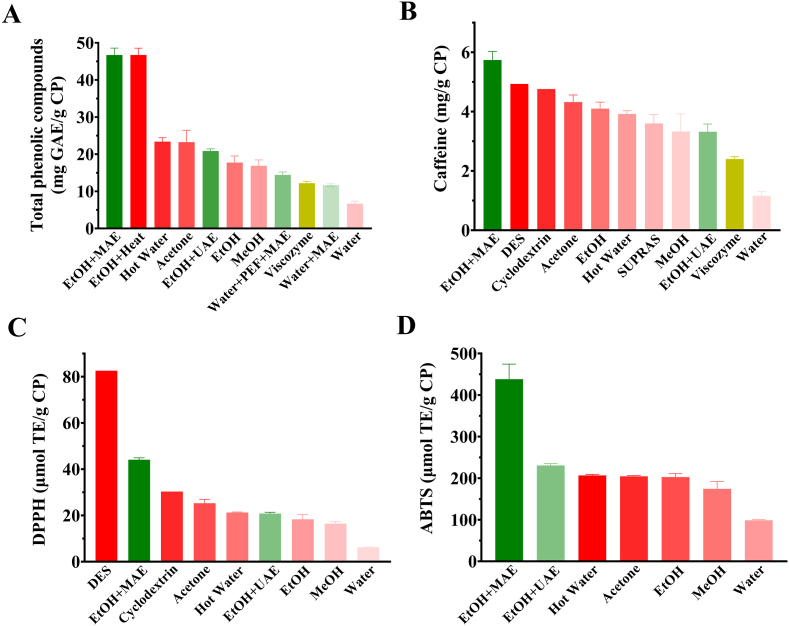
Ranking diagram of the extraction techniques applied to coffee pulp (CP) at optimal conditions in terms of total phenolic content (mg gallic acid equivalent/g CP) (A), caffeine content (mg/g CP) (B), DPPH (μmol Trolox equivalent/g CP) (C), and ABTS (μmol Trolox equivalent/g CP) (D). Only the studies providing the information needed to normalize the results for their appropriate comparison were included. According to the inclusion criteria, the plotted data were those reported information by Tran et al. (2020a); Tran et al. (2022a,; Kusumocahyo et al. (2020); Patil et al. (2022); Macías-Garbett et al. (2022); Torres-Valenzuela et al. (2020); Loukri et al. (2020); Loukri et al. (2022). EtOH: Ethanol, MeOH: Methanol, MAE: Microwave-Assisted Extraction, UAE: Ultrasound-Assisted Extraction, PEF: Pulsed Electric Field-Assisted Extraction, DES: Deep Eutectic Solvent, SUPRAS: Supramolecular Solvent, SWE: Subcritical Water Extraction.
Fig. 4
Fig. 4
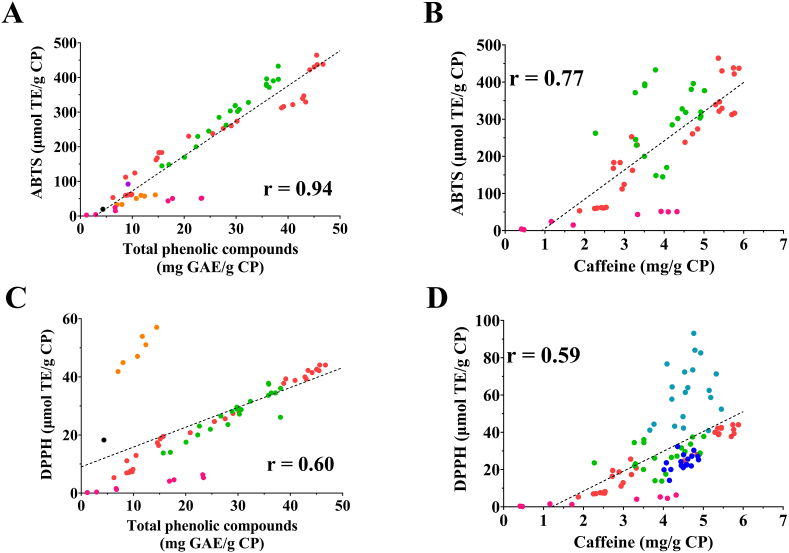
Correlation of the most studied bioactive compounds from coffee pulp (CP) and their antioxidant activity, corresponding to total phenolic compounds (A) or caffeine (B)versus ABTS radical scavenging activity and total phenolic compounds (C) or caffeine (D)versus DPPH. Colored circles represent the study providing the data being, purple for Heeger et al. (2017), black for Myo et al. (2021), green for Tran et al. (2022a), red for Tran et al. (2022b), pink for Tran et al. (2020a), orange for Macías-Garbett et al. (2022), dark blue for Loukri et al. (2020) and light blue for Loukri et al. (2022). Results were normalized before plotting using the available data provided by authors therefore, studies missing the information needed for recalculation were excluded. Pearson's correlation coefficients (r) were obtained by SPSS v24 software (p = 0.02 for A, p = 0.05 for B, p = 0.005 for C and p = 0.04 for D). (For interpretation of the references to color in this figure legend, the reader is referred to the Web version of this article).

References

    1. Aires A. Phenolic Compounds - Natural Sources. Importance and Applications; 2017. Phenolics in foods: extraction, analysis and measurements; pp. 61–88. - DOI
    1. Alara O.R., Abdurahman N.H., Ukaegbu C.I. Extraction of phenolic compounds: a review. Curr. Res. Food Sci. 2021;4:200–214. doi: 10.1016/j.crfs.2021.03.011. - DOI - PMC - PubMed
    1. Alkaltham M.S., Salamatullah A., Hayat K. Determination of coffee fruit antioxidants cultivated in Saudi Arabia under different drying conditions. J. Food Meas. Char. 2020;14:1306–1313. doi: 10.1007/s11694-020-00378-4. - DOI
    1. Arellano-González M.A., Ascención Ramírez-Coronel M., Torres-Mancera M.T., Pérez-Morales G.G., Saucedo-Castañeda G. Antioxidant activity of fermented and nonfermented coffee (Coffea arabica) pulp extracts. Food Technol. Biotechnol. 2011;49:374–378. https://hrcak.srce.hr/71068
    1. Bhandarkar N.S., Mouatt P., Majzoub M.E., Thomas T., Brown L., Panchal S.K. Coffee pulp, a by-product of coffee production, modulates gut microbiota and improves metabolic syndrome in high-carbohydrate, high-fat diet-fed rats. Pathogens. 2021;10:1369. doi: 10.3390/pathogens10111369. - DOI - PMC - PubMed

LinkOut - more resources