


A bibliometric analysis of systematic reviews and meta-analyses in ophthalmology
- PMID: 36936241
- PMCID: PMC10017479
- DOI: 10.3389/fmed.2023.1135592
A bibliometric analysis of systematic reviews and meta-analyses in ophthalmology
Abstract
Background: Bibliometric analysis is a quantitative method which applies mathematical and statistical tools to evaluate the inter-relationships and impacts of publications, authors, institutions and countries in a specific research area. Systematic reviews and meta-analyses (SRMAs) are summaries of the best available evidence to address a specific research question via comprehensively literature search, in-depth analysis and synthesis of results. To date, there have been several studies summarizing the publication trends of SRMAs in research specialties, however, none has conducted specifically in ophthalmology. The purpose of this study is to establish the scientometric landscape of SRMAs published in the field of ophthalmology over time.
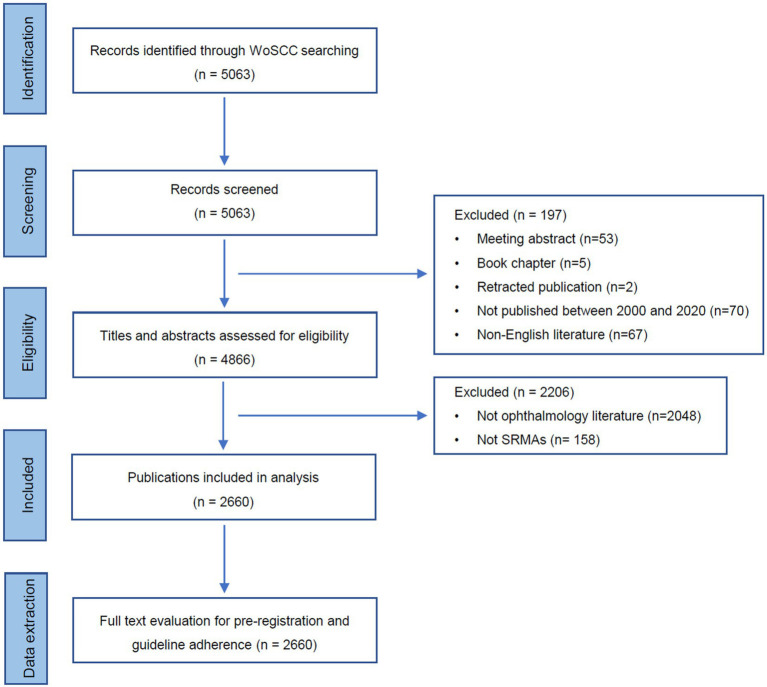
Methods: We retrieved relevant ophthalmological SRMAs and the corresponding bibliometric parameters during 2000 to 2020 from Web of Science Core Collection. Bibliometric analysis was performed using bibliometrix package. Pre-registration and guideline compliance of each article was independently assessed by two investigators.
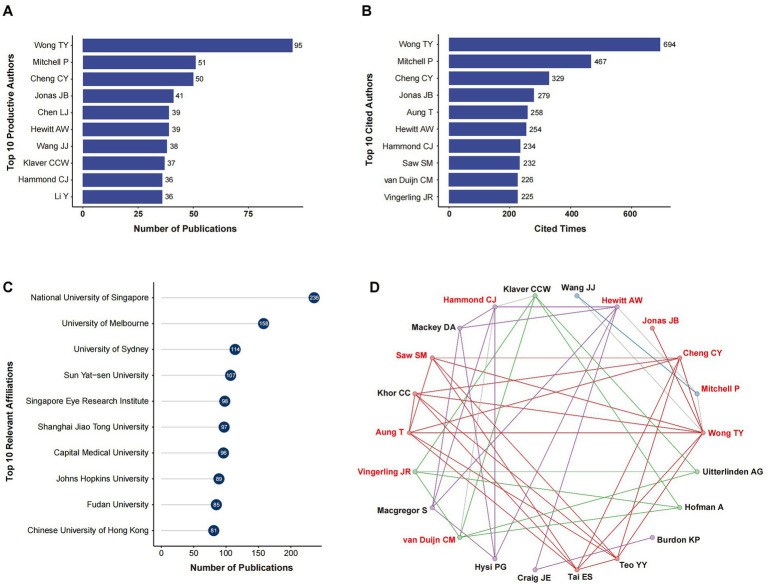
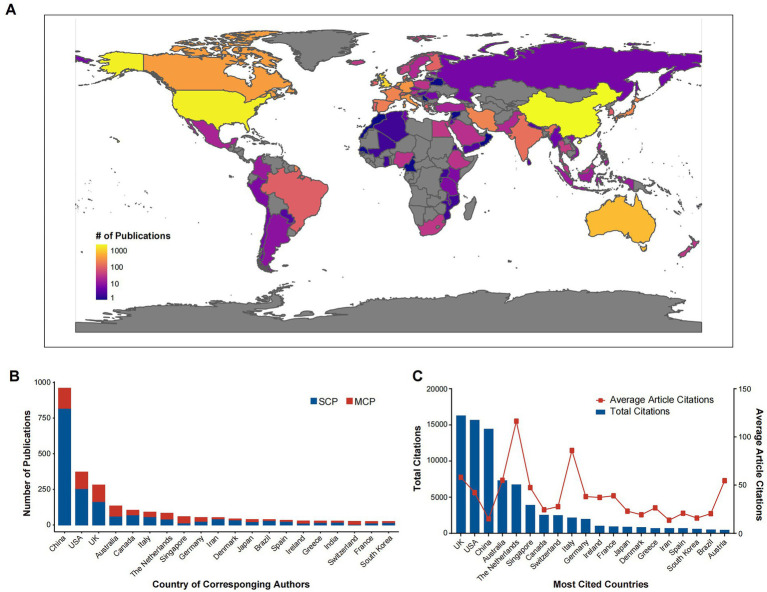
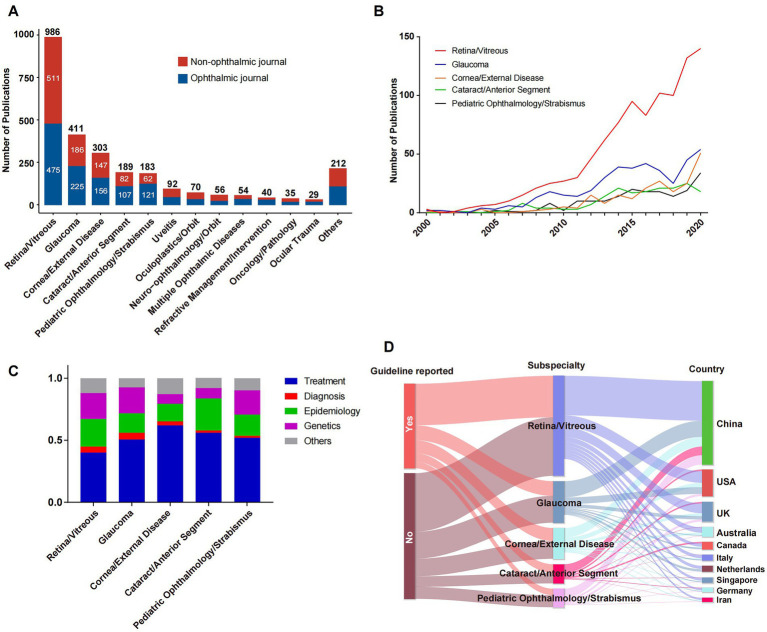
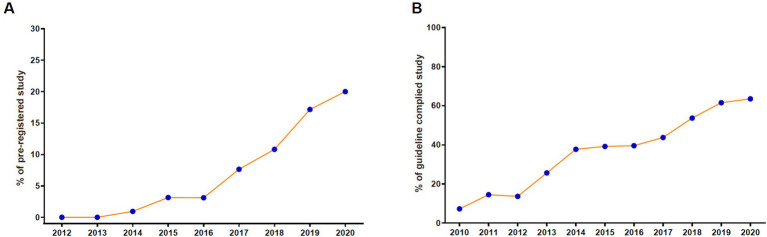
Results: A total of 2,660 SRMAs were included, and the average annual growth rate was 21.26%. China and the United States were the most productive countries, while Singapore was the country with the highest average citations per document. Wong TY was not only the most productive, but also the most frequently cited author. The most productive affiliation was National University of Singapore (n = 236). Systematic reviews and meta-analyses output in most subspecialties had steadily increased with retina/vitreous (n = 986), glaucoma (n = 411) and cornea/external diseases (n = 303) constantly as the most dominant fields. Rates of pre-registration and guideline compliance had dramatically increased over time, with 20.0 and 63.5% of article being pre-registered and reported guideline in 2020, respectively. However, SRMAs published on ophthalmology journals tended to be less frequently pre-registered and guideline complied than those on non-ophthalmology journals (both p < 0.001).
Conclusion: The annual output of SRMAs has been rapidly increasing over the past two decades. China and the United States were the most productive countries, whereas Singapore has the most prolific and influential scholar and institution. Raising awareness and implementation of SRMAs pre-registration and guideline compliance is still necessary to ensure quality, especially for ophthalmology journals.
Keywords: bibliometric analysis; ophthalmology; publication productivity; research trend; systematic reviews and meta-analyses.
Copyright © 2023 Fu, Mao, Jiang, Luo, Chen and Xiao.
Conflict of interest statement
The authors declare that the research was conducted in the absence of any commercial or financial relationships that could be construed as a potential conflict of interest.
Figures
References
Associated data
LinkOut - more resources
Full Text Sources
Miscellaneous
