Role of precision medicine in obstructive sleep apnoea
- PMID: 36936264
- PMCID: PMC9951383
- DOI: 10.1136/bmjmed-2022-000218
Role of precision medicine in obstructive sleep apnoea
Abstract
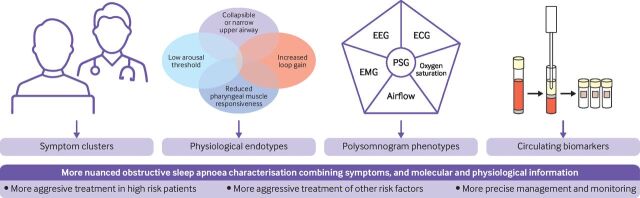
Obstructive sleep apnoea is a substantial clinical and public health problem because it contributes to harmful effects on quality of life, daytime symptoms, road traffic incidents, and cardiometabolic disease. Increasingly, obstructive sleep apnoea is recognised as a heterogeneous disease, and patients have varied susceptibility to long term complications and different responses to treatment. This narrative review summarises the current knowledge of precision medicine in obstructive sleep apnoea, particularly the role of symptom clusters, polysomnogram phenotypes, physiological endotypes, and circulating biomarkers in defining subtypes. In the near future, the prognostic accuracy of these measures in predicting long term complications in obstructive sleep apnoea will likely be improved, together with better matching of treatments to disease subtypes.
Keywords: Medicine; Public health; Sleep medicine specialty; Therapeutics.
© Author(s) (or their employer(s)) 2023. Re-use permitted under CC BY-NC. No commercial re-use. See rights and permissions. Published by BMJ.
Conflict of interest statement
Competing interests: We have read and understood the BMJ policy on declaration of interests and declare the following interests: none.
Figures
References
-
- Semelka M, Wilson J, Floyd R. Diagnosis and treatment of obstructive sleep apnea in adults. Am Fam Physician 2016;94:355–60. - PubMed
-
- Chen L, Chapman JL, Yee BJ, et al. Agreement between electronic and paper Epworth sleepiness scale responses in obstructive sleep apnoea: secondary analysis of a randomised controlled trial undertaken in a specialised tertiary care clinic. BMJ Open 2018;8:e019255. 10.1136/bmjopen-2017-019255 - DOI - PMC - PubMed
Publication types
LinkOut - more resources
Full Text Sources