Review
. 2022 Oct 31;1(1):e000152.
doi: 10.1136/bmjmed-2022-000152. eCollection 2022.

Endometrial cancer: molecular classification and future treatments

Affiliations
Review

Endometrial cancer: molecular classification and future treatments

Bradley Corr et al. BMJ Med. .

Abstract

The treatment for endometrial cancer is rapidly evolving with the development of molecular analysis and novel strategies. Surgical resection, cytotoxic chemotherapy, endocrine or hormonal treatment, and radiation have been the staples of treatment for decades. However, precision based approaches for tumours are rapidly becoming a part of these strategies. Biomarker driven treatments are now a part of primary and recurrent treatment algorithms. This review aims to describe the current state of molecular analysis and treatment for endometrial cancer as well as to elucidate potential approaches for the near future.

Keywords: genetics; medical oncology; molecular medicine.


Conflict of interest statement

Competing interests: We have read and understood the BMJ policy on declaration of interests and declare the following interests: BC has held positions on advisory boards for Immunogen, Merck, AstraZeneca, Novocure, and GSK, and declares research funding from Clovis; DS has a family member who is employed by Invitae with equity holding.

Figures
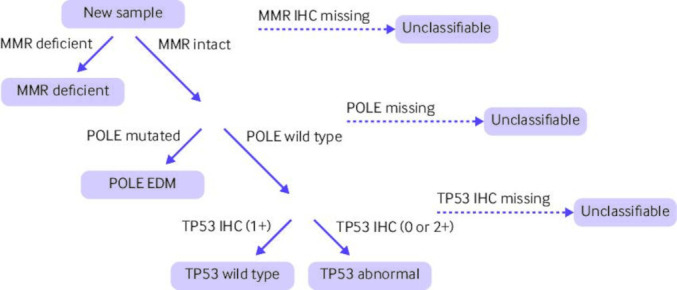
Figure 1
Figure 1
Steps of molecular classification using the ProMisE (proactive molecular risk classifier for endometrial cancer) technique to classify endometrial cancers using immunohistochemistry and Sanger sequencing techniques. MMR=mismatch repair; POLE=polymerase ε; IHC=immunochemistry; EDM=exonuclease domain mutations; TP53=tumour protein p53. Figure adapted with permission
Figure 2
Figure 2
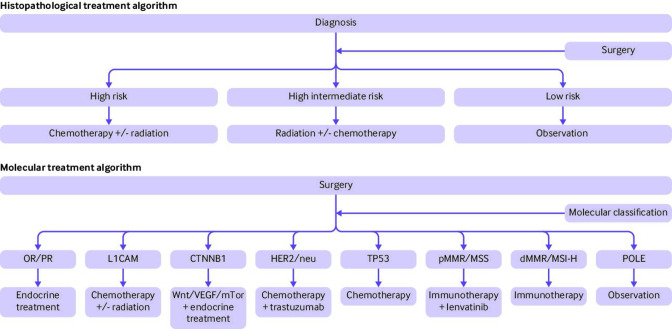
Examples of potential treating algorithms for primary endometrial cancer. The two treatment methods highlight the variation in treatment strategies. The histopathological algorithm relies solely on cancer stage and histopathological features, and the molecular algorithm highlights the multitude of tumour focused treatment strategies. Future studies will help determine whether one approach is superior to the other, or whether a combined analysis is more prudent. OR/PR=oestrogen/progesterone receptors: L1CAM=L1 cell adhesion molecule; Wnt=wingless related integration site; VEGF=vascular endothelial growth factor; mTor=mammalian target of rapamycin; HER2=human epidermal growth factor receptor 2; TP53=tumour protein 53; pMMR=mismatch repair proficient tumours; MSS=microsatellite stable; dMMR=mismatch repair deficient tumours; MSI-H=microsatellite instability, hypermutated; POLE=DNA polymerase ε

References

    1. Siegel RL, Miller KD, Jemal A. Cancer statistics, 2019. CA Cancer J Clin 2019;69:7–34. 10.3322/caac.21551 - DOI - PubMed
    1. Sung H, Ferlay J, Siegel RL, et al. Global cancer statistics 2020: GLOBOCAN estimates of incidence and mortality worldwide for 36 cancers in 185 countries. CA Cancer J Clin 2021;71:209–49. 10.3322/caac.21660 - DOI - PubMed
    1. Giaquinto AN, Broaddus RR, Jemal A, et al. The changing landscape of gynecologic cancer mortality in the United States. Obstet Gynecol 2022;139:440–2. 10.1097/AOG.0000000000004676 - DOI - PMC - PubMed
    1. Creasman WT, Morrow CP, Bundy BN, et al. Surgical pathologic spread patterns of endometrial cancer. A gynecologic Oncology Group study. Cancer 1987;60:2035–41. 10.1002/1097-0142(19901015)60:8+<2035::aid-cncr2820601515>3.0.co;2-8 - DOI - PubMed
    1. Guntupalli SR, Zighelboim I, Kizer NT, et al. Lymphovascular space invasion is an independent risk factor for nodal disease and poor outcomes in endometrioid endometrial cancer. Gynecol Oncol 2012;124:31–5. 10.1016/j.ygyno.2011.09.017 - DOI - PMC - PubMed

LinkOut - more resources