Review
. 2023 Mar 3:11:1100514.
doi: 10.3389/fped.2023.1100514. eCollection 2023.

Fontan-associated liver disease: Diagnosis, surveillance, and management

Affiliations
Review

Fontan-associated liver disease: Diagnosis, surveillance, and management

Charlotte de Lange et al. Front Pediatr. .

Abstract

The Fontan operation is a lifesaving procedure for patients with functional single-ventricle congenital heart disease, where hypoplastic left heart syndrome is the most frequent anomaly. Hemodynamic changes following Fontan circulation creation are now increasingly recognized to cause multiorgan affection, where the development of a chronic liver disease, Fontan-associated liver disease (FALD), is one of the most important morbidities. Virtually, all patients with a Fontan circulation develop liver congestion, resulting in fibrosis and cirrhosis, and most patients experience childhood onset. FALD is a distinctive type of congestive hepatopathy, and its pathogenesis is thought to be a multifactorial process driven by increased nonpulsatile central venous pressure and decreased cardiac output, both of which are inherent in the Fontan circulation. In the advanced stage of liver injury, complications of portal hypertension often occur, and there is a risk of developing secondary liver cancer, reported at young age. However, FALD develops with few clinical symptoms, a surprisingly variable degree of severity in liver disease, and with little relation to poor cardiac function. The disease mechanisms and modifying factors of its development are still not fully understood. As one of the more important noncardiac complications of the Fontan circulation, FALD needs to be diagnosed in a timely manner with a structured monitoring scheme of disease development, early detection of malignancy, and determination of the optimal time point for transplantation. There is also a clear need for consensus on the best surveillance strategy for FALD. In this regard, imaging plays an important role together with clinical scoring systems, biochemical workups, and histology. Patients operated on with a Fontan circulation are generally followed up in cardiology units. Ultimately, the resulting multiorgan affection requires a multidisciplinary team of healthcare personnel to address the different organ complications. This article discusses the current concepts, diagnosis, and management of FALD, with special emphasis on the role of different imaging techniques in the diagnosis and monitoring of disease progression, as well as current recommendations for liver disease surveillance.

Keywords: Fontan procedure; chronic liver disease; congestion; imaging; surveillance.


Conflict of interest statement

The authors declare that the research was conducted in the absence of any commercial or financial relationships that could be construed as a potential conflict of interest.

Figures

Figure 1
Figure 1
Illustration of the total cavopulmonary circulation with the extracardiac conduit connecting the inferior caval vein and the pulmonary arteries. Illustration created by Michael Bjaanes in collaboration with the Department of Pediatric Cardiology and the Department of Adult Congenital Heart Disease at Oslo University Hospital.
Figure 2
Figure 2
Cardiac MRI, T2 black-blood sequence in a coronal plane showing the extracardiac conduit (arrow) connecting the inferior caval vein to the pulmonary arteries.
Figure 3
Figure 3
Figure displaying the most common proposed mechanisms influencing FALD development. Neutrophil chemotactic chemokine (C-X-C motif) and tumor necrosis factor-α (TNFα). A part of the illustration is created by Michael Bjaanes in collaboration with the Department of Pediatric Cardiology and the Department of Adult Congenital Heart Disease at Oslo University Hospital. FALD, Fontan-associated liver disease.
Figure 4
Figure 4
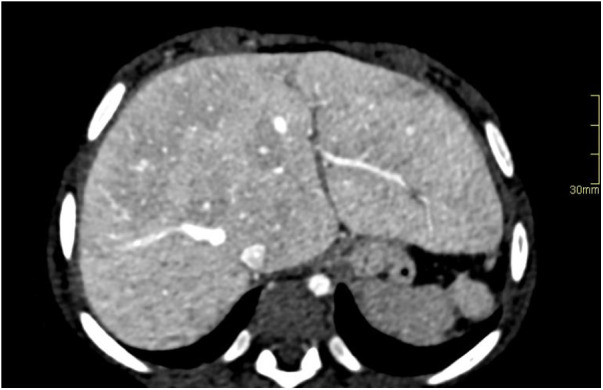
Hypoplastic left heart syndrome with Fontan circulation in a 4-year-old girl with failing Fontan. Abdominal CT with i.v. contrast, portal venous phase, in an axial plane reveals hepatomegaly with round hepatic borders and perisinusoidal edema. A biopsy performed pretransplantation, revealed fibrosis grade 3–4. Note the small spleen due to previous infarction.
Figure 5
Figure 5
A 17-year-old boy with hypoplastic left heart complex operated with a Fontan circulation. Abdominal MRI, a coronal T2-weighted image, reveals the typical heterogenous distribution of the liver disease with irregular signal, perisinusoidal edema, in the right liver lobe with a more homogeneous signal in the left lobe.
Figure 6
Figure 6
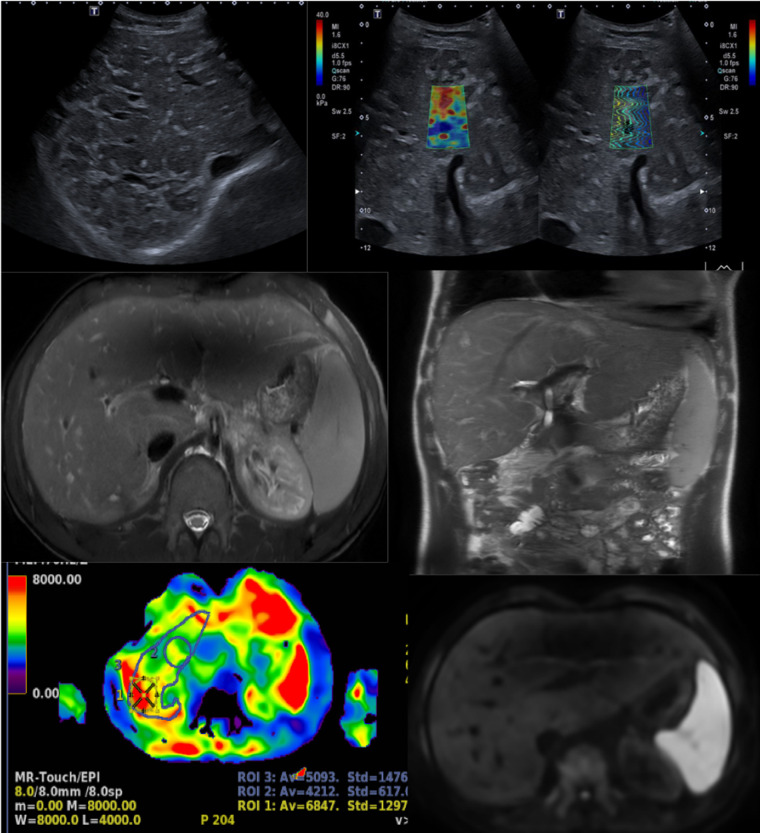
A 17-year-old boy with a hypoplastic left heart complex and Fontan circulation (same patient as in Figure 5). Clinical workup revealed a slightly increased GGT and a newly developed reduced exercise capacity. Ultrasound reveals severe heterogeneous echogenicity (upper left) and increased values of elasticity of 25 kPa (upper right). Abdominal MR T2-weighted coronal image (middle right), with increased size right liver lobe. The liver length is 20 cm and there is a splenomegaly measuring 17 cm in length. Corresponding axial T2-weighted image reveals the reticular peripheral pattern (middle left). Heterogenous diffusion (lower right). MR elastography in an axial plane, measuring increased values of 5.1 KPa (lower left). GGT, gamma-glutamyl transferase.
Figure 7
Figure 7
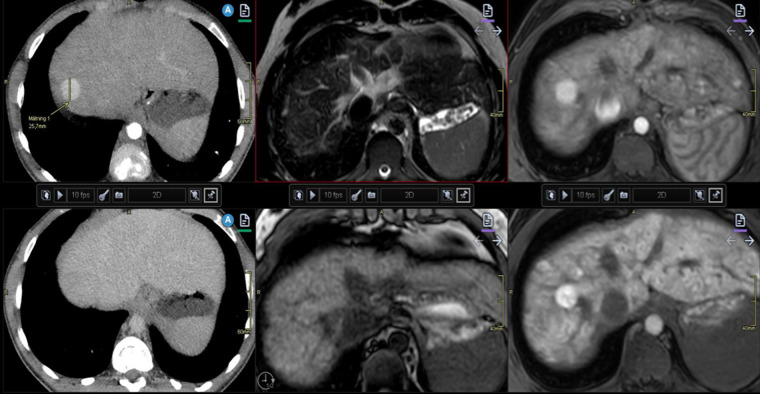
Illustration of liver nodules in a 20-year-old man with pulmonary atresia and a Fontan circulation. Increased hepatic serological marker, and alkaline phosphatase was observed. Multiphase contrast-enhanced CT revealed a nodule of 2.5 cm in diameter in segment eight with arterial enhancement (upper left) and apparent washout on portal venous phase (lower left). Follow-up MRI with hepatocyte-specific contrast displays low signal on T2-weighted (upper middle) and isointense signal on T1 (lower middle). Arterial enhancement (upper right) and slightly heterogeneous hyper-enhancement on late hepatocyte phase (lower right). Note the heterogenous congestion and multiple small surrounding nodules in this late phase. These are both benign and malign features. Biopsy in this case was considered difficult due to the high position of the nodule under the diaphragm. Close monitoring was recommended. CT, computed tomography; MRI, magnetic resonance imaging.
Figure 8
Figure 8
MR lymphography of the thorax in a coronal plane with maximum intensity projection, of the same patient as in Figure 6, reveals a tortuous cisterna chyli and thoracic duct (arrows) and lymphedema in the perihilar region as well as small amounts of pleural effusion over the apices of the lungs (arrows). MR, magnetic resonance.
Figure 9
Figure 9
Illustration of the total cavopulmonary circulation including the thoracic duct (in green). Illustration created by Michael Bjaanes in collaboration with the Department of Pediatric Cardiology and the Department of Adult Congenital Heart Disease at Oslo University Hospital.
Figure 10
Figure 10
An 18-year-old boy born with double inlet left ventricle and pulmonary stenosis with a Fontan circulation. Satisfactory ventricular function was observed. Abdominal MRI was performed as a regular follow-up before transition to adult care. A 14 mm nodule not visible on ultrasound was found in the lateral part of the right liver lobe on MRI. Dynamic contrast-enhanced MRI with hepatocyte specific contrast agent was performed, revealing hyper-enhancement in arterial phase (upper left) and in late portal venous phase (upper right) as well as slightly irregular in hepatocyte phase (after 20 min) (lower right). The nodule is difficult to see clearly on the diffusion-weighted image (lower left). The nodule was interpreted with features of a probably benign nodule, and close follow-up with contrast-enhanced MRI was recommended. MRI, magnetic resonance imaging.
Figure 11
Figure 11
Typical hyperechogenic vascular nodules 3–5 mm (arrows) on ultrasound (left) and corresponding nodules with high signal on axial T2-weighted MRI (right). Note the generally increased T2 signal in the parenchyma as an expression of congestion (right). MRI, magnetic resonance imaging
Figure 12
Figure 12
Flow chart of the proposed follow-up from the European Society of Pediatric Radiology, Abdominal Task Force. Reprint with permission from Perruca et al. Surveillance of Fontan associated liver disease: current standards and a proposal from the ESPR Abdominal Task Force. Pediatr Radiol. (2021) 51:2598–2606.

References

    1. Khairy P, Fernandes SM, Mayer JE, Jr., Triedman JK, Walsh EP, Lock JE, et al. Long-term survival, modes of death, and predictors of mortality in patients with Fontan surgery. Circulation. (2008) 117(1):85–92. 10.1161/CIRCULATIONAHA.107.738559 - DOI - PubMed
    1. Downing TE, Allen KY, Glatz AC, Rogers LS, Ravishankar C, Rychik J, et al. Long-term survival after the Fontan operation: twenty years of experience at a single center. J Thorac Cardiovasc Surg. (2017) 154(1):243–53.e2. 10.1016/j.jtcvs.2017.01.056 - DOI - PubMed
    1. Schilling C, Dalziel K, Nunn R, Du Plessis K, Shi WY, Celermajer D, et al. The Fontan epidemic: population projections from the Australia and New Zealand Fontan Registry. Int J Cardiol. (2016) 219:14–9. 10.1016/j.ijcard.2016.05.035 - DOI - PubMed
    1. Kverneland LS, Kramer P, Ovroutski S. Five decades of the Fontan operation: a systematic review of international reports on outcomes after univentricular palliation. Congenit Heart Dis. (2018) 13(2):181–93. 10.1111/chd.12570 - DOI - PubMed
    1. Pundi KN, Johnson JN, Dearani JA, Pundi KN, Li Z, Hinck CA, et al. 40-year follow-up after the Fontan operation: long-term outcomes of 1,052 patients. J Am Coll Cardiol. (2015) 66(15):1700–10. 10.1016/j.jacc.2015.07.065 - DOI - PubMed