COVID-19 and Breast Cancer in Brazil
- PMID: 36938303
- PMCID: PMC10020228
- DOI: 10.3389/ijph.2023.1605485
COVID-19 and Breast Cancer in Brazil
Abstract
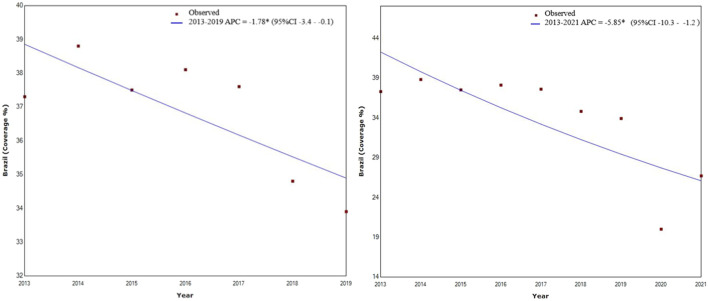
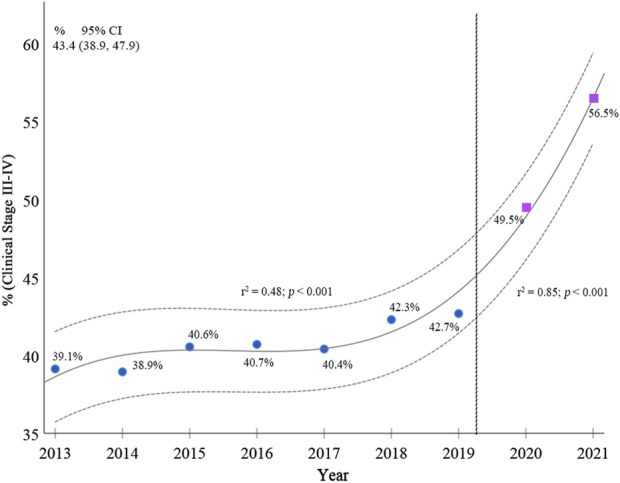
Objectives: This study aimed to evaluate COVID-19 effects on breast cancer screening and clinical stage at diagnosis in patients of 50-69 years of age receiving care within the public healthcare network (SUS) in 2013-2021 in Brazil and its macro-regions. Methods: This ecological study used Poisson regression to analyze trends in screening and staging. A secondary database was formed using SUS sources: outpatient data system of the SUS network and Oncology-Brazil Panel. Results: There was a reduction in screening, with an annual percent change of -5.9 (p < 0.022). The number of notified cases fell by 31.5% in 2020-2021 compared to 2018-2019. There was a 10.7% increase in the proportion of stage III/IV cases (p < 0.001) in 2020-2021 compared to 2013-2019, now surpassing the number of cases of early stage breast cancer. Conclusion: COVID-19 led to a reduction in breast cancer screening and an expressive increase in advanced tumors in users of the public healthcare network. Urgent interventions in public policies are required as the negative effects of the pandemic on the diagnosis/treatment of breast cancer are becoming apparent even earlier than expected.
Keywords: Brazil; COVID-19; breast cancer; breast cancer screening; clinical staging of breast cancer.
Copyright © 2023 Rocha, Freitas-Junior, Ferreira, Rodrigues and Rahal.
Conflict of interest statement
The authors declare that they do not have any conflicts of interest.
Figures
References
-
- CBR/FEBRASGO/SBM. Joint Note from the Brazilian College of Radiology and Diagnostic Imaging (CBR), Brazilian Federation of Gynecology and Obstetrics Associations (Febrasgo) and Brazilian Society of Mastology (SBM) on Guidelines for Scheduling Breast Imaging Exams during the COVID-19 Pandemic (2020). Available at: https://cbr.org.br/wp-content/uploads/2020/03/NOTA-CONJUNTA-DO-CBR_FEBRA... (Accessed October 9, 2022).
-
- INCA. Technical Note - DIDEPRE/CONPREV/INCA Cancer Screening during the COVID-19 Pandemic, July 9 2020 (2020). Available at: https://www.inca.gov.br/sites/ufu.sti.inca.local/files/media/document/no... (Accessed October 9, 2022).
-
- Pan American Health Organization/ World Health Organization. Considerations for the Reorganization of Cancer Services during the COVID-19 Pandemic, 26 May 2020 (2020. ). https://iris.paho.org/handle/10665.2/52263 (Accessed October 9, 2022).
-
- INCA. Technical Note - DIDEPRE/CONPREV/INCA, 3 March 2020. Early Detection of Cancer during the Covid-19 Pandemic (2020). Available at: https://www.inca.gov.br/sites/ufu.sti.inca.local/files//media/document//... (Accessed October 9, 2022).
MeSH terms
LinkOut - more resources
Full Text Sources
Medical