


The rapid rise of SARS-CoV-2 Omicron subvariants with immune evasion properties: XBB.1.5 and BQ.1.1 subvariants
- PMID: 36938325
- PMCID: PMC10015854
- DOI: 10.1002/mco2.239
The rapid rise of SARS-CoV-2 Omicron subvariants with immune evasion properties: XBB.1.5 and BQ.1.1 subvariants
Abstract
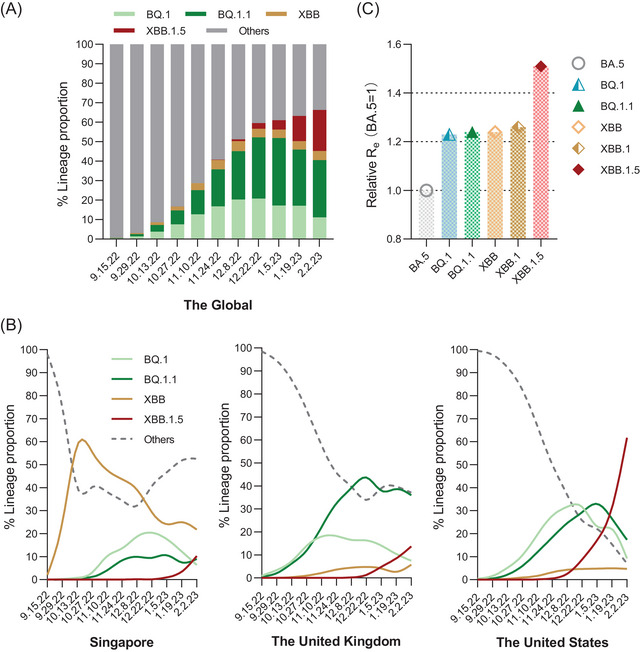
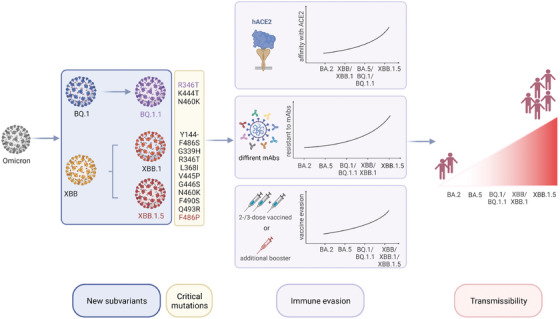
As the fifth variant of concern of the SARS-CoV-2 virus, the Omicron variant (B.1.1.529) has quickly become the dominant type among the previous circulating variants worldwide. During the Omicron wave, several subvariants have emerged, with some exhibiting greater infectivity and immune evasion, accounting for their fast spread across many countries. Recently, two Omicron subvariants, BQ.1 and XBB lineages, including BQ.1.1, XBB.1, and XBB.1.5, have become a global public health issue given their ability to escape from therapeutic monoclonal antibodies and herd immunity induced by prior coronavirus disease 2019 (COVID-19) vaccines, boosters, and infection. In this respect, XBB.1.5, which has been established to harbor a rare mutation F486P, demonstrates superior transmissibility and immune escape ability compared to other subvariants and has emerged as the dominant strain in several countries. This review provides a comprehensive overview of the epidemiological features, spike mutations, and immune evasion of BQ.1 and XBB lineages. We expounded on the mechanisms underlying mutations and immune escape from neutralizing antibodies from vaccinated or convalescent COVID-19 individuals and therapeutic monoclonal antibodies (mAbs) and proposed strategies for prevention against BQ.1 and XBB sublineages.
Keywords: BQ.1 and XBB lineages; Omicron; XBB.1.5; immune escape.
© 2023 The Authors. MedComm published by Sichuan International Medical Exchange & Promotion Association (SCIMEA) and John Wiley & Sons Australia, Ltd.
Conflict of interest statement
The authors declare no conflict of interests.
Figures

References
-
- WHO . WHO Coronavirus (COVID‐19) Dashboard. 2023. Accessed January 16, 2023. https://covid19.who.int/
-
- WHO . Tracking SARS‐CoV‐2 variants. 2023. Accessed January 16, 2023. https://www.who.int/activities/tracking‐SARS‐CoV‐2‐variants/tracking‐SAR...
-
- WHO . Statement on Omicron sublineages BQ.1 and XBB. 2023. Accessed January 16, 2023. https://www.who.int/news/item/27‐10‐2022‐tag‐ve‐statement‐on‐omicron‐sub...
LinkOut - more resources
Full Text Sources
Research Materials
Miscellaneous