


doi: 10.1093/braincomms/fcad045.
eCollection 2023.
Reconciling profiles of reward-seeking versus reward-restricted behaviours in frontotemporal dementia
Affiliations
- PMID: 36938524
- PMCID: PMC10020032
- DOI: 10.1093/braincomms/fcad045
Item in Clipboard
Reconciling profiles of reward-seeking versus reward-restricted behaviours in frontotemporal dementia
Brain Commun.
.
Abstract
This scientific commentary refers to 'The architecture of abnormal reward behaviour in dementia: multimodal hedonic phenotypes and brain substrate', by Chokesuwattanaskul et al. (https://doi.org/10.1093/braincomms/fcad027).
© The Author(s) 2023. Published by Oxford University Press on behalf of the Guarantors of Brain.
Conflict of interest statement
The authors report no competing interests.
Figures
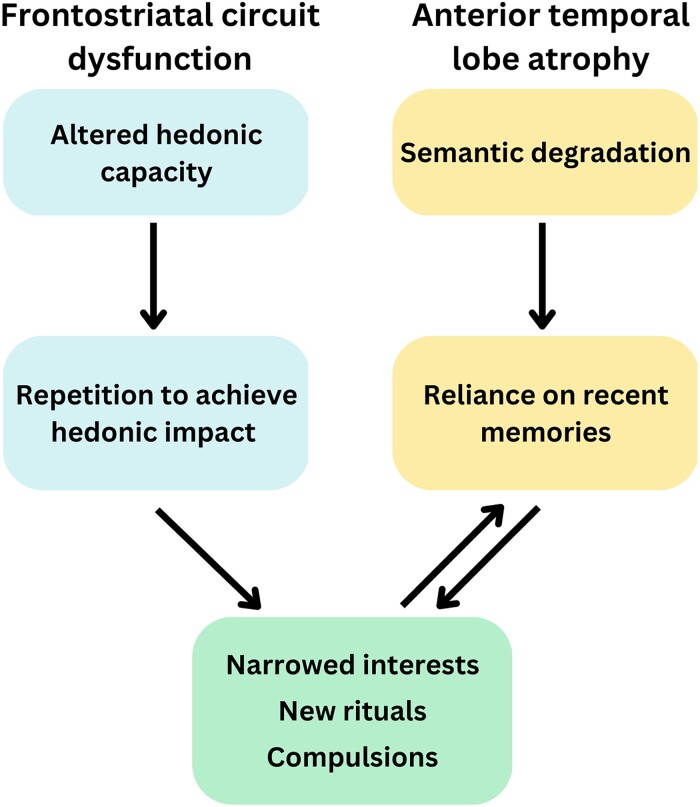
Dual pathways underlying the emergence of repetitive behaviours and restricted interests in FTD. We propose that frontostriatal dysfunction in FTD disrupts a primary hedonic pathway that diminishes the fundamental capacity to experience pleasure (i.e. anhedonia). This dampening of pleasure is posited to result in a narrowing of interests, as formerly pleasurable activities no longer bring enjoyment. However, some activities might confer residual feelings of pleasure if a minimum threshold is surpassed, leading to repetitive behaviours in the pursuit of reward. Temporal lobe dysfunction can potentiate repetitive behaviours via a secondary semantic pathway, by which the representation of general world knowledge regarding activities, objects and their corresponding reward properties is disrupted. With increasing semantic deterioration, recent events become the dominant template for future behaviours, leading to a cycling of intensified behaviours towards specific targets, most pronounced in semantic variants of FTD.
Comment in
-
The architecture of abnormal reward behaviour in dementia: multimodal hedonic phenotypes and brain substrate.Brain Commun. 2023 Feb 9;5(2):fcad027. doi: 10.1093/braincomms/fcad027. eCollection 2023. Brain Commun. 2023. PMID: 36942157 Free PMC article.
References
-
- Ahmed RM, Irish M, Henning E, et al. . Assessment of eating behavior disturbance and associated neural networks in frontotemporal dementia. JAMA Neurol. 2016;73(3):282–290. - PubMed
-
- Husain M, Roiser JP. Neuroscience of apathy and anhedonia: A transdiagnostic approach. Nat Rev Neurosci. 2018;19(8):470–484. - PubMed
LinkOut - more resources
Full Text Sources