Review
. 2023 Jun;54(6):1695-1705.
doi: 10.1161/STROKEAHA.122.040008. Epub 2023 Mar 20.

Large Vessel Occlusion Stroke due to Intracranial Atherosclerotic Disease: Identification, Medical and Interventional Treatment, and Outcomes

Affiliations
Review

Large Vessel Occlusion Stroke due to Intracranial Atherosclerotic Disease: Identification, Medical and Interventional Treatment, and Outcomes

Adam de Havenon et al. Stroke. 2023 Jun.

Abstract

Large vessel occlusion stroke due to underlying intracranial atherosclerotic disease (ICAD-LVO) is prevalent in 10 to 30% of LVOs depending on patient factors such as vascular risk factors, race and ethnicity, and age. Patients with ICAD-LVO derive similar functional outcome benefit from endovascular thrombectomy as other mechanisms of LVO, but up to half of ICAD-LVO patients reocclude after revascularization. Therefore, early identification and treatment planning for ICAD-LVO are important given the unique considerations before, during, and after endovascular thrombectomy. In this review of ICAD-LVO, we propose a multistep approach to ICAD-LVO identification, pretreatment and endovascular thrombectomy considerations, adjunctive medications, and medical management. There have been no large-scale randomized controlled trials dedicated to studying ICAD-LVO, therefore this review focuses on observational studies.

Keywords: intracranial atherosclerosis; mortality; risk factors; stroke; thrombectomy.


Conflict of interest statement

Disclosures Dr de Havenon reports compensation from Novo Nordisk for consultant services; grants from American Heart Association; stock options in TitinKM; compensation from Integra for consultant services; and stock options in Certus. Dr Nguyen reports compensation from Medtronic for other services and grants from Society of Vascular and Interventional Neurology. Dr Mazighi reports compensation from Boehringer-Ingelheim for consultant services; compensation from Novo Nordisk for consultant services; and compensation from acticor biotech for consultant services. Dr Mistry reports employment by University of Cincinnati; grants from National Institutes of Health; compensation from RAPID AI for consultant services; and compensation from American Heart Association for consultant services. Dr Yaghi reports compensation from Medtronic USA, Inc, for other services and employment by Brown University. Dr Derdeyn reports employment by University of Iowa; compensation from Penumbra, Inc. for data and safety monitoring services; compensation from noNO for data and safety monitoring services; compensation from Silk Road Medical, Inc. for data and safety monitoring services; and stock options in Euphrates Vascular. Dr Al Kasab reports compensation from Stryker for other services.

Figures

Figure 1.
Figure 1.
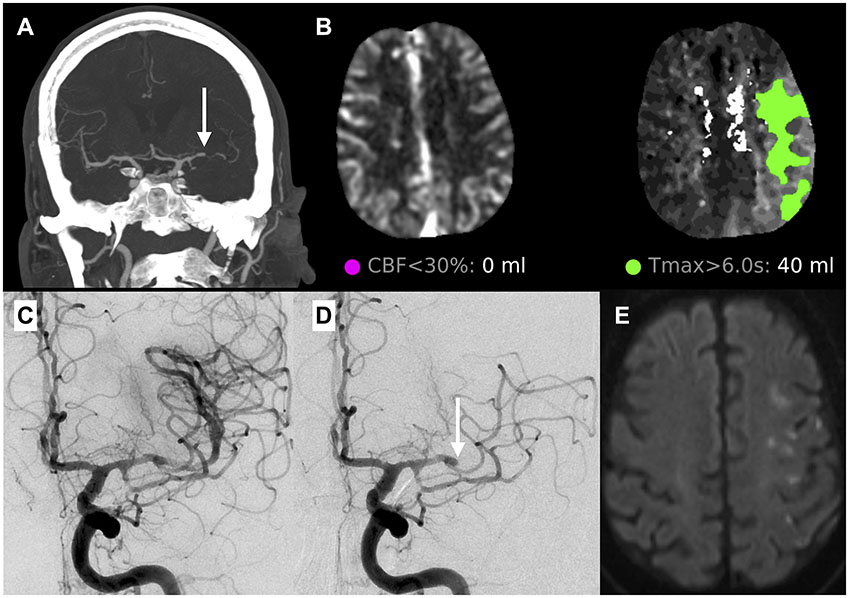
A case of ICAD-LVO of the left middle cerebral artery (MCA) (panel A, white arrow) showing a truncal type occlusion with adjacent stenosis. CT perfusion (panel B) shows no appreciable core with a moderate sized ischemic penumbra of 40 mL. After one pass of a stentriever, the vessel was recanalized (panel C). However, on a 10-minute follow-up angiogram, there was re-occlusion (panel D, white arrow) and the EVT procedure was terminated. Despite the re-occlusion, the final infarct volume was moderate sized on MRI with scattered areas of ischemic throughout the left MCA territory (panel E).
Figure 2.
Figure 2.
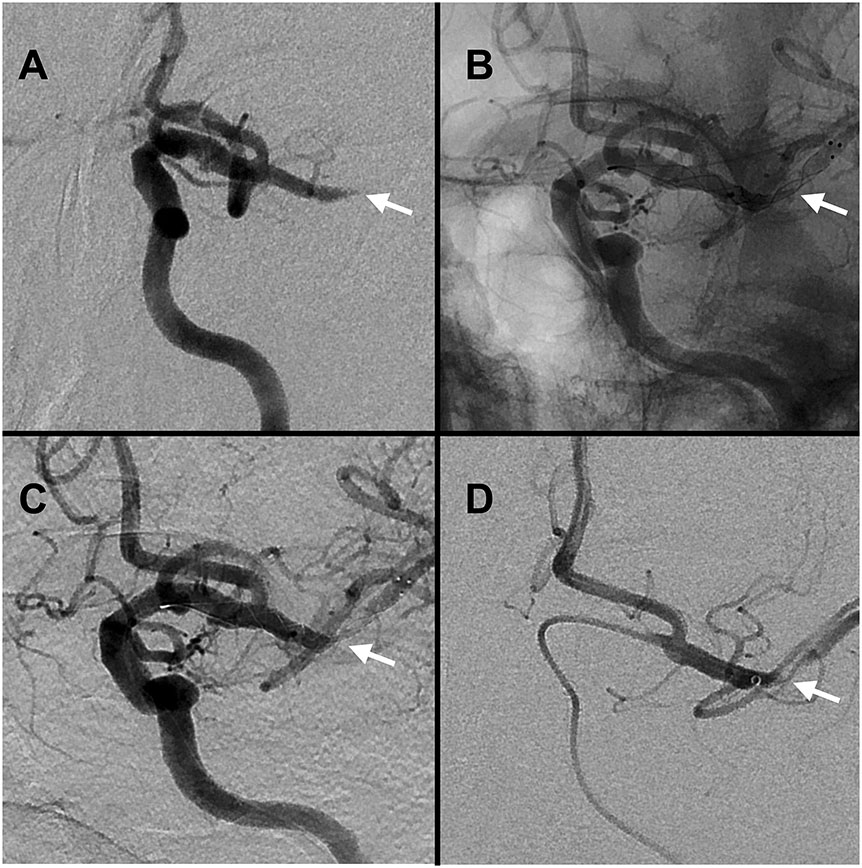
Case of middle cerebral artery ICAD-LVO on angiography. Panel A: ICAD-LVO tapered occlusion (white arrow). Panels B-C: recanalization with deployed stentriever conforming to the underlying stenosis (white arrow, B unsubtracted, C subtracted). Panel D: post-recanalization angiography confirming ICAD with severe stenosis (black arrow).
Figure 3.
Figure 3.
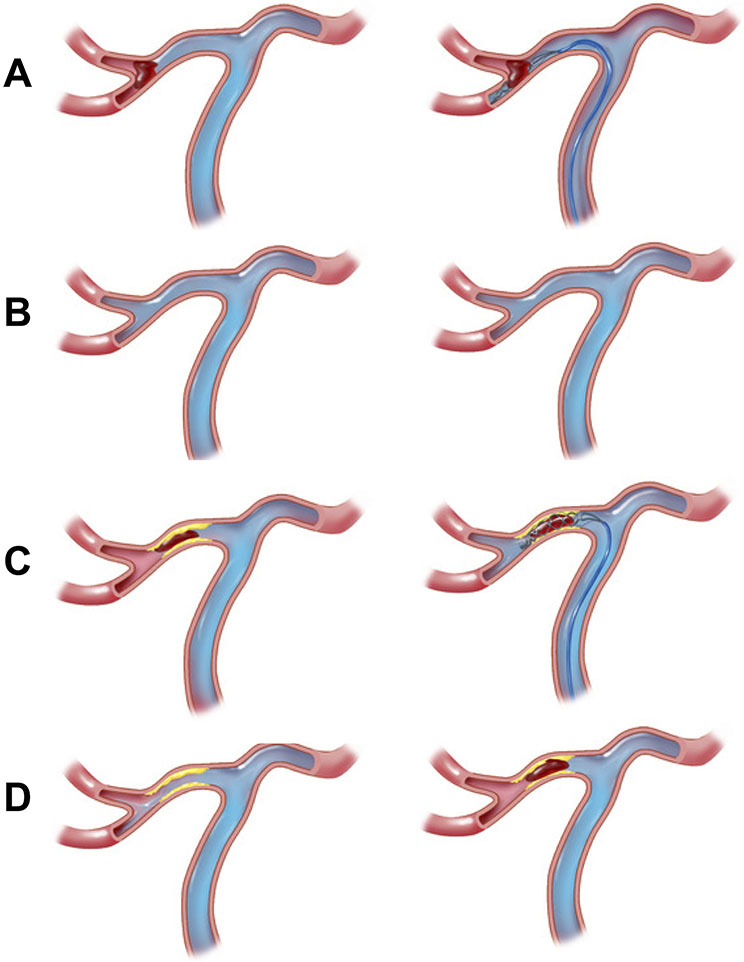
Middle cerebral artery occlusion angiographic and EVT treatment images. Panels A-B (cardioembolic): a branch segment occlusion characteristic of atrial fibrillation that is successfully recanalized with a stent-retriever on follow-up angiography (panel B, right); Panels C-D (ICAD): a truncal occlusion characteristic of ICAD that is successfully recanalized with a stent-retriever (panel D, left) followed by re-occlusion due to ICAD (panel D, right). Note contrast flow when stentriever is deployed in the inferior division only with embolic LVO (panel A, right) compared to flow in both superior and inferior divisions in ICAD LVO case (panel C, right)

References

    1. Donkor ES. Stroke in the 21st Century: A Snapshot of the Burden, Epidemiology, and Quality of Life. Stroke Res. Treat 2018;2018:3238165. - PMC - PubMed
    1. Waqas M, Rai AT, Vakharia K, Chin F, Siddiqui AH. Effect of definition and methods on estimates of prevalence of large vessel occlusion in acute ischemic stroke: a systematic review and meta-analysis. J. NeuroInterventional Surg 2020;12:260–265. - PubMed
    1. Rai AT, Seldon AE, Boo S, Link PS, Domico JR, Tarabishy AR, Lucke-Wold N, Carpenter JS. A population-based incidence of acute large vessel occlusions and thrombectomy eligible patients indicates significant potential for growth of endovascular stroke therapy in the USA. J. Neurointerventional Surg 2017;9:722–726. - PMC - PubMed
    1. Suri MFK, Johnston SC. Epidemiology of intracranial stenosis. J. Neuroimaging Off. J. Am. Soc. Neuroimaging 2009;19 Suppl 1:11S–6S. - PubMed
    1. Bang OY. Intracranial Atherosclerosis: Current Understanding and Perspectives. J. Stroke 2014;16:27–35. - PMC - PubMed

Publication types