Association Between Magnitude of Differential Blood Pressure Reduction and Secondary Stroke Prevention: A Meta-analysis and Meta-Regression
- PMID: 36939729
- PMCID: PMC10028545
- DOI: 10.1001/jamaneurol.2023.0218
Association Between Magnitude of Differential Blood Pressure Reduction and Secondary Stroke Prevention: A Meta-analysis and Meta-Regression
Abstract
Importance: The degree to which more intensive blood pressure reduction is better than less intensive for secondary stroke prevention has not been delineated.
Objective: To perform a standard meta-analysis and a meta-regression of randomized clinical trials to evaluate the association of magnitude of differential blood pressure reduction and recurrent stroke in patients with stroke or transient ischemic attack (TIA).
Data sources: PubMed, Embase, the Cochrane Central Register of Controlled Trials, and ClinicalTrials.gov were searched from January 1, 1980, to June 30, 2022.
Study selection: Randomized clinical trials that compared more intensive vs less intensive blood pressure lowering and recorded the outcome of recurrent stroke in patients with stroke or TIA.
Data extraction and synthesis: The Preferred Reporting Items for Systematic Reviews and Meta-analyses (PRISMA) reporting guideline was used for abstracting data and assessing data quality and validity. Risk ratio (RR) with 95% CI was used as a measure of the association of more intensive vs less intensive blood pressure lowering with primary and secondary outcomes. The univariate meta-regression analyses were conducted to evaluate a possible moderating effect of magnitude of differential systolic blood pressure (SBP) and diastolic blood pressure (DBP) reduction on the recurrent stroke and major cardiovascular events.
Main outcomes and measures: The primary outcome was recurrent stroke and the lead secondary outcome was major cardiovascular events.
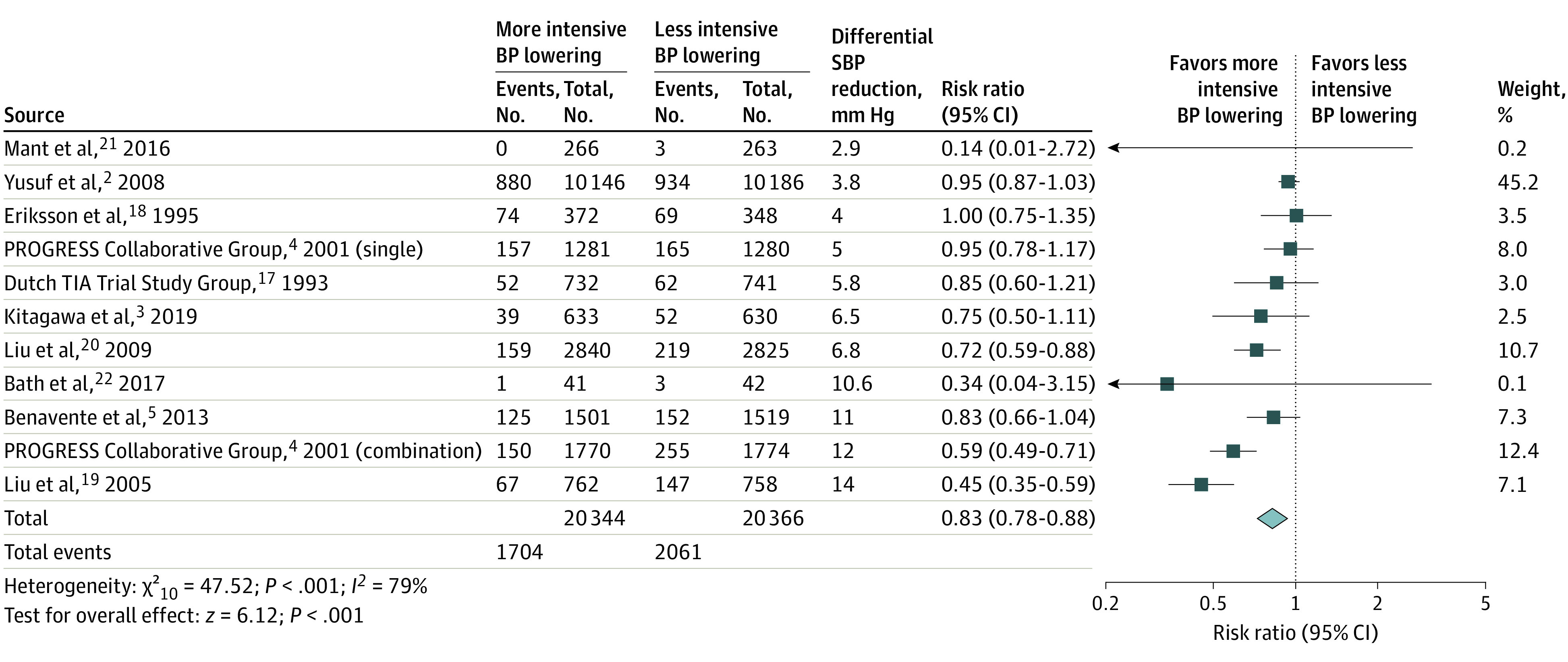
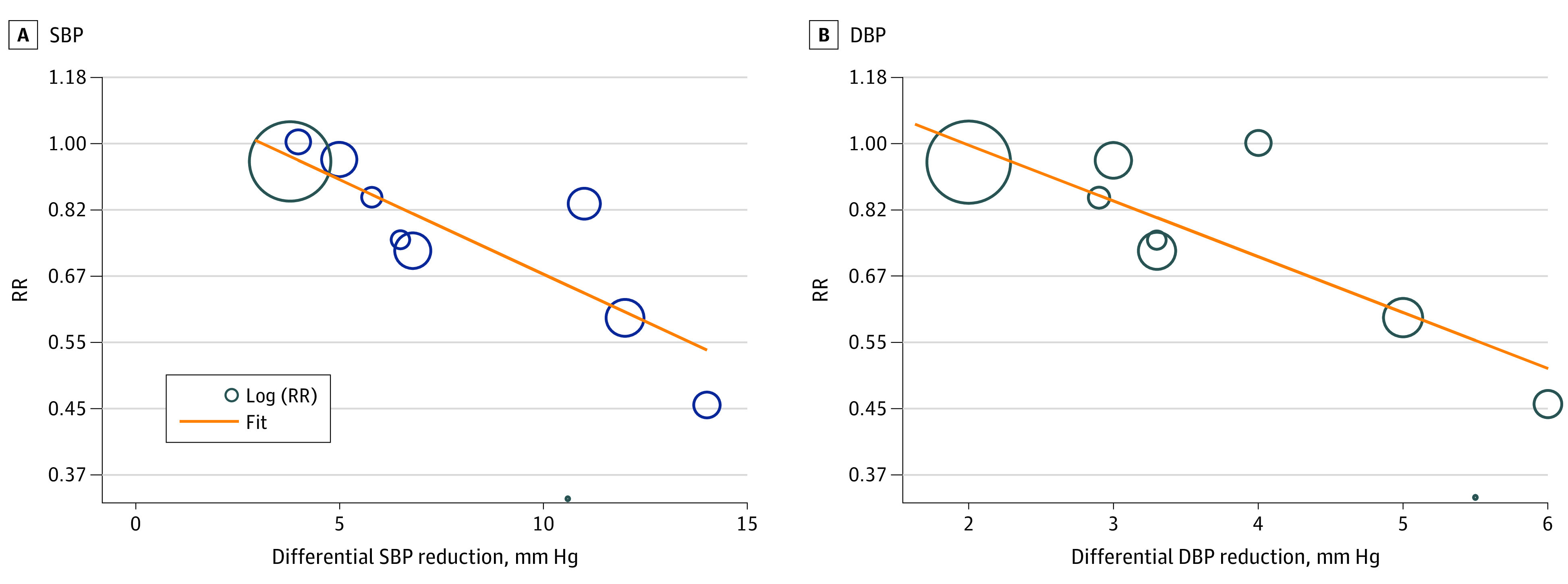
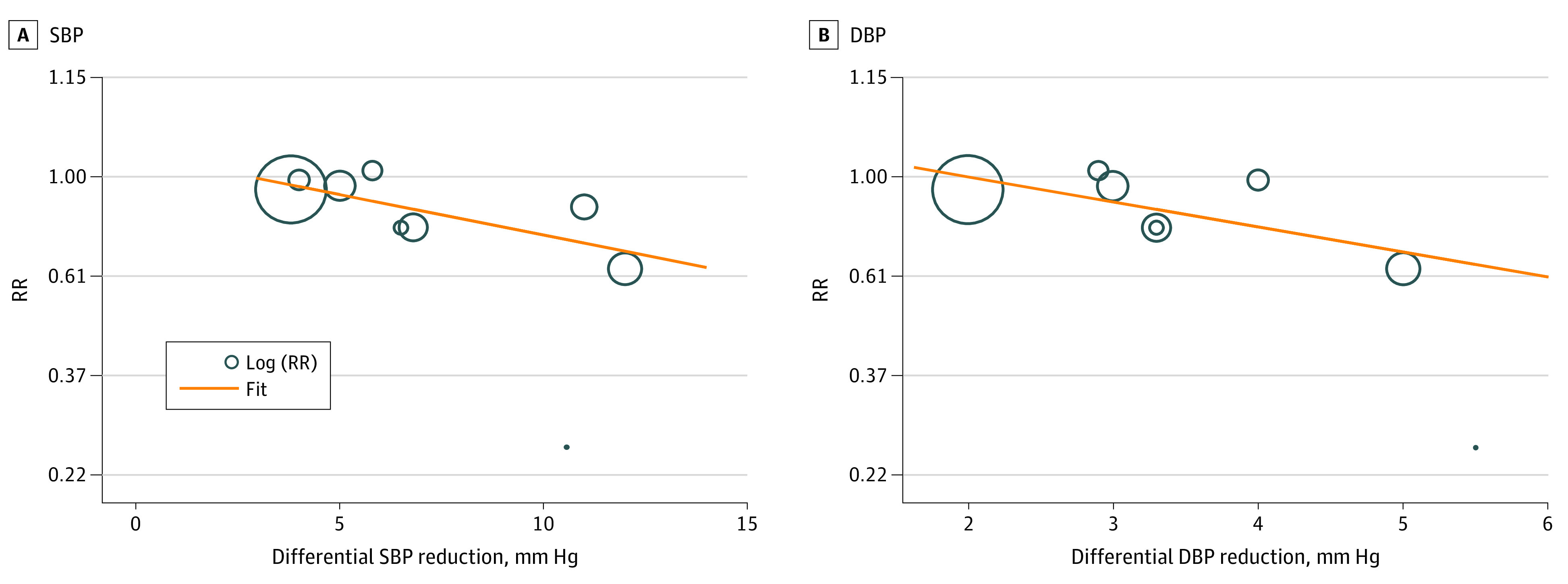
Results: Ten randomized clinical trials comprising 40 710 patients (13 752 women [34%]; mean age, 65 years) with stroke or TIA were included for analysis. The mean duration of follow-up was 2.8 years (range, 1-4 years). Pooled results showed that more intensive treatment compared with less intensive was associated with a reduced risk of recurrent stroke in patients with stroke or TIA (absolute risk, 8.4% vs 10.1%; RR, 0.83; 95% CI, 0.78-0.88). Meta-regression showed that the magnitude of differential SBP and DBP reduction was associated with a lower risk of recurrent stroke in patients with stroke or TIA in a log-linear fashion (SBP: regression slope, -0.06; 95% CI, -0.08 to -0.03; DBP: regression slope, -0.17; 95% CI, -0.26 to -0.08). Similar results were found in the association between differential blood pressure lowering and major cardiovascular events.
Conclusions and relevance: More intensive blood pressure-lowering therapy might be associated with a reduced risk of recurrent stroke and major cardiovascular events. These results might support the use of more intensive blood pressure reduction for secondary prevention in patients with stroke or TIA.
Conflict of interest statement
Figures
References
-
- Kitagawa K, Yamamoto Y, Arima H, et al. ; Recurrent Stroke Prevention Clinical Outcome (RESPECT) Study Group . Effect of standard vs intensive blood pressure control on the risk of recurrent stroke: a randomized clinical trial and meta-analysis. JAMA Neurol. 2019;76(11):1309-1318. doi: 10.1001/jamaneurol.2019.2167 - DOI - PMC - PubMed
Publication types
MeSH terms
LinkOut - more resources
Full Text Sources
Medical