


Why Do We Care More About Disease than Health?
- PMID: 36939781
- PMCID: PMC9590501
- DOI: 10.1007/s43657-021-00037-8
Why Do We Care More About Disease than Health?
Abstract
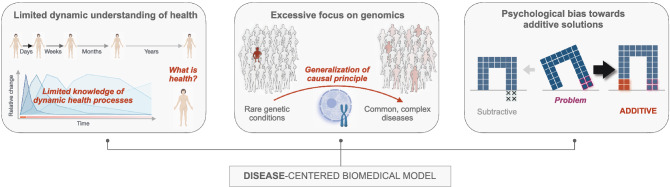
Modern Western biomedical research and clinical practice are primarily focused on disease. This disease-centric approach has yielded an impressive amount of knowledge around what goes wrong in illness. However, in comparison, researchers and physicians know little about health. What is health? How do we quantify it? And how do we improve it? We currently do not have good answers to these questions. Our lack of fundamental knowledge about health is partly driven by three main factors: (i) a lack of understanding of the dynamic processes that cause variations in health/disease states over time, (ii) an excessive focus on genes, and (iii) a pervasive psychological bias towards additive solutions. Here I briefly discuss potential reasons why scientists and funders have generally adopted a gene- and disease-centric framework, how medicine has ended up practicing "diseasecare" rather than healthcare, and present cursory evidence that points towards an alternative energetic view of health. Understanding the basis of human health with a similar degree of precision that has been deployed towards mapping disease processes could bring us to a point where we can actively support and promote human health across the lifespan, before disease shows up on a scan or in bloodwork.
Keywords: Energetics; Genomics; Health; Medical care; Personalized medicine; Preventative medicine.
© International Human Phenome Institutes (Shanghai) 2021.
Conflict of interest statement
Conflict of InterestThe author declares no competing financial interests.
Figures

References
-
- Careau V, Halsey LG, Pontzer H, Ainslie PN, Andersen LF, Anderson LJ, Arab L, Baddou I, Bedu-Addo K, Blaak EE, Blanc S, Bonomi AG, Bouten CVC, Buchowski MS, Butte NF, Camps S, Close GL, Cooper JA, Das SK, Cooper R, Dugas LR, Eaton SD, Ekelund U, Entringer S, Forrester T, Fudge BW, Goris AH, Gurven M, Hambly C, El Hamdouchi A, Hoos MB, Hu S, Joonas N, Joosen AM, Katzmarzyk P, Kempen KP, Kimura M, Kraus WE, Kushner RF, Lambert EV, Leonard WR, Lessan N, Martin CK, Medin AC, Meijer EP, Morehen JC, Morton JP, Neuhouser ML, Nicklas TA, Ojiambo RM, Pietilainen KH, Pitsiladis YP, Plange-Rhule J, Plasqui G, Prentice RL, Rabinovich RA, Racette SB, Raichlen DA, Ravussin E, Reilly JJ, Reynolds RM, Roberts SB, Schuit AJ, Sjodin AM, Stice E, Urlacher SS, Valenti G, Van Etten LM, Van Mil EA, Wells JCK, Wilson G, Wood BM, Yanovski J, Yoshida T, Zhang X, Murphy-Alford AJ, Loechl CU, Luke AH, Rood J, Sagayama H, Schoeller DA, Wong WW, Yamada Y, Speakman JR, group IDd Energy compensation and adiposity in humans. Curr Biol. 2021 doi: 10.1016/j.cub.2021.08.016. - DOI - PMC - PubMed
-
- Colom B, Herms A, Hall MWJ, Dentro SC, King C, Sood RK, Alcolea MP, Piedrafita G, Fernandez-Antoran D, Ong SH, Fowler JC, Mahbubani KT, Saeb-Parsy K, Gerstung M, Hall BA, Jones PH. Mutant clones in normal epithelium outcompete and eliminate emerging tumours. Nature. 2021;598(7881):510–514. doi: 10.1038/s41586-021-03965-7. - DOI - PMC - PubMed
Grants and funding
LinkOut - more resources
Full Text Sources