COVID-19 severity is related to poor executive function in people with post-COVID conditions
- PMID: 36939932
- PMCID: PMC10026205
- DOI: 10.1007/s00415-023-11587-4
COVID-19 severity is related to poor executive function in people with post-COVID conditions
Abstract
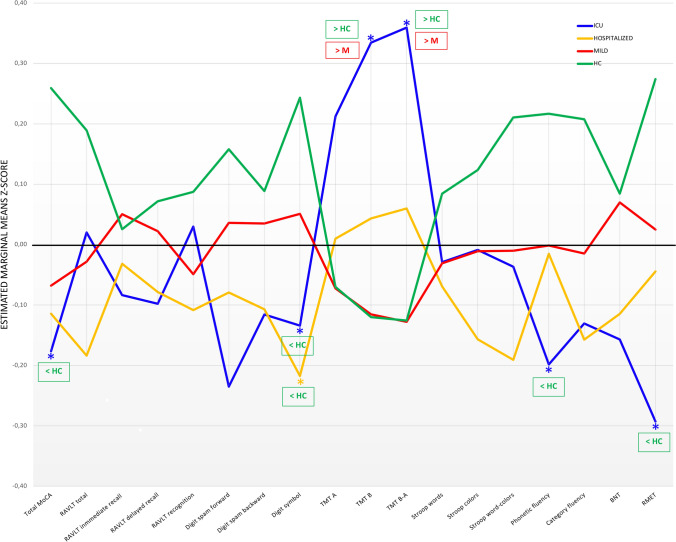
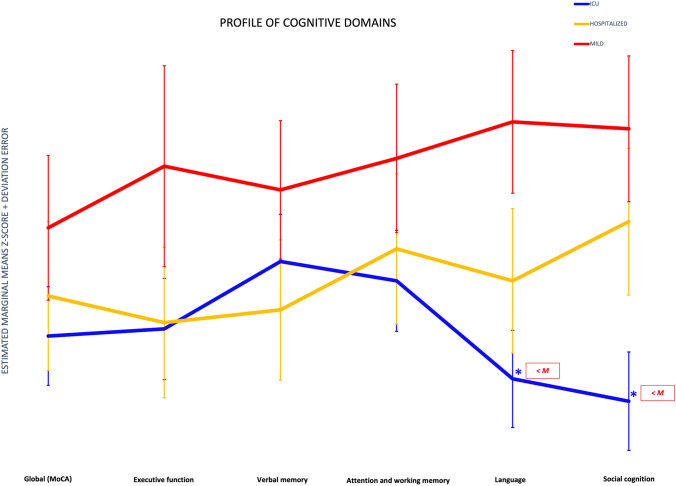
Patients with post-coronavirus disease 2019 (COVID-19) conditions typically experience cognitive problems. Some studies have linked COVID-19 severity with long-term cognitive damage, while others did not observe such associations. This discrepancy can be attributed to methodological and sample variations. We aimed to clarify the relationship between COVID-19 severity and long-term cognitive outcomes and determine whether the initial symptomatology can predict long-term cognitive problems. Cognitive evaluations were performed on 109 healthy controls and 319 post-COVID individuals categorized into three groups according to the WHO clinical progression scale: severe-critical (n = 77), moderate-hospitalized (n = 73), and outpatients (n = 169). Principal component analysis was used to identify factors associated with symptoms in the acute-phase and cognitive domains. Analyses of variance and regression linear models were used to study intergroup differences and the relationship between initial symptomatology and long-term cognitive problems. The severe-critical group performed significantly worse than the control group in general cognition (Montreal Cognitive Assessment), executive function (Digit symbol, Trail Making Test B, phonetic fluency), and social cognition (Reading the Mind in the Eyes test). Five components of symptoms emerged from the principal component analysis: the "Neurologic/Pain/Dermatologic" "Digestive/Headache", "Respiratory/Fever/Fatigue/Psychiatric" and "Smell/ Taste" components were predictors of Montreal Cognitive Assessment scores; the "Neurologic/Pain/Dermatologic" component predicted attention and working memory; the "Neurologic/Pain/Dermatologic" and "Respiratory/Fever/Fatigue/Psychiatric" components predicted verbal memory, and the "Respiratory/Fever/Fatigue/Psychiatric," "Neurologic/Pain/Dermatologic," and "Digestive/Headache" components predicted executive function. Patients with severe COVID-19 exhibited persistent deficits in executive function. Several initial symptoms were predictors of long-term sequelae, indicating the role of systemic inflammation and neuroinflammation in the acute-phase symptoms of COVID-19." Study Registration: www.ClinicalTrials.gov , identifier NCT05307549 and NCT05307575.
Keywords: COVID-19; Executive function; Neuropsychological test; Post-acute COVID-19 syndrome; Symptom assessment.
© 2023. The Author(s).
Conflict of interest statement
All authors declare that they have no conflicts of interest, and the authors are responsible for the content and writing of the paper.
Figures