. 2023 May;156(2):231-245.
doi: 10.1007/s11120-023-01008-y. Epub 2023 Mar 20.

Singular adaptations in the carbon assimilation mechanism of the polyextremophile cyanobacterium Chroococcidiopsis thermalis

Affiliations

Singular adaptations in the carbon assimilation mechanism of the polyextremophile cyanobacterium Chroococcidiopsis thermalis

Pere Aguiló-Nicolau et al. Photosynth Res. 2023 May.

Abstract

Cyanobacteria largely contribute to the biogeochemical carbon cycle fixing ~ 25% of the inorganic carbon on Earth. However, the carbon acquisition and assimilation mechanisms in Cyanobacteria are still underexplored regardless of being of great importance for shedding light on the origins of autotropism on Earth and providing new bioengineering tools for crop yield improvement. Here, we fully characterized these mechanisms from the polyextremophile cyanobacterium Chroococcidiopsis thermalis KOMAREK 1964/111 in comparison with the model cyanobacterial strain, Synechococcus sp. PCC6301. In particular, we analyzed the Rubisco kinetics along with the in vivo photosynthetic CO2 assimilation in response to external dissolved inorganic carbon, the effect of CO2 concentrating mechanism (CCM) inhibitors on net photosynthesis and the anatomical particularities of their carboxysomes when grown under either ambient air (0.04% CO2) or 2.5% CO2-enriched air. Our results show that Rubisco from C. thermalis possess the highest specificity factor and carboxylation efficiency ever reported for Cyanobacteria, which were accompanied by a highly effective CCM, concentrating CO2 around Rubisco more than 140-times the external CO2 levels, when grown under ambient CO2 conditions. Our findings provide new insights into the Rubisco kinetics of Cyanobacteria, suggesting that improved Sc/o values can still be compatible with a fast-catalyzing enzyme. The combination of Rubisco kinetics and CCM effectiveness in C. thermalis relative to other cyanobacterial species might indicate that the co-evolution between Rubisco and CCMs in Cyanobacteria is not as constrained as in other phylogenetic groups.

Keywords: CO2-concentrating mechanisms; CO2-fixation; Cyanobacteria; Photosynthesis; Rubisco.


Conflict of interest statement

The authors declare no conflict of interest.

Figures

Fig. 1
Fig. 1
In vitro Rubisco kinetic traits at 25 °C: a CO2/O2 specificity factor (Sc/o); b Michaelis–Menten semi-saturation constant for CO2 at 0% O2 (Kc); c Michaelis–Menten semi-saturation constant for CO2 at 21% O2 (Kc21\% O2); d Michaelis–Menten semi-saturation constant for O2 (Ko); e carboxylation turnover rate (kcatc), and f Rubisco carboxylation efficiency (kcatc/Kc) of Chroococcidiopsis thermalis KOMAREK 1964/111 (yellow triangles) and Synechococcus sp. PCC6301 (blue squares), measured from semi-purified protein extracts of both strains in the present study, compared to Rubisco kinetics of other previously measured cyanobacterial strains (data compilation from Iñiguez et al. , empty circles). 3–6 replicates of each Rubisco kinetic parameter were used to calculate the mean value shown for Synechococcus sp. PCC6301 and C. thermalis KOMAREK 1964/111 in the boxplots (mean values and standard deviations are shown in Supplementary Table 1). For the other cyanobacterial strains, kinetic parameters are the mean of all values reported in the compiled studies for each strain (values and references provided in Supplementary Spreadsheet 1)
Fig. 2
Fig. 2
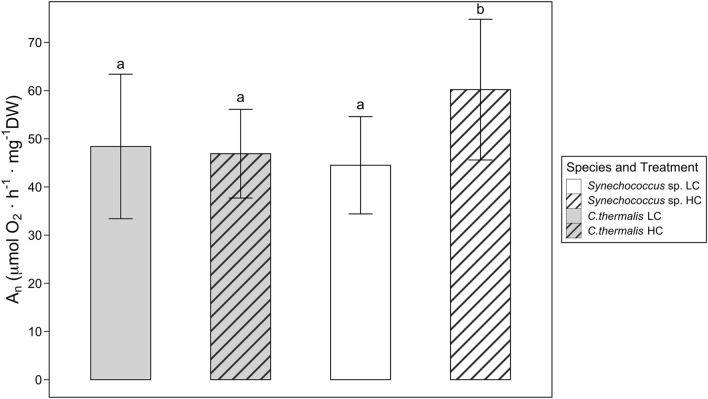
Net photosynthetic rate (An) in Synechococcus sp. PCC6301 (white) and Chroococcidiopsis thermalis KOMAREK 1964/111 (grey) at 20 °C under ambient air (0.04% CO2, LC, empty pattern) or 2.5% CO2—enriched air (HC, line pattern) and saturating irradiance (300 μmol photons m−2 s−1). Values are means ± standard deviation of 10 replicates. Different letters denote significant differences among different strains and CO2 treatments (P < 0.05, two-way ANOVA followed by Tukey’s test or Kruskal–Wallis test followed with Bonferroni correction for non-parametric data)
Fig. 3
Fig. 3
Rubisco in vitro CO2 assimilation under 21% O2 (green line), photosynthetic in vivo CO2 assimilation of ambient air grown cells (blue dotted line; LC) and photosynthetic in vivo CO2 assimilation of 2.5% CO2 grown cells (orange dashed line, HC) from a Synechococcus sp. PCC6301 and b Chroococcidiopsisthermalis KOMAREK 1964/111. The maximum Rubisco and photosynthetic CO2 assimilation rates were standardized to 1 in both plots. The ratio between the Rubisco in vitro Michaelis–Menten semi-saturation constant for CO2 under 21% O2 (Kc21\% O2) and the photosynthetic in vivo Michaelis–Menten semi-saturation constant for CO2 from either cells grown under ambient air (Km in vivo LC) or cells grown under 2.5% CO2 (Km in vivo HC) indicates the CCM effectiveness. Different letters denote significant differences among treatments, and the asterisk (*) indicates significant differences between the two analyzed species (P < 0.05, Kruskal–Wallis test followed by Bonferroni correction for (Kc21\% O2), Kmin vivo LC and Km in vivo HC within species; and Student’s t test for parametric data, or Mann–Whitney–Wilcoxon test for non-parametric data, to compare means between species). 3–6 replicates were used to calculate the mean values of the Rubisco in vitro measurements and 10 replicates were used for the photosynthetic in vivo measurements
Fig. 4
Fig. 4
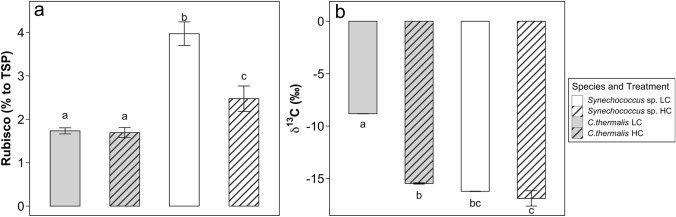
a Percentage of Total Soluble Protein (TSP) that corresponds to Rubisco; b Cell 13C isotopic discrimination (δ13C). Values are means ± SD. White color corresponds to Chroococcidiopsis thermalis KOMAREK 1964/111 and grey color corresponds to Synechococcus sp. PCC6301. The line pattern refers to 2.5% CO2—enriched air grown cells (HC) and the empty pattern to ambient air grown cells (0.04% CO2, LC). Different letters denote significant differences among strains and CO2 treatments (P < 0.05, two-way ANOVA followed by Tukey’s test or Kruskal–Wallis test followed with Bonferroni correction for non-parametric data). 3 replicates were used to calculate the % of Rubisco to TSP and 4–7 replicates to calculate δ13C
Fig. 5
Fig. 5
a Modeled Rubisco gross assimilation rate (ARub) at 25 °C at varying CO2 partial pressure at the Rubisco active sites (Cc) of Synechococcus sp. PCC 6301 (blue dotted line), Chroococcidiopsis thermalis KOMAREK 1964/111 (orange dashed line) and Triticum aestivum (green line), and b Previous graph zoomed in at a Cc ranging from 0 to 900 µbar
Fig. 6
Fig. 6
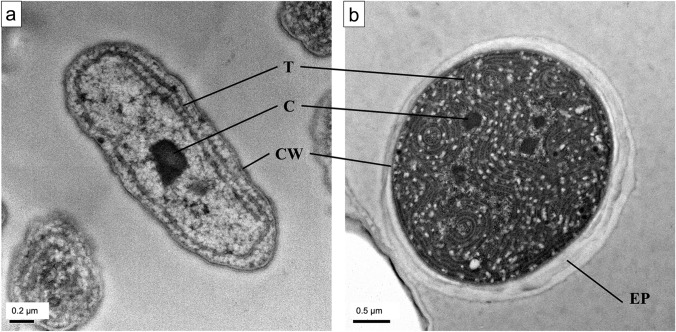
Transmission electron microscope images of a Synechococcus sp. PCC6301 and b Chroococcidiopsis thermalis KOMAREK 1964/111. EP exopolysaccharide shell, CW cell wall, C carboxysome, T thylakoid membrane. Scale bars are 0.2 µm for Synechococcus sp. and 0.5 µm for C. thermalis

References

    1. Andersson I, Backlund A. Structure and function of Rubisco. Plant Physiol Biochem. 2008;46:275–291. doi: 10.1016/j.plaphy.2008.01.001. - DOI - PubMed
    1. Badger MR, Andrews TJ (1987) CO-Evolution of Rubisco and CO2 concentrating mechanisms. In: Progress in photosynthesis research, pp 601–609
    1. Badger MR, Hanson D, Price GD. Evolution and diversity of CO2 concentrating mechanisms in cyanobacteria. Funct Plant Biol. 2002;29:161–173. doi: 10.1071/pp01213. - DOI - PubMed
    1. Basu S, Mackey KRM. Effect of rising temperature and carbon dioxide on the growth, photophysiology, and elemental ratios of marine Synechococcus: a multistressor approach. Sustainability. 2022;14:9508. doi: 10.3390/su14159508. - DOI
    1. Bathellier C, Tcherkez G, Lorimer GH, Farquhar GD. Rubisco is not really so bad. Plant Cell Environ. 2018;41:705–716. doi: 10.1111/pce.13149. - DOI - PubMed

Supplementary concepts

LinkOut - more resources