Clinical Aureobasidium Isolates Are More Fungicide Sensitive than Many Agricultural Isolates
- PMID: 36943135
- PMCID: PMC10100788
- DOI: 10.1128/spectrum.05299-22
Clinical Aureobasidium Isolates Are More Fungicide Sensitive than Many Agricultural Isolates
Abstract
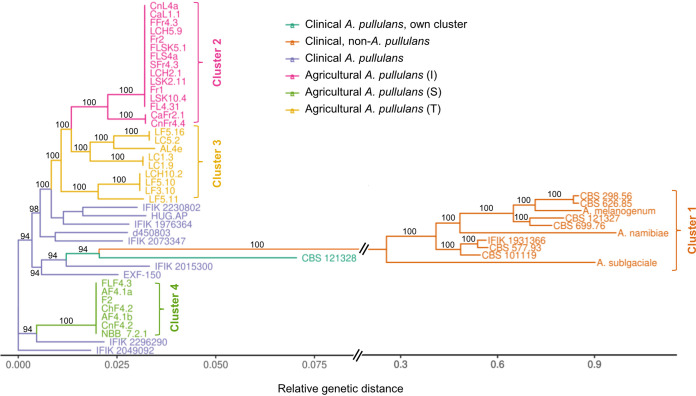
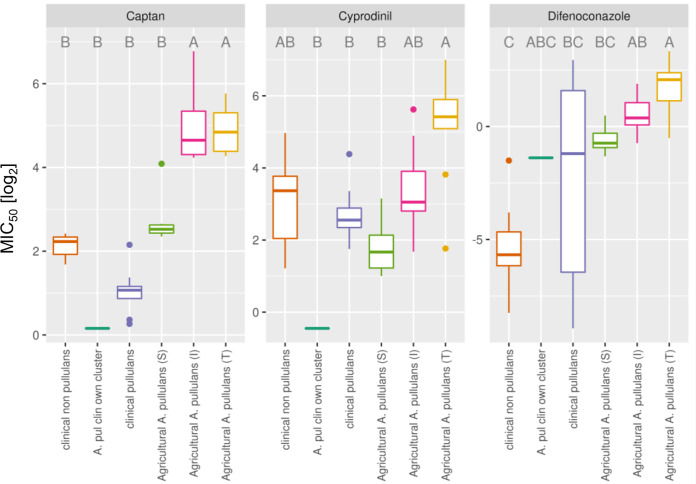
Fungicide applications in agriculture and medicine can promote the evolution of resistant, pathogenic fungi, which is a growing problem for disease management in both settings. Nonpathogenic mycobiota are also exposed to fungicides, may become tolerant, and could turn into agricultural or medical problems, for example, due to climate change or in immunocompromised individuals. However, quantitative data about fungicide sensitivity of environmental fungi is mostly lacking. Aureobasidium species are widely distributed and frequently isolated yeast-like fungi. One species, A. pullulans, is used as a biocontrol agent, but is also encountered in clinical samples, regularly. Here, we compared 16 clinical and 30 agricultural Aureobasidium isolates based on whole-genome data and by sensitivity testing with the 3 fungicides captan, cyprodinil, and difenoconazole. Our phylogenetic analyses determined that 7 of the 16 clinical isolates did not belong to the species A. pullulans. These isolates clustered with other Aureobasidium species, including A. melanogenum, a recently separated species that expresses virulence traits that are mostly lacking in A. pullulans. Interestingly, the clinical Aureobasidium isolates were significantly more fungicide sensitive than many isolates from agricultural samples, which implies selection for fungicide tolerance of non-target fungi in agricultural ecosystems. IMPORTANCE Environmental microbiota are regularly found in clinical samples and can cause disease, in particular, in immunocompromised individuals. Organisms of the genus Aureobasidium belonging to this group are highly abundant, and some species are even described as pathogens. Many A. pullulans isolates from agricultural samples are tolerant to different fungicides, and it seems inevitable that such strains will eventually appear in the clinics. Selection for fungicide tolerance would be particularly worrisome for species A. melanogenum, which is also found in the environment and exhibits virulence traits. Based on our observation and the strains tested here, clinical Aureobasidium isolates are still fungicide sensitive. We, therefore, suggest monitoring fungicide sensitivity in species, such as A. pullulans and A. melanogenum, and to consider the development of fungicide tolerance in the evaluation process of fungicides.
Keywords: Aureobasidium; fungicide resistance.
Conflict of interest statement
The authors declare no conflict of interest.
Figures
References
-
- Fisher MC, Alastruey-Izquierdo A, Berman J, Bicanic T, Bignell EM, Bowyer P, Bromley M, Brüggemann R, Garber G, Cornely OA, Gurr SJ, Harrison TS, Kuijper E, Rhodes J, Sheppard DC, Warris A, White PL, Xu J, Zwaan B, Verweij PE. 2022. Tackling the emerging threat of antifungal resistance to human health. Nat Rev Microbiol 20:557–571. doi:10.1038/s41579-022-00720-1. - DOI - PMC - PubMed
LinkOut - more resources
Full Text Sources