. 2023 May;39(4):290-299.
doi: 10.1089/jop.2022.0139. Epub 2023 Mar 21.

Internalization of Angiotensin-(1-12) in Adult Retinal Pigment Epithelial-19 Cells

Affiliations

Internalization of Angiotensin-(1-12) in Adult Retinal Pigment Epithelial-19 Cells

Sarfaraz Ahmad et al. J Ocul Pharmacol Ther. 2023 May.

Abstract

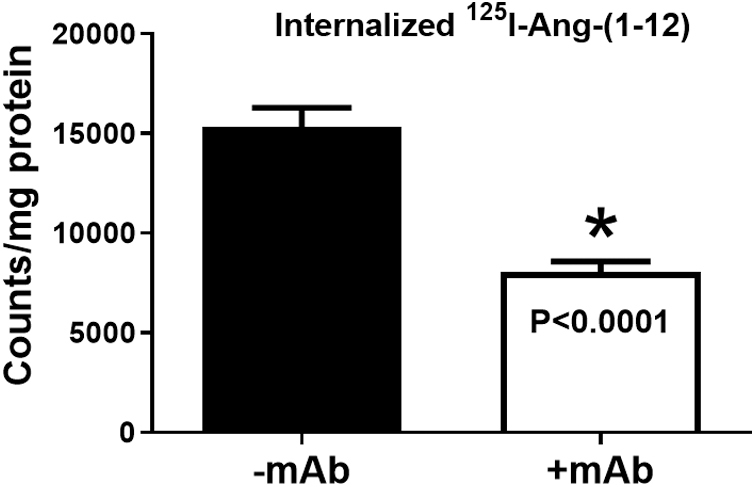
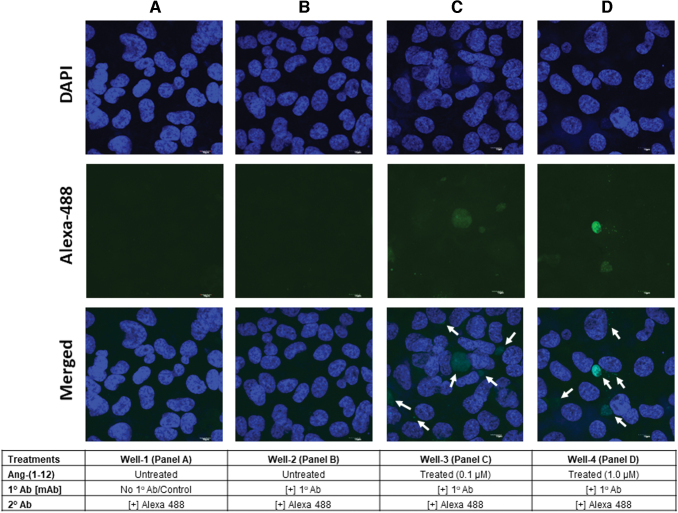
Purpose: Angiotensin-(1-12) [Ang-(1-12)] serves as a primary substrate to generate angiotensin II (Ang II) by angiotensin-converting enzyme and/or chymase suggests it may be an unrecognized source of Ang II-mediated microvascular complication in hypertension-mediated retinopathy. We investigated Ang-(1-12) expression and internalization in adult retinal pigment epithelial-19 (ARPE-19) cultured cells. We performed the internalization of Ang-(1-12) in ARPE-19 cells in the presence of a highly specific monoclonal antibody (mAb) developed against the C-terminal end of the Ang-(1-12) sequence. Methods: All experiments were performed in confluent ARPE-19 cells (passage 28-35). We employed high-performance liquid chromatography to purify radiolabeled, 125I-Ang-(1-12) and immuno-neutralization with Ang-(1-12) mAb to demonstrate Ang-(1-12)'s internalization in ARPE-19 cells. Internalization was also demonstrated by immunofluorescence (IF) method. Results: These procedures revealed internalization of an intact 125I-Ang-(1-12) in ARPE-19 cells. A significant reduction (∼53%, P < 0.0001) in 125I-Ang-(1-12) internalization was detected in APRE-19 cells in the presence of the mAb. IF staining experiments further confirms internalization of Ang-(1-12) into the cells from the extracellular culture medium. No endogenous expression was detected in the ARPE-19 cells. An increased intensity of IF staining was detected in cells exposed to 1.0 μM Ang-(1-12) compared with 0.1 μM. Furthermore, we found hydrolysis of Ang-(1-12) into Ang II by ARPE-19 cells' plasma membranes. Conclusions: Intact Ang-(1-12) peptide is internalized from the extracellular spaces in ARPE-19 cells and metabolized into Ang II. The finding that a selective mAb blocks cellular internalization of Ang-(1-12) suggests alternate therapeutic approaches to prevent/reduce the RPE cells Ang II burden.

Keywords: angiotensin II; angiotensin-(1–12); internalization; monoclonal antibody therapy; peptide metabolism; retinal pigment epithelial cells.


Conflict of interest statement

No competing financial interests exist.

Figures
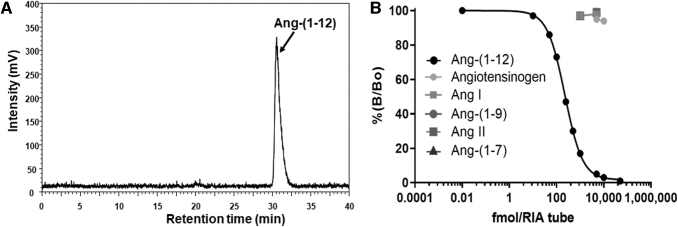
FIG. 1.
FIG. 1.
HPLC chromatogram of purified 125I-Ang-(1–12) and mAb specificity and cross-reactivity. The human Ang-(1–12) was radiolabeled with Iodine-125 and was purified on C18 column by HPLC. As shown in HPLC chromatogram, (A) the purified radiolabeled 125I-Ang-(1–12) peptide fraction was highly pure (≥99% purity) and was used in internalization and metabolism studies. (B) The Protein L column purified mAb shows high specificity for Ang-(1–12) (filled black circle) and does not cross-react with closely related Ang peptides (1,000 and 5,000 fmol) and human angiotensinogen (5,000 and 10,000 fmol) as demonstrated by RIA. Ang, angiotensin; HPLC, high-performance liquid chromatography; mAb, monoclonal antibody.
FIG. 2.
FIG. 2.
Radiolabeled 125I-Ang-(1–12) Internalization −/+mAb. Internalization of radiolabeled 125I-Ang-(1–12) in confluent ARPE-19 cells at 37°C for 4 h in the presence and absence of mAb (1 mg/mL). All experiments were performed at least 3 times or more on different passages. Values are expressed in terms of counts per milligram protein (*P < 0.0001 vs. −mAb). Details are in Methods section. ARPE-19, adult retinal pigment epithelial-19.
FIG. 3.
FIG. 3.
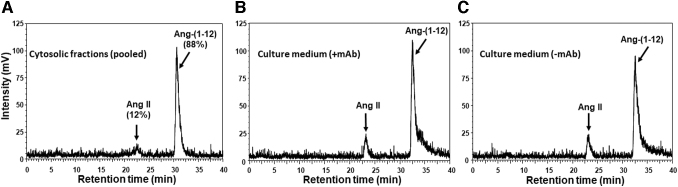
HPLC chromatograms of cytosolic fractions (from 100 mm dishes) and culture media (from 12-well plates). ARPE-19 cells were treated with 125I-Ang-(1–12) for 4 h at 37°C. The cells and culture media were collected after 4 h of exposure. The radiolabeled substrate and its metabolic products were analyzed by HPLC. Chromatograms; (A) pooled cytosolic fractions, (B) culture medium in the presence of mAb, and (C) culture medium in the absence of mAb. Details are in Methods section.
FIG. 4.
FIG. 4.
ARPE-19 cells immunofluorescence staining. The ARPE-19 cells grown on 4-well chambered slides and treated with or without Ang-(1–12) for 4 h at 37°C. Well-1 [A, untreated Ang-(1–12) and mAb] and well-2 [B, untreated Ang-(1–12)] serve as negative control and endogenous Ang-(1–12) expression, respectively. Well-3 (C) and well-4 were treated with Ang-(1–12) (0.1 and 1.0 μM, respectively) serve as internalization of Ang-(1–12) from extracellular culture medium. Endogenous (B) and arrows indicate the Ang-(1–12) internalization (C, D) were detected by immunofluorescence staining using Ang-(1–12) mAb as primary and anti-mouse Alexa Fluor 488 for secondary antibody as described in Methods section. Color images are available online.
FIG. 5.
FIG. 5.
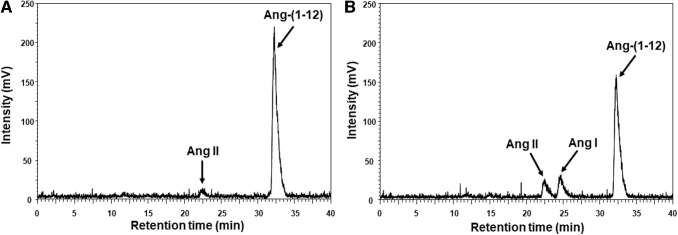
HPLC chromatograms of radiolabeled 125I-Ang-(1–12) substrate and its hydrolytic products generation by ARPE-19 cells. HPLC analysis of the hydrolytic products generated from 125I-Ang-(1–12) substrate by solubilized plasma membranes in the absence of both ACE and chymase inhibitors. The HPLC chromatograms, represent the hydrolytic products are generated in presence of ACE and chymase inhibitors (panel A) and in the absence of both inhibitors (panel B). Details are in Methods section. ACE, angiotensin-converting enzyme.

References

    1. Nagata S, Kato J, Sasaki, K, et al. . Isolation and identification of proangiotensin-12, a possible component of the renin-angiotensin system. Biochem Biophys Res Commun 2006;350(4):1026–1031. - PubMed
    1. Moniwa N, Varagic J, Simington SW, et al. . Primacy of angiotensin converting enzyme in angiotensin-(1–12) metabolism. Am J Physiol Heart Circ Physiol 2013;305(5):H644–H650. - PMC - PubMed
    1. Ahmad S, Simmons T, Varagic J, et al. . Chymase-dependent generation of angiotensin II from angiotensin-(1–12) in human atrial tissue. PLoS One 2011;6(12):e28501. - PMC - PubMed
    1. Ahmad S, Varagic J, Groban L, et al. . Angiotensin-(1–12): A chymase-mediated cellular angiotensin II substrate. Curr Hypertens Rep 2014;16(5):429. - PMC - PubMed
    1. Ahmad S, Varagic J, VonCannon JL, et al. . Primacy of cardiac chymase over angiotensin converting enzyme as an angiotensin-(1–12) metabolizing enzyme. Biochem Biophys Res Commun 2016;478(2):559–564. - PMC - PubMed

Publication types

LinkOut - more resources