Review
. 2023 Mar 21;15(1):45.
doi: 10.1186/s13148-023-01450-8.

Chromatin remodeler Activity-Dependent Neuroprotective Protein (ADNP) contributes to syndromic autism

Affiliations
Review

Chromatin remodeler Activity-Dependent Neuroprotective Protein (ADNP) contributes to syndromic autism

Claudio Peter D'Incal et al. Clin Epigenetics. .

Abstract

Background: Individuals affected with autism often suffer additional co-morbidities such as intellectual disability. The genes contributing to autism cluster on a relatively limited number of cellular pathways, including chromatin remodeling. However, limited information is available on how mutations in single genes can result in such pleiotropic clinical features in affected individuals. In this review, we summarize available information on one of the most frequently mutated genes in syndromic autism the Activity-Dependent Neuroprotective Protein (ADNP).

Results: Heterozygous and predicted loss-of-function ADNP mutations in individuals inevitably result in the clinical presentation with the Helsmoortel-Van der Aa syndrome, a frequent form of syndromic autism. ADNP, a zinc finger DNA-binding protein has a role in chromatin remodeling: The protein is associated with the pericentromeric protein HP1, the SWI/SNF core complex protein BRG1, and other members of this chromatin remodeling complex and, in murine stem cells, with the chromodomain helicase CHD4 in a ChAHP complex. ADNP has recently been shown to possess R-loop processing activity. In addition, many additional functions, for instance, in association with cytoskeletal proteins have been linked to ADNP.

Conclusions: We here present an integrated evaluation of all current aspects of gene function and evaluate how abnormalities in chromatin remodeling might relate to the pleiotropic clinical presentation in individual"s" with Helsmoortel-Van der Aa syndrome.

Keywords: ADNP; Activity-Dependent Neuroprotective Protein; Autism, intellectual disability, neurodevelopmental disorder, cancer; Chromatin remodeler; Helsmoortel–Van der Aa syndrome.


Conflict of interest statement

The authors declare no conflict of interest. Professor Illana Gozes is a Co-Founder, Chief Scientific Officer and a Director at ATED Therapeutics, clinically developing davunetide.

Figures
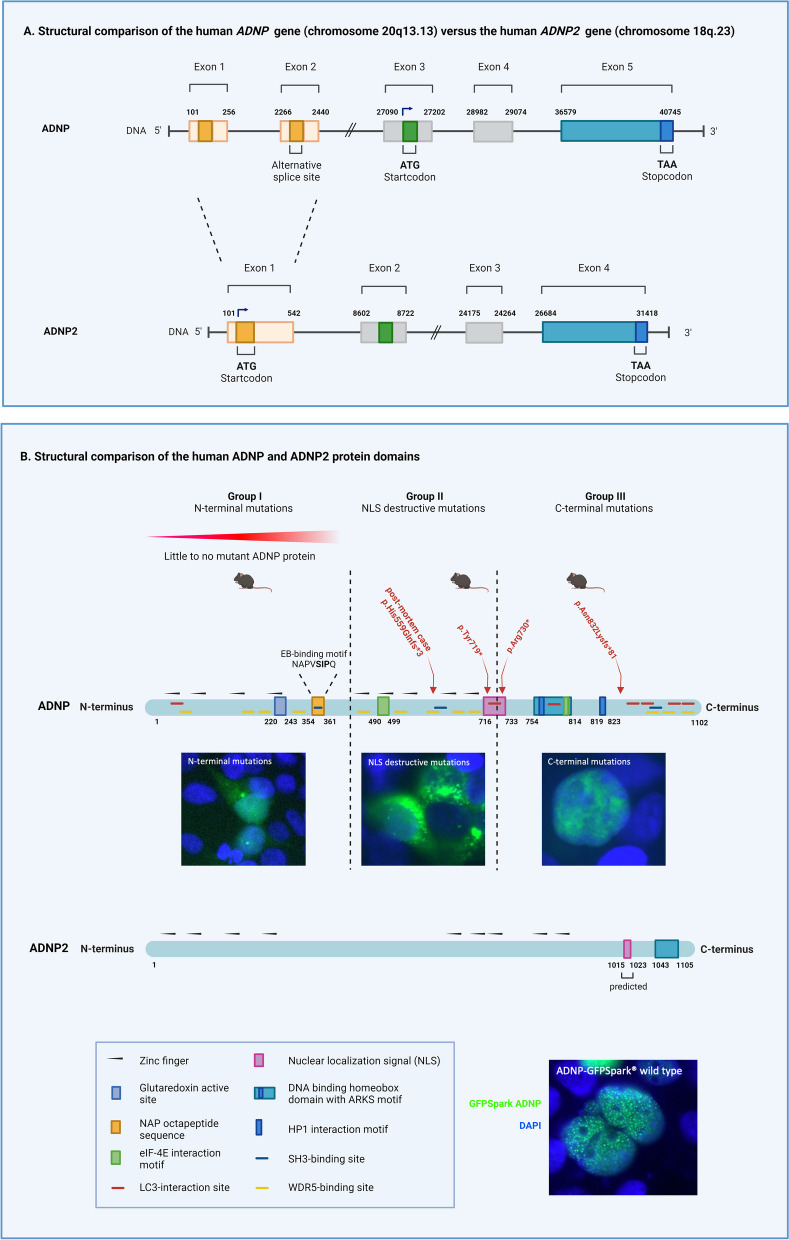
Fig. 1
Fig. 1
Structural comparison of the ADNP and ADNP2 gene structure and functional protein domains. (A) The ADNP gene contains five exons of which only the last three are translated (https://www.ensembl.org/). The ADNP2 gene contains only four exons. The 5’UTR of ADNP2 corresponds with exons 1 and 2 of ADNP. The 3’UTR is comprised of a part of exon 4, correlating to exon 5 of ADNP. ATG, start codon; TAA, stop codon. (B) The relative positions of the ADNP nine zinc fingers (lines) together with the glutaredoxin active site, NAP sequence, eIF-4E interaction motif, nuclear localization signal (NLS), DNA-binding homeobox domain with ARKS and PxVxL motif are illustrated on the figure. Computational sequence analysis also revealed LC3 interaction sites (MAP1ALC3), SH3-binding sites (SHANK3), and WRD5-binding sites (SIRT1) in ADNP which could be confirmed by direct co-immunoprecipitation experiments. The ADNP gene is divided in three mutational classes: N-terminal, perinuclear (NLS destructive), and C-terminal mutations, each of them altering the subcellular localization and expression of the protein. The most recurring and prevalent ADNP mutations of the spectrum include the p.Tyr719*, p.Arg730*, and p.Asn832Lysfs*81 with the unique deceased ADNP toddler mutation c.1676Adupl/p.His559Gln*3. The three viable Adnp heterozygous mouse strains mimic in part mutation designated to each class of the mutational spectrum, e.g., haploinsufficient mouse accounting for N-terminal mutations, respectively, the p.Tyr718* Adnp mouse for the NLS-destroying group of patient mutations, and the frameshift Adnp mouse for patients with C-terminal mutations. ADNP2 shows homology to ADNP by the presence of an equal amount of zinc fingers and a DNA-binding homeobox
Fig. 2
Fig. 2
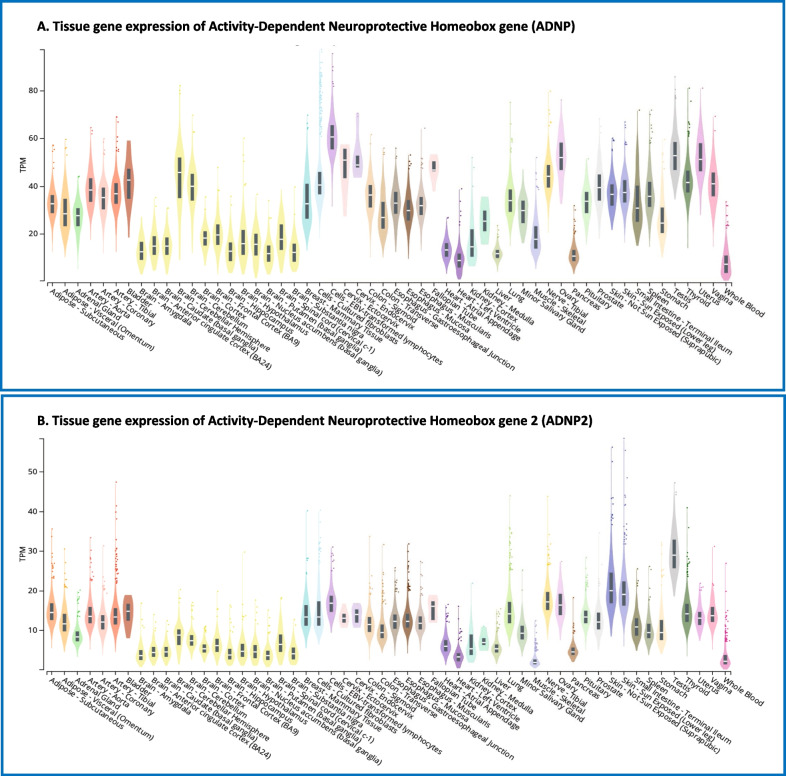
Tissue gene expression of the ADNP and ADNP2 (GTEx Portal). (A) Tissue gene expression of ADNP. A high expression of ADNP is reported in brain regions such as the cerebellum and cortex, gastrointestinal tissues, lungs, and reproductive system. A moderate expression is observed in the kidneys, smooth muscles, and soft tissues, while low to absent levels present in cardiac muscles, adipose tissue, liver, and skeletal muscles. (B) Tissue gene expression of the ADNP2. A high expression of ADNP2 is observed in brain regions such as the cortex and cerebellum, although lower in comparison with ADNP. Heart, kidneys, and uterine tissues were reported with a moderate expression. Low expression levels are seen in the pancreas, spleen, liver, lungs, and skeletal muscles. TPM, transcripts per million
Fig. 3
Fig. 3
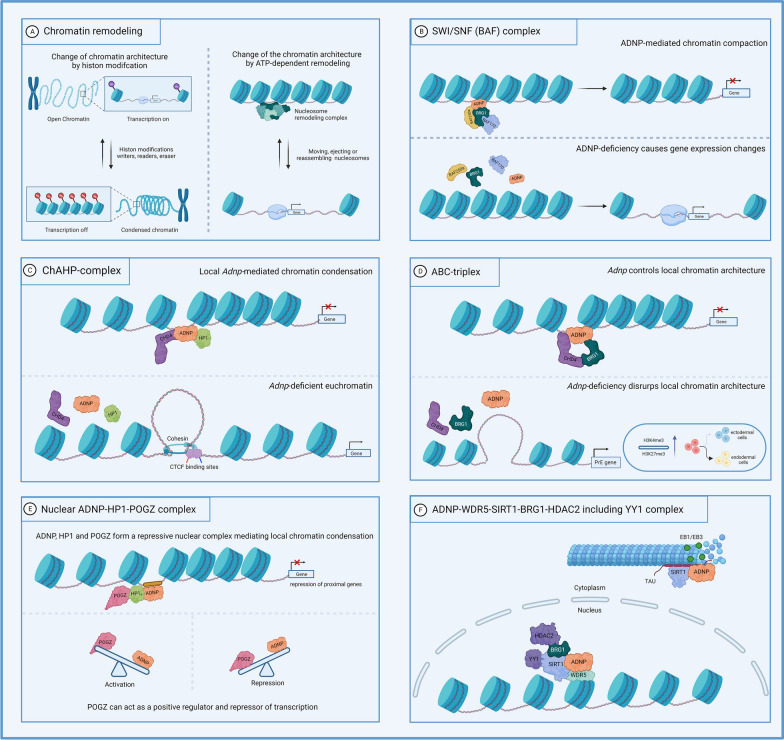
Overview of ADNP interactions with different chromatin remodelers. (A) General outline of chromatin remodeling, a dynamic process where changes in chromatin architecture can be modified by histone-enzymes such as writers, readers, and erasers. Change in chromatin conformation impacts the transcription machinery, e.g., open chromatin (euchromatin) is associated with gene transcription, while condensed chromatin (heterochromatin) is characterized by repression of transcription. Structural chromatin changes can be inducted by different chromatin remodeling complexes in an ATP-dependent manner, although non-ATP-related alterations have been identified (Box 2). (B) ADNP interacts with the ATP-dependent SWI/SNF (BAF) complex by its C-terminal portion with BRG1, BAF170, and BAF250a, thereby causing aberrant gene expression. (C) ADNP interacts with chromatin remodeler CHD4 by its N-terminus and HP1 by its C-terminus, forming a stable complex called the ChAHP complex, which masks local CTCF-motifs. Locally, the ChAHP complex mediates chromatin condensation at euchromatic regions, repressing stem cell differentiation-related genes. Complete Adnp deficiency results in disruption of the ChAHP complex and exposes the masked CTCF-motifs, normally bound by ChAHP, to introduce novel cohesion-insulated regions, resulting in chromatin recondensation, gene transcription, and spontaneous cell differentiation. (D) ADNP forms a stable triplex with BRG1 and CHD4 (ABC) which strongly binds to inaccessible chromatin. Loss of ADNP increases the ratio H3K4me3/H3K27me3 at key primitive endoderm (PrE) gene promoters, promoting differentiation toward endodermal cells. (E) The ADNP-HP1-POGZ complex is a nuclear repressive complex mediating local chromatin condensation. POGZ had a dual role as activator and repressor of transcription. High levels of POGZ and reduced levels of ADNP cause gene activation, observed as downregulation of proximal genes in Pogz knockout mice, while low POGZ levels and high ADNP levels cause gene repression, shown as upregulation of proximal genes in Pogz knockout mice. (F) In the nucleus, shared promotor region motifs were identified in the ADNP gene with YY1, BRG1 (SMARCA4), and HDAC2, with HDAC2 showing the highest similarity. Recently, WD repeat-containing protein 5 (WDR5) sites were found to be common between ADNP and chromatin modifier SIRT, mediating a nuclear-cytoplasmatic crosstalk and associating with microtubules/Tau
Fig. 4
Fig. 4
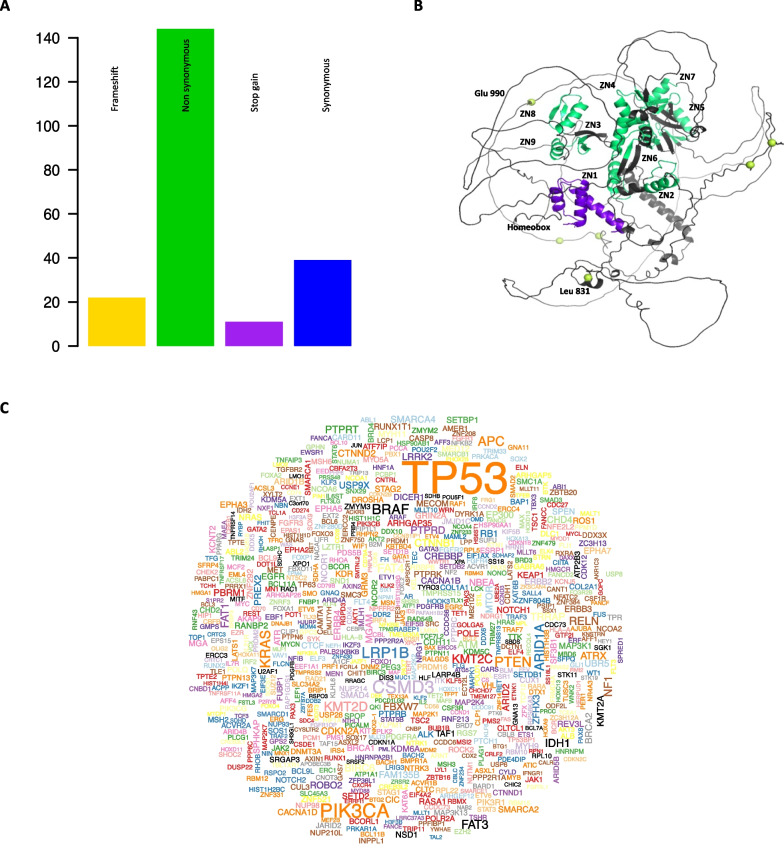
Cancer-related associations of ADNP. (A) Table of types of ADNP mutations found in PanCancer. (B) 3D structure of ADNP retrieved from Alphafold database; light green domains represent zinc (ZN) fingers and the purple domain represent the homeobox domain; lime yellow spheres represent alpha carbon of residues in which genetic mutations cause frameshifts and incorporation of a premature stop codon. Leu 831 is reported as a reference position of hot locations that are often mutated into early stop codon/frameshift causing HVDAS. (C) Word cloud adapted from the OncoVar website, referring to top cancer drivers, which includes several known ADNP interactors

References

    1. American Psychiatric Association. American Psychiatric Association: Diagnostic and Statisti­cal Manual of Mental Disorders. Fifth. Arlington, VA; 2013.
    1. Zhou X, Feliciano P, Shu C, Wang T, Astrovskaya I, Hall JB, et al. Integrating de novo and inherited variants in 42,607 autism cases identifies mutations in new moderate-risk genes. Nat Genet. 2022;54:1305–1319. doi: 10.1038/s41588-022-01148-2. - DOI - PMC - PubMed
    1. Fu JM, Satterstrom FK, Peng M, Brand H, Collins RL, Dong S, et al. Rare coding variation provides insight into the genetic architecture and phenotypic context of autism. Nat Genet. 2022;54:1320–1331. doi: 10.1038/s41588-022-01104-0. - DOI - PMC - PubMed
    1. Wang T, Kim CN, Bakken TE, Gillentine MA, Henning B, Mao Y, et al. Integrated gene analyses of de novo variants from 46,612 trios with autism and developmental disorders. Proc Natl Acad Sci USA. 2022;119:e2203491119. doi: 10.1073/pnas.2203491119. - DOI - PMC - PubMed
    1. Mossink B, Negwer M, Schubert D, Nadif KN. The emerging role of chromatin remodelers in neurodevelopmental disorders: a developmental perspective. Cell Mol Life Sci. 2021;78:2517–2563. doi: 10.1007/s00018-020-03714-5. - DOI - PMC - PubMed

Publication types

LinkOut - more resources