


Scientific Publishing in Biomedicine: A Brief History of Scientific Journals
- PMID: 36945344
- PMCID: PMC10024814
- DOI: 10.5812/ijem-131812
Scientific Publishing in Biomedicine: A Brief History of Scientific Journals
Abstract
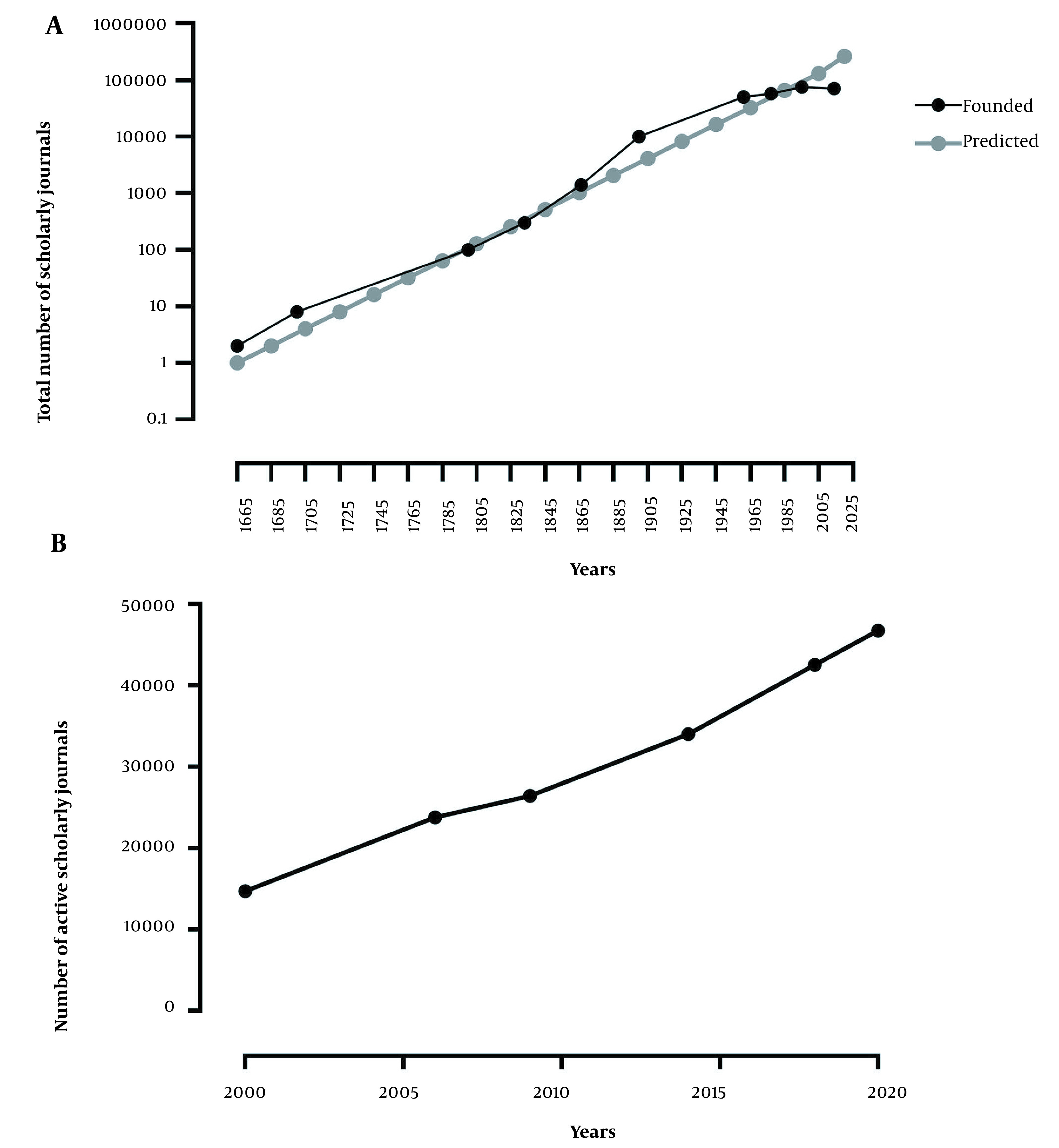
Scientific publishing, with about 350-year historical background, has played a central role in advancing science by disseminating new findings, generalizing accepted theories, and sharing novel ideas. The number of scientific journals has exponentially grown from 10 at the end of the 17th century to 100,000 at the end of the 20th century. The publishing landscape has dramatically changed over time from printed journals to online publishing. Although scientific publishing was initially non-commercial, it has become a profitable industry with a significant global financial turnover, reaching $28 billion in annual revenue before the COVID-19 pandemic. However, scientific publishing has encountered several challenges and is suffering from unethical practices and some negative phenomena, like publish-or-perish, driven by the need to survive or get a promotion in academia. Developing a global landscape with collaborative non-commercial journals and platforms is a primary proposed model for the future of scientific publishing. Here, we provide a brief history of the foundation and development of scientific journals and their evolution over time. Furthermore, current challenges and future perspectives of scientific publishing are discussed.
Keywords: History; Journal; Scientific Paper; Scientific Publishing.
Copyright © 2022, International Journal of Endocrinology and Metabolism.
Conflict of interest statement
Conflict of Interests: We declare that two authors (A. Gh. and P. M.) are associate editors of the International Journal of Endocrinology and Metabolism.
Figures
References
-
- Feynman RP. Cargo cult science. In: Williams J, editor. The art and science of analog circuit design. Amsterdam, Netherlands: Elsevier; 1998. pp. 55–61.
-
- Murakami YP. Scientization of Science. Annals of the Japan Association for Philosophy of Science. 1993;8(3):175–85. doi: 10.4288/jafpos1956.8.175. - DOI
-
- Layton ET. American Ideologies of Science and Engineering. Technol Cult. 1976;17(4) doi: 10.2307/3103675. - DOI
-
- Ross S. Scientist: The story of a word. Ann. Sci. 2006;18(2):65–85. doi: 10.1080/00033796200202722. - DOI
Publication types
LinkOut - more resources
Full Text Sources