. 2023 Dec;18(1):2192324.
doi: 10.1080/15592294.2023.2192324.

Identification and characterization of extrachromosomal circular DNA in patients with high myopia and cataract

Affiliations

Identification and characterization of extrachromosomal circular DNA in patients with high myopia and cataract

Kai Wen et al. Epigenetics. 2023 Dec.

Abstract

To explore the presence of extrachromosomal circular DNA (eccDNA) in the anterior capsule of the lens in the eyes of patients with cataract and with high myopia. Circle-Seq was performed to identify differences in the eccDNA and gene expression between the anterior capsule of the lens of patients with simple nuclear cataract (C, n = 6 cases) and patients with nuclear cataract along with high myopia (HM, n = 6 cases). The expression of eccDNA was confirmed using routine quantitative polymerase chain reaction. The eccDNA ranked in C and HM ranged in length from 0.017 kb - 9.9 Mb with two distinctive peaks detected at 0.2 kb and 0.5 kb, while eccDNA that were differentially expressed ranged in size from 0.05 kb - 57.8 kb with two distinctive peaks observed at 0.1 kb and 0.5 kb. Only 2.5% of the eccDNA in C and 2% in HM were>25 kb in size. The gene-rich chromosomes contributed to more number of eccDNA/Mb, while several well-known high myopia candidate genes, including catenin delta 2 (CTNND2) and ubiquitin-like with PHD, exhibited significantly increased levels of eccDNA in the anterior capsule of the lens in patients with high myopia. This study highlighted the topologic analysis of the anterior capsule of eyes with high myopia, which is an emerging direction for research and clinical applications. These findings suggested that eccDNA was commonly detected in eyes with high myopia and cataracts, and the candidate genes for high myopia identified in previous studies were also observed in the eccDNA.

Keywords: Circle-seq; Extrachromosomal circular DNA; anterior capsule of the lens; cataract; high myopia.


Conflict of interest statement

No potential conflict of interest was reported by the authors.

Figures
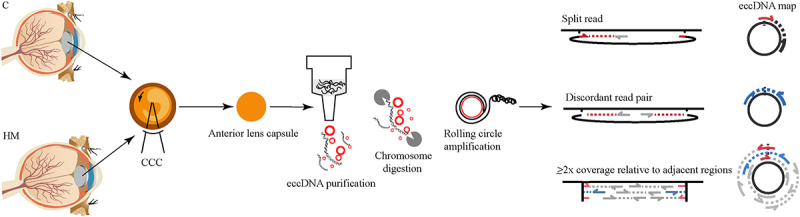
Figure 1.
Figure 1.
Circle-Seq method for mapping of eccDNA. OD: right eye OS: left eye CCC: Continuous circular capsulorhexis, an important operation in cataract surgery.
Figure 2.
Figure 2.
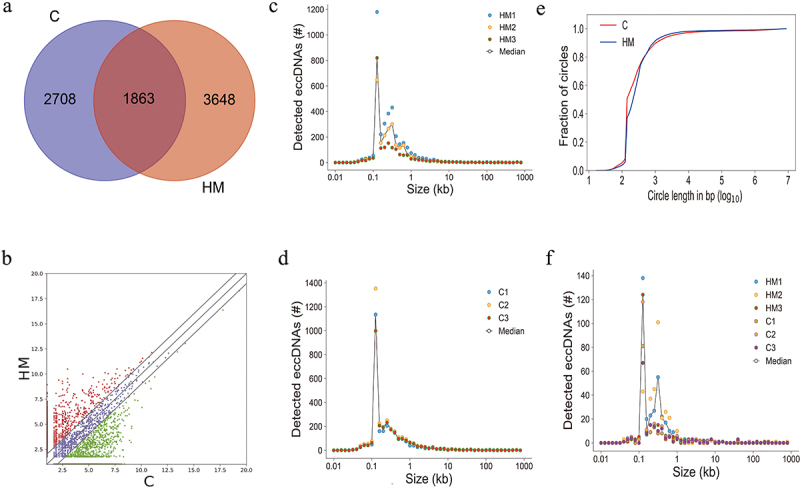
Genome-wide detection and analysis of eccDnas distribution by high throughput sequencing in HM and C samples. (a). the number of eccDnas of C and HM. (b). Scatter plots showing the differentially expressed eccDnas (fold changes ≥2 and p < 0.05). (c). Number of eccDnas relative to size in kb of each C samples. (d). Number of eccDnas relative to size in kb of each HM samples. (e). Cumulative frequency plots of HM (blue) and C (red) eccDNA in anterior capsular of the lens. (f). Number of significant differentially eccDnas relative to size in kb of HM and C samples.
Figure 3.
Figure 3.
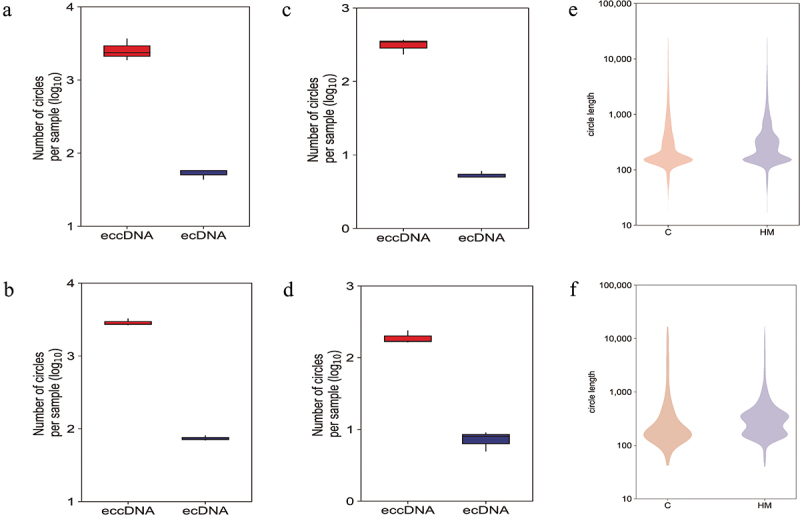
A genome-wide map of eccDnas and ecDnas in anterior capsular of the lens. (a). Number of ecDnas and eccDnas of HM samples. (b). Number of ecDnas and eccDnas of C samples. (c). Number of significant differentially eccDnas and ecDnas of HM samples. (d). Number of significant differentially eccDnas and ecDnas of C samples. (e): Size distribution of all ecDnas and eccDnas identified using Circle-seq in HM and C samples. (f). Size distribution of significant differentially eccDnas and ecDnas identified using Circle-seq in HM and C samples.
Figure 4.
Figure 4.
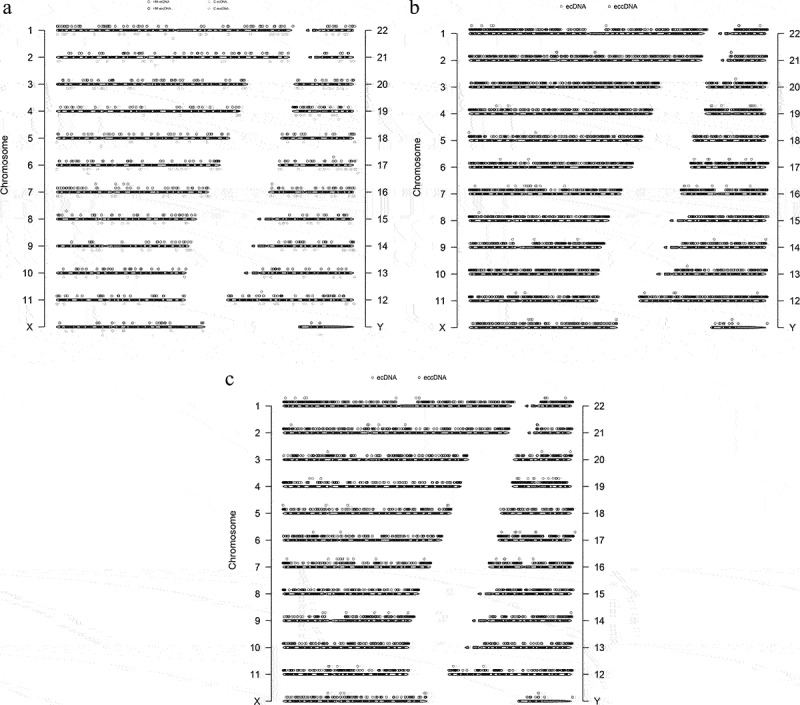
Genomic overview of eccDNA types detected anterior capsular of the lens. (a). Chromosomal map of significant differentially eccDnas and ecDnas from Circle-Seq. (b). Chromosomal map of all eccDnas and ecDnas of HM samples. (c). Chromosomal map of all eccDnas and ecDnas of C samples.
Figure 5.
Figure 5.
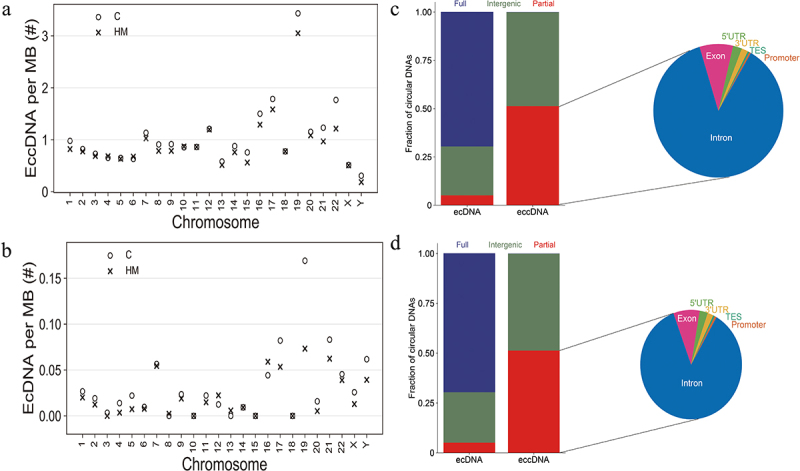
The relationship between eccDNA and genomes and chromosomes. (a). Significant differentially eccDNA frequency relative to chromosome. (b). Significant differentially ecDNA frequency relative to chromosome. (c). Fraction of genomic regions affected by eccDNA compared to ecDNA in C samples. D. Fraction of genomic regions affected by eccDNA compared to ecDNA in HM samples.
Figure 6.
Figure 6.
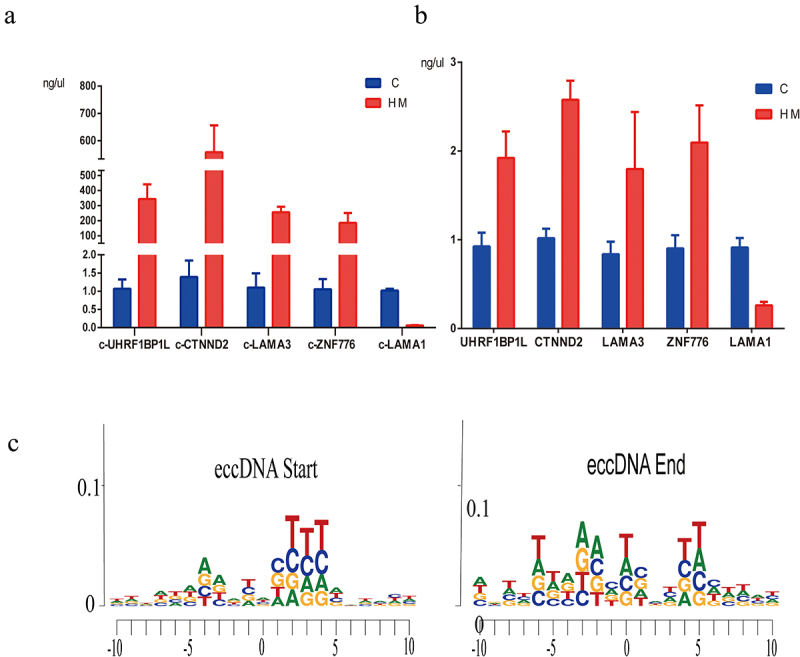
The PCR results of eccDnas and motif analysis. (a). the PCR results of 5 candidate eccDnas (c-gene) in 3 pairs of C and HM samples. (b). the PCR results of gene expression in mRNA level. (c). the motif analysis flanking eccDNA junctional sites by high throughput sequencing.
Figure 7.
Figure 7.
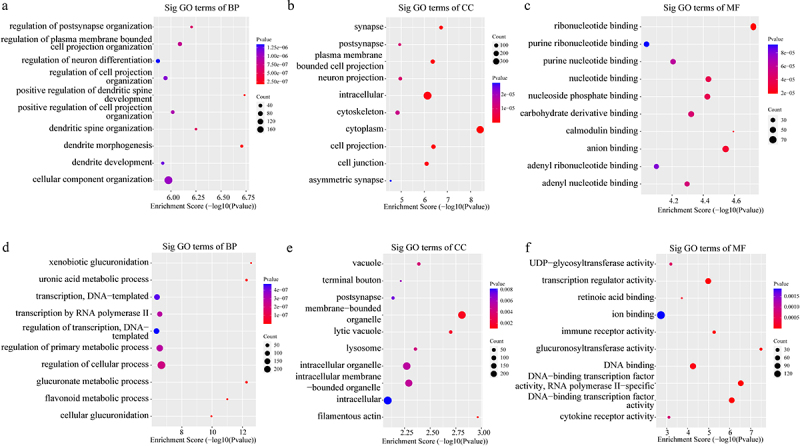
The results of the GO analysis. (a-c). Major gene ontology terms (BP, CC, MF, respectively) were significantly enriched for upregulation eccDNA-associated genes. (d-f). Major gene ontology terms (BP, CC, MF, respectively) were significantly enriched for downregulation eccDNA-associated genes. BP: biological process; CC: cellular component; MF: molecular function.
Figure 8.
Figure 8.
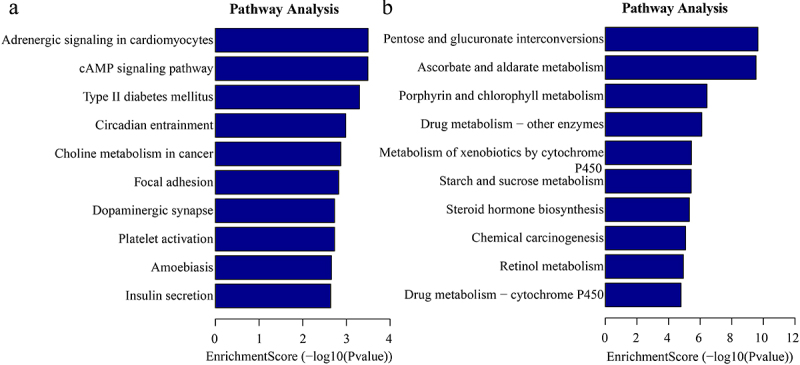
Kyoto Encyclopedia of Genes and Genomes (KEGG) enrichment analysis of significant differentially eccDNA (select the top 10 by the value of p.Adjust). (a) the top ten significantly enriched pathways for the upregulation eccDNA. (b). the top ten significantly enriched pathways for the downregulation eccDNA.

References

    1. Turner KM, Deshpande V, Beyter D, et al. Extrachromosomal oncogene amplification drives tumour evolution and genetic heterogeneity. Nature. 2017;543:122–12. - PMC - PubMed
    1. Moller HD, Mohiyuddin M, Prada-Luengo I, et al. Circular DNA elements of chromosomal origin are common in healthy human somatic tissue. Nat Commun. 2018;9:1069. - PMC - PubMed
    1. Shibata Y, Kumar P, Layer R, et al. Extrachromosomal microDnas and chromosomal microdeletions in normal tissues. Science. 2012;336:82–86. - PMC - PubMed
    1. Pennisi E. Circular DNA throws biologists for a loop. Science. 2017;356:996. - PubMed
    1. Sin STK, Jiang P, Deng J, et al. , Identification and characterization of extrachromosomal circular DNA in maternal plasma. Proceedings of the National Academy of Sciences of the United States of America. 2020. Jan 21;117:1658–1665. - PMC - PubMed

Publication types