. 2023 Mar 29;290(1995):20222484.
doi: 10.1098/rspb.2022.2484. Epub 2023 Mar 22.

Sexually antagonistic selection maintains genetic variance when sexual dimorphism evolves

Affiliations

Sexually antagonistic selection maintains genetic variance when sexual dimorphism evolves

Philipp Kaufmann et al. Proc Biol Sci. .

Abstract

Genetic variance (VG) in fitness related traits is often unexpectedly high, evoking the question how VG can be maintained in the face of selection. Sexually antagonistic (SA) selection favouring alternative alleles in the sexes is common and predicted to maintain VG, while directional selection should erode it. Both SA and sex-limited directional selection can lead to sex-specific adaptations but how each affect VG when sexual dimorphism evolves remain experimentally untested. Using replicated artificial selection on the seed beetle Callosobruchus maculatus body size we recently demonstrated an increase in size dimorphism under SA and male-limited (ML) selection by 50% and 32%, respectively. Here we test their consequences on genetic variation. We show that SA selection maintained significantly more ancestral, autosomal additive genetic variance than ML selection, while both eroded sex-linked additive variation equally. Ancestral female-specific dominance variance was completely lost under ML, while SA selection consistently sustained it. Further, both forms of selection preserved a high genetic correlation between the sexes (rm,f). These results demonstrate the potential for sexual antagonism to maintain more genetic variance while fuelling sex-specific adaptation in a short evolutionary time scale, and are in line with predicted importance of sex-specific dominance reducing sexual conflict over alternative alleles.

Keywords: animal model; artificial selection; balancing selection; body size; dominance variation; sexual conflict.


Conflict of interest statement

We declare we have no competing interests.

Figures
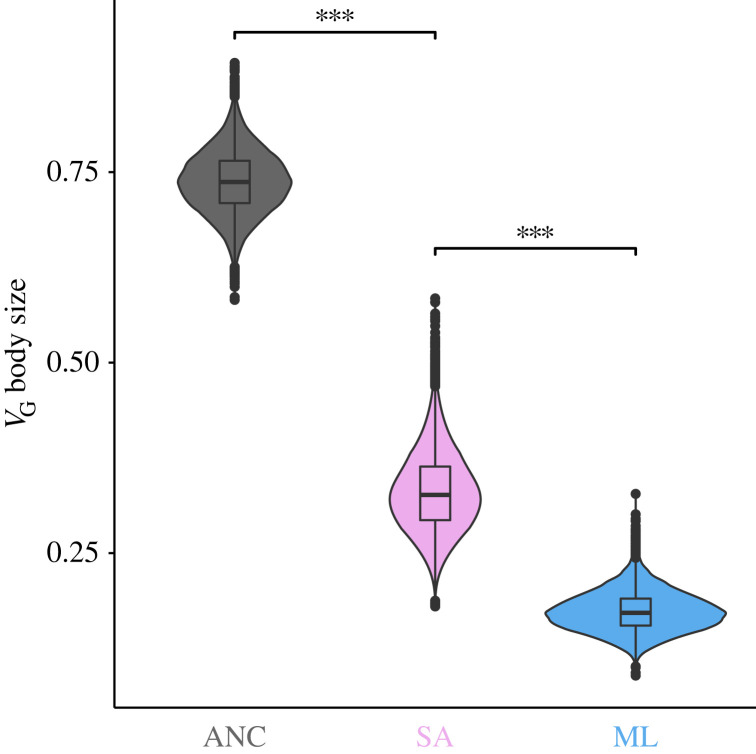
Figure 1.
Figure 1.
SA selection maintained more total genetic variance (VG) for body size (across the sexes) relative to the directional selection limited to males. Violin plots show the posterior distribution of VG in the ancestral (ANC) population and after ten generations of artificial male-limited (ML) and sexually antagonistic (SA) selection. *** = posterior difference 99.99% CI does not overlap zero. Note that replicate lines a and b are presented together because they do not significantly differ among the replicate lines within selection regimes, replicate specific comparisons are presented in electronic supplementary material, figure S6.
Figure 2.
Figure 2.
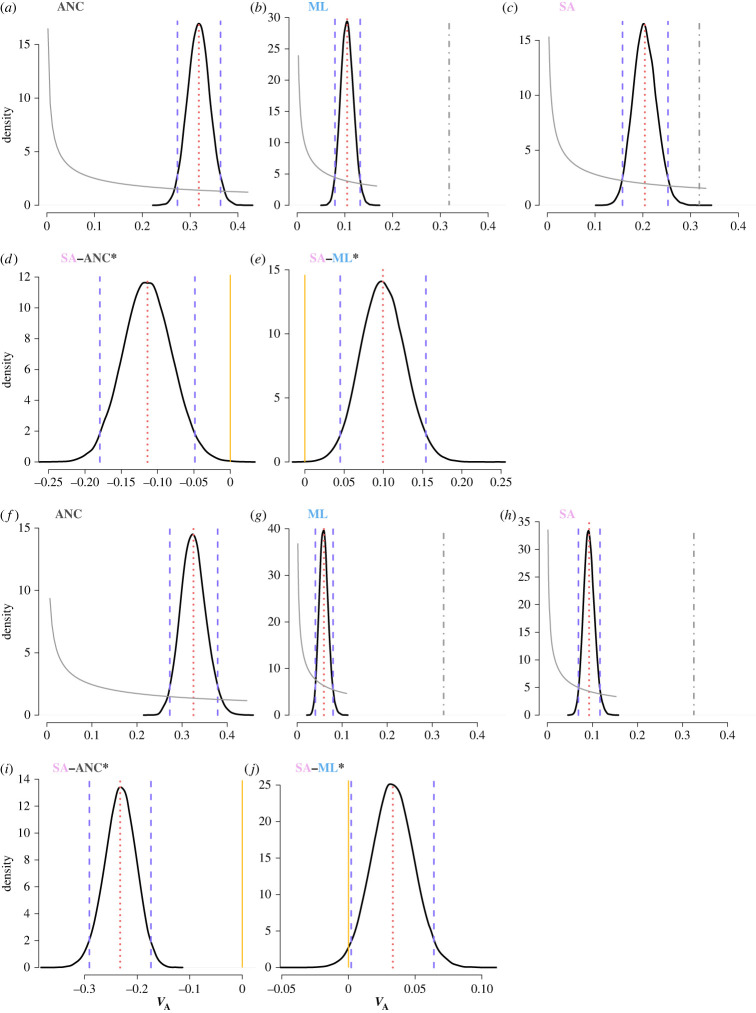
More additive genetic variance (VA) is maintained under SA selection in (a–e) females and (f–j) males. Panels (a,f) show VA in the ancestral (ANC) population, while (b,g) show the evolved patterns after ten generations of artificial male-limited (ML) and (c,h) of sexually antagonistic (SA) selection. Panels (d,i) and (e,j) show the posterior difference between SA-ANC and SA-ML. Indicated are the marginal posterior distributions (solid black lines), 95% credible intervals (vertical dashed purple lines), posterior means (vertical dotted red lines) and prior distributions (solid grey lines). In panels (b,c) we additionally show the mean variance of the ancestral population (vertical dot-dashed grey line) to guide comparison. Asterisks indicate posterior difference distributions significantly greater than zero, i.e. where the 95% credible interval does not overlap 0 (highlighted with a vertical yellow line). Note the different scales on the x-axis and y-axis between different plots.
Figure 3.
Figure 3.
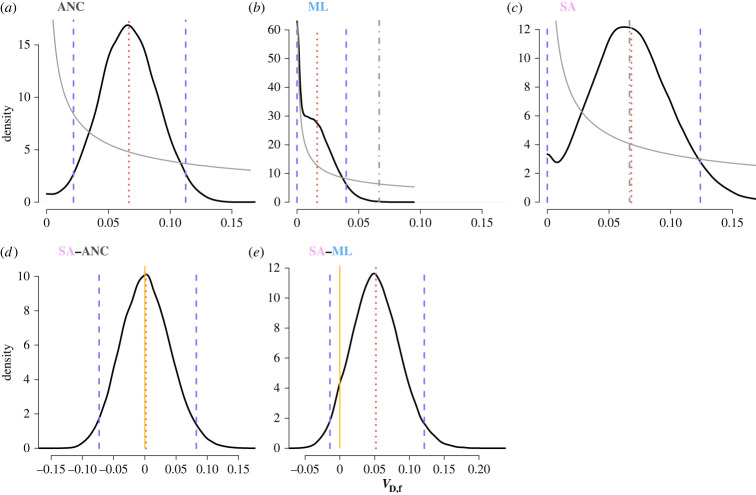
SA selection maintained more female dominance variance (VD) for body size relative to the directional selection limited to males. Marginal posterior distributions of female dominance variance in (a) the ancestral (ANC) population and in the populations after ten generations of (b) artificial male-limited (ML) and (c) sexually antagonistic (SA) selection. Panels (d) and (e) show the posterior difference between SA- ANC and SA-ML, respectively. Indicated are the marginal posterior distributions (solid black lines), 95% credible intervals (vertical dashed purple lines), posterior means (vertical dotted red lines) and prior distributions (solid grey lines). In panels (b,c) we additionally show the mean variance of the ancestral population (vertical dot-dashed grey line) to guide comparison. Asterisks indicate posterior difference distributions significantly greater than zero, i.e. where the 95% credible interval does not overlap 0 (highlighted with a vertical yellow line). Note the different scales on the x-axis and y-axis between different plots.
Figure 4.
Figure 4.
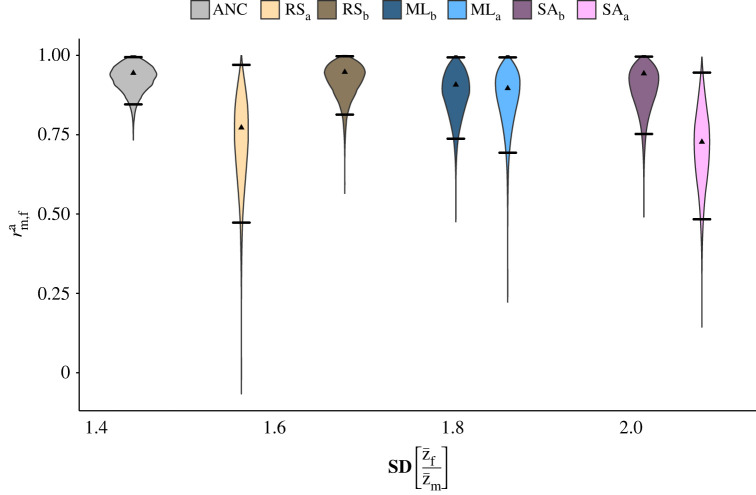
Posterior distributions of the autosomal intersexual genetic correlation plotted against the level of observed sexual dimorphism before (ANC) and after selection (RS, SA, ML). Indicated are the posterior mode (black triangle) and the 95% credible interval (horizontal, black lines).

References

    1. Barton NH, Turelli M. 1989. Evolutionary quantitative genetics: how little do we know? Annu. Rev. Genet. 23, 337-370. (10.1146/annurev.ge.23.120189.002005) - DOI - PubMed
    1. Houle D. 1989. The maintenance of polygenic variation in finite populations. Evolution (NY) 43, 1767-1780. (10.1111/j.1558-5646.1989.tb02625.x) - DOI - PubMed
    1. Mitchell-Olds T, Willis JH, Goldstein DB. 2007. Which evolutionary processes influence natural genetic variation for phenotypic traits? Nat. Rev. Genet. 8, 845-856. (10.1038/nrg2207) - DOI - PubMed
    1. Grieshop K, Arnqvist G. 2018. Sex-specific dominance reversal of genetic variation for fitness. PLoS Biol. 16, 1-21. (10.1371/journal.pbio.2006810) - DOI - PMC - PubMed
    1. Barton NH, Keightley PD. 2002. Understanding quantitative genetic variation. Nat. Rev. Genet. 3, 11-21. (10.1038/nrg700) - DOI - PubMed

Publication types