


Feeding practices, dietary adequacy, and dietary diversities among caregivers with under-five children: A descriptive cross-section study in Dodoma region, Tanzania
- PMID: 36947536
- PMCID: PMC10032515
- DOI: 10.1371/journal.pone.0283036
Feeding practices, dietary adequacy, and dietary diversities among caregivers with under-five children: A descriptive cross-section study in Dodoma region, Tanzania
Abstract
Introduction: Suboptimal feeding practices among caregivers contribute to nutritional-related health problems in children in low and middle-income countries, such as Tanzania. The continuum of the recommended feeding practices has been an utmost challenge among caregivers during the transition from health facilities to homes for improved under-five children's health.
Objective: This study assessed feeding practices, dietary diversities, and dietary adequacy among caregivers with under-five children in the Dodoma region, Tanzania.
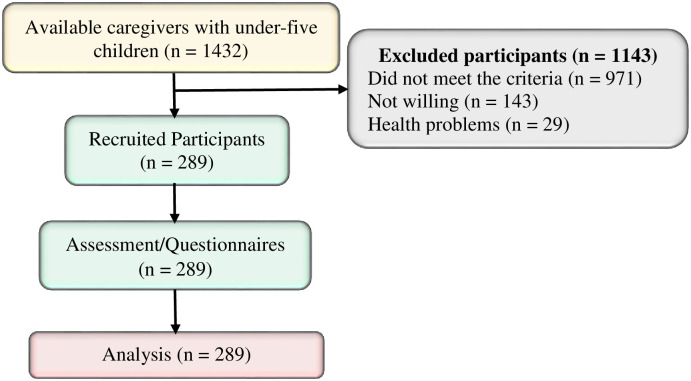
Methods: A community-based descriptive cross-sectional study in a quantitative research approach was adopted to study 289 randomly selected caregivers of under-five children in Dodoma region, Tanzania from March to August 2022. The World Health Organization Infant and Young Children Feeding Guidelines was the main data collection tool. Data were analyzed descriptively using a Statistical Package for Social Sciences computer software program version 25. Statistical limits were set at a 95% confidence interval and a 5% significance level.
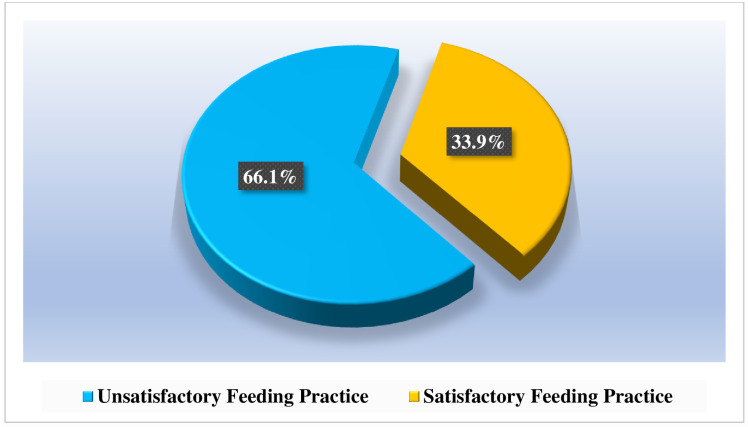
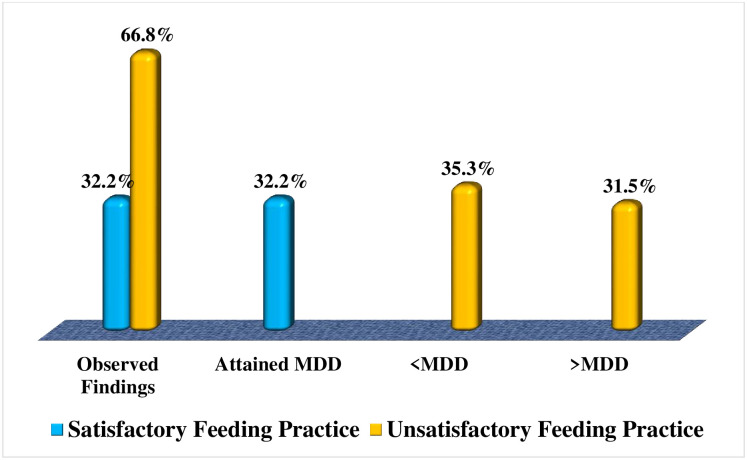
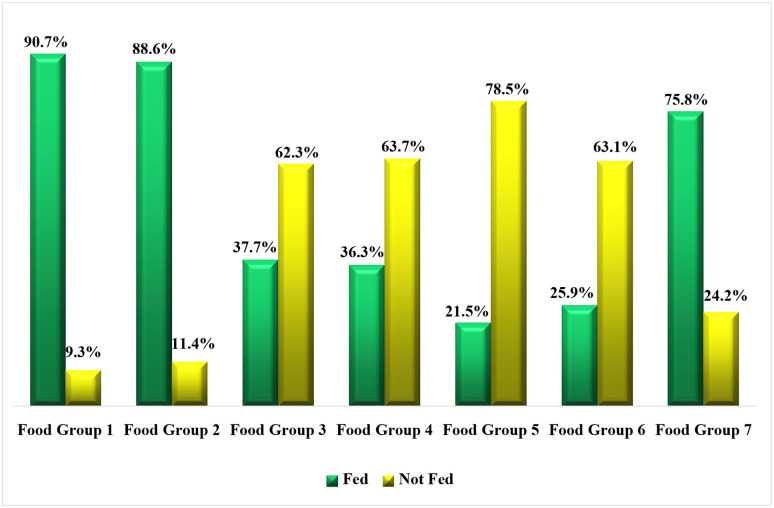
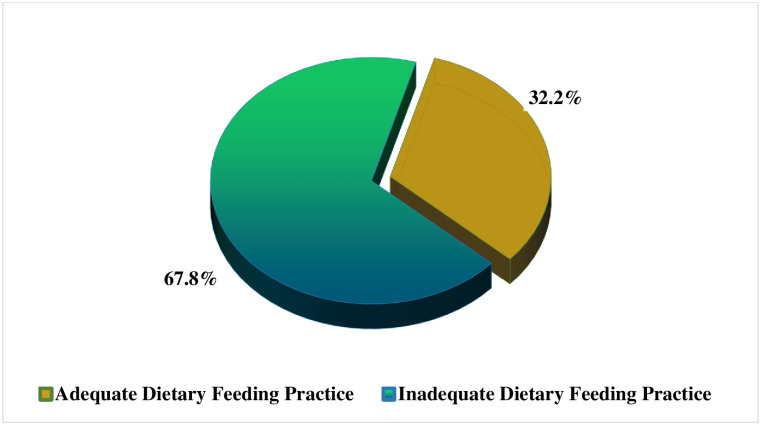
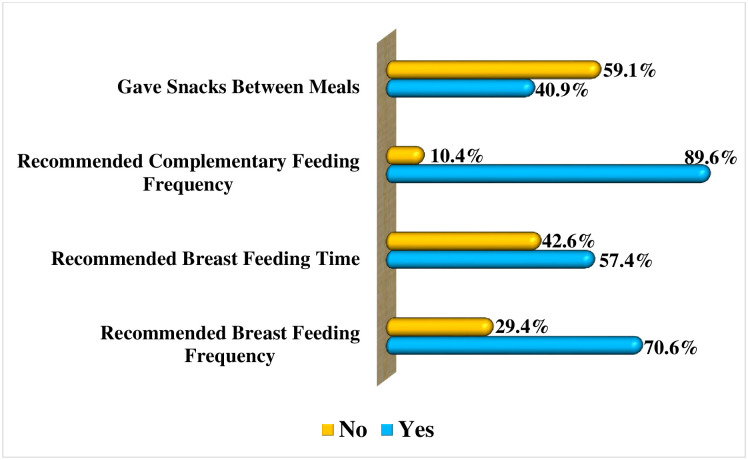
Results: Mean age was 26±6.47 of which 68.2% (n = 197) were females. Findings revealed 66.1% of caregivers had unsatisfactory feeding practices. It was observed that 67.8% of the caregivers fed their under-five children inadequately. Only 32.2% of them attained the minimum dietary diversity while 35.3% and 31.5% of caregivers demonstrated feeding practices < and > the recommended minimum Dietary diversity respectively. Moreover, 90.7% of caregivers fed their children group one food while 59.1% of them did not practice feeding the children snacks between meals. Feeding practice, dietary diversity, and dietary adequacy were significantly related to the caregiver's sex, education level, and socioeconomic status (p<0.05).
Conclusion: Under-five children are at serious risk of nutritional problems as most caregivers in this study demonstrated unsatisfactory feeding practices on dietary diversities for dietary adequacy below the world health organization recommended Minimum Dietary diversity and Minimum Meal Frequency. Community-based nutritional education programs for caregivers need to be disseminated to the community level to address the problem accordingly.
Copyright: © 2023 Millanzi et al. This is an open access article distributed under the terms of the Creative Commons Attribution License, which permits unrestricted use, distribution, and reproduction in any medium, provided the original author and source are credited.
Conflict of interest statement
NO - The authors have declared that no competing interests exist.
Figures
Similar articles
-
Meal frequency and dietary diversity feeding practices among children 6-23 months of age in Wolaita Sodo town, Southern Ethiopia.J Health Popul Nutr. 2017 May 19;36(1):18. doi: 10.1186/s41043-017-0097-x. J Health Popul Nutr. 2017. PMID: 28526058 Free PMC article.
-
Effect of inappropriate complementary feeding practices on the nutritional status of children aged 6-24 months in urban Moshi, Northern Tanzania: Cohort study.PLoS One. 2021 May 13;16(5):e0250562. doi: 10.1371/journal.pone.0250562. eCollection 2021. PLoS One. 2021. PMID: 33983950 Free PMC article.
-
Effectiveness of a nutrition education package in improving feeding practices, dietary adequacy and growth of infants and young children in rural Tanzania: rationale, design and methods of a cluster randomised trial.BMC Public Health. 2014 Oct 16;14:1077. doi: 10.1186/1471-2458-14-1077. BMC Public Health. 2014. PMID: 25318980 Free PMC article. Clinical Trial.
-
Determinants of Child Malnutrition and Infant and Young Child Feeding Approaches in Cambodia.World Rev Nutr Diet. 2016;115:61-7. doi: 10.1159/000444609. Epub 2016 May 19. World Rev Nutr Diet. 2016. PMID: 27197522 Review.
-
Dietary diversity feeding practice and its associated factors among children age 6-23 months in Ethiopia from 2011 up to 2018: a systematic review and meta-analysis.Ital J Pediatr. 2018 Sep 17;44(1):109. doi: 10.1186/s13052-018-0567-9. Ital J Pediatr. 2018. PMID: 30223854 Free PMC article.
Cited by
-
Prevalence, medication adherence, and determinants of type 2 diabetes mellitus during Coronavirus Disease 2019 pandemic among adults in Tanzania.SAGE Open Med. 2024 Mar 1;12:20503121241234222. doi: 10.1177/20503121241234222. eCollection 2024. SAGE Open Med. 2024. PMID: 38434796 Free PMC article.
-
Knowledge, attitude, intentional practice and individualized determinants of COVID-19 vaccine uptake among adults: A cross-sectional study in Tanzania.Nurs Open. 2024 May;11(5):e2171. doi: 10.1002/nop2.2171. Nurs Open. 2024. PMID: 38773765 Free PMC article.
-
What keeps children small, thin, and weak?: exploring the early childhood impacts of socioeconomic disadvantages in Pakistan.BMC Pediatr. 2025 Aug 4;25(1):598. doi: 10.1186/s12887-025-05877-1. BMC Pediatr. 2025. PMID: 40760029 Free PMC article.
-
A Cross-Sectional Survey to Measure Attitude, Self-Reported Practice, Levels, Typology, and Determinants of Lifetime Gambling Behaviors Among Undergraduate Students in Higher Training Institutions, Tanzania.J Gambl Stud. 2025 Mar;41(1):145-165. doi: 10.1007/s10899-024-10362-y. Epub 2024 Oct 30. J Gambl Stud. 2025. PMID: 39477844 Free PMC article.
-
Attitude and prevalence of early sexual debut and associated risk sexual behavior among adolescents in Tanzania; Evidence from baseline data in a Randomized Controlled Trial.BMC Public Health. 2023 Sep 9;23(1):1758. doi: 10.1186/s12889-023-16623-6. BMC Public Health. 2023. PMID: 37689638 Free PMC article. Clinical Trial.
References
-
- Rahman M, Tariqujjaman M, Ahmed T, Sarma H. Effect of home visits by community health workers on complementary feeding practices among caregivers of children aged 6–23 months in 10 districts of Bangladesh. Front Public Heal [Internet]. 2023. Jan 19 [cited 2023 Jan 19];10:5467. Available from: https://www.frontiersin.org/articles/10.3389/fpubh.2022.1014281/full - DOI - PMC - PubMed
-
- Wu Q, Helena M. Trends in complementary feeding practices and caregivers ‘ feeding knowledge among children aged 6–23 months: Repeated cross- sectional surveys in rural Qinghai China 2012–18. J Glob Health [Internet]. 2021;11(08003):1–9. Available from: doi: 10.7189/jogh.11.08003 - DOI - PMC - PubMed
-
- WHO and UNICEF. Indicators for assessing infant and young child feeding practices [Internet]. Vol. WHA55 A55/, World Health Organization and the United Nations Children’s Fund (UNICEF). 2021. 19 p. http://apps.who.int/iris/bitstream/handle/10665/44306/9789241599290_eng.....
MeSH terms
LinkOut - more resources
Full Text Sources
Medical
