. 2023 Mar 22;32(167):220159.
doi: 10.1183/16000617.0159-2022. Print 2023 Mar 31.

Supplemental oxygen and noninvasive ventilation

Affiliations

Supplemental oxygen and noninvasive ventilation

Robert L Owens et al. Eur Respir Rev. .

Abstract

The respiratory system attempts to maintain normal levels of oxygen and carbon dioxide. However, airflow limitation, parenchymal abnormalities and dysfunction of the respiratory pump may be compromised in individuals with advanced COPD, eventually leading to respiratory failure, with reduced arterial oxygen tension (hypoxaemia) and/or increased arterial carbon dioxide tension (P aCO2 ; hypercapnia). Hypoxaemia may persist in individuals with severe COPD despite smoking cessation and optimisation of pharmacotherapy. Long-term oxygen therapy (LTOT) can improve survival in those with severe daytime hypoxaemia, whereas those with less severe hypoxaemia may only have improved exercise capacity and dyspnoea. Changes in respiratory physiology that occur during sleep further predispose to hypoxaemia, particularly in individuals with COPD. However, the major cause of hypoxaemia is hypoventilation. Noninvasive ventilation (NIV) may reduce mortality and need for intubation in individuals with COPD and acute hypercapnic respiratory failure. However, NIV may also improve survival and quality of life in individuals with stable, chronic hypercapnia and is now suggested for those with prolonged hypercapnia (e.g. P aCO2 >55 mmHg 2-6 weeks after hospital discharge) when clinically stable and after optimisation of medical therapy including LTOT if indicated. Many questions remain about the optimal mode, settings and goal of NIV therapy.


Conflict of interest statement

Conflict of interest: R.L. Owens has received grant NIH/NHLBI R01HL142114 paid to his institution, outside the submitted work. The remaining authors have nothing to disclose.

Figures
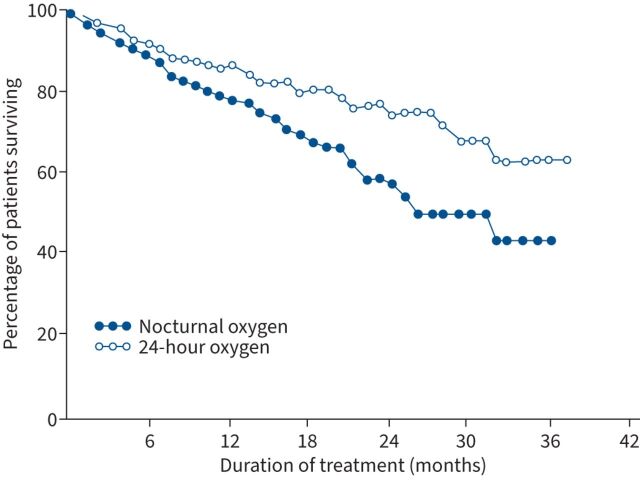
FIGURE 1
FIGURE 1
Overall mortality in the Nocturnal Oxygen Treatment Trial study [30]. Ordinate is fraction of individuals surviving; abscissa is time from randomisation or duration of treatment. Open circles represent the continuous oxygen therapy group, closed circles represent the nocturnal oxygen therapy group. Of the total group, 80 nocturnal and 87 continuous O2 therapy individuals were followed for 12 months, and 29 nocturnal and 37 continuous O2 therapy individuals were followed for 24 months. Reproduced and modified from [30] with permission.
FIGURE 2
FIGURE 2
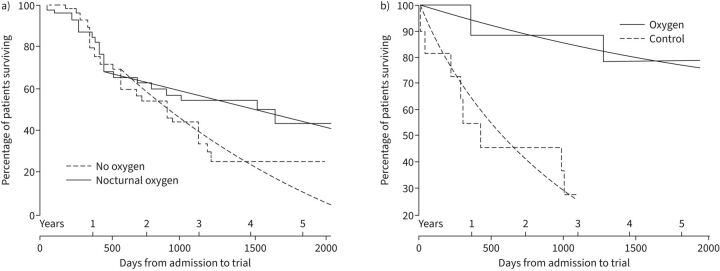
Mortality in a) male and b) female individuals in the Medical Research Council study [29]. Smooth curves indicate expected proportions surviving from 500 days, at constant risk of 11.9% per annum for those on oxygen and 29% per annum for controls (males) and of 5.7% per annum for those on oxygen and 36.5% per annum for controls (females). Reproduced and modified from [29] with permission.
FIGURE 3
FIGURE 3
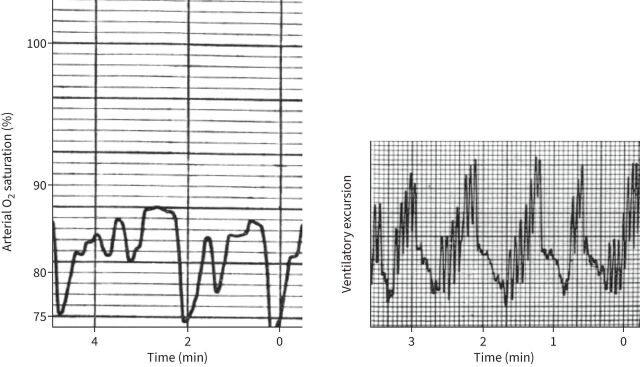
Example of nocturnal oxygen desaturation, with evidence of hypoventilation as the cause. Reproduced from [63] with permission.
FIGURE 4
FIGURE 4
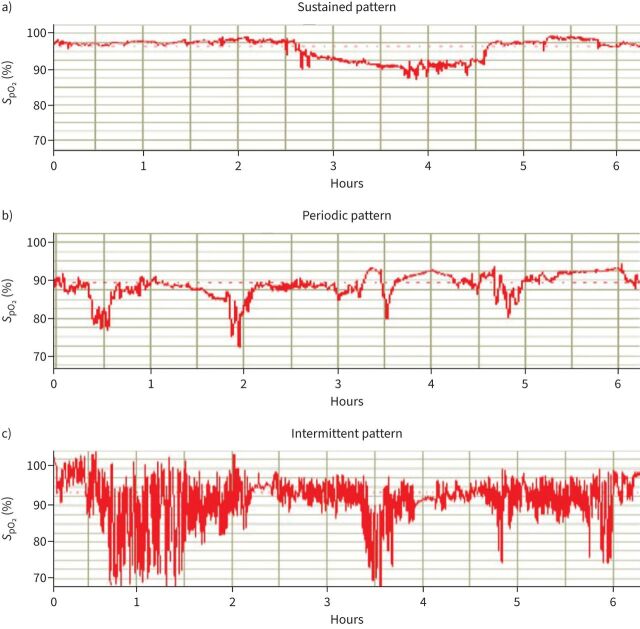
Overnight oximetry patterns: a) sustained, b) periodic and c) intermittent. The intermittent pattern has been suggested to be specific for obstructive sleep apnoea, while the other patterns are thought to be more consistent with COPD. However, the data are more mixed (see text). Reproduced and modified from [85] with permission. SpO2: oxygen saturation measured by pulse oximetry.

Comment in

  • Nonpharmacological interventions in COPD.
    Janssens W, Verleden GM. Janssens W, et al. Eur Respir Rev. 2023 Mar 22;32(167):230028. doi: 10.1183/16000617.0028-2023. Print 2023 Mar 31. Eur Respir Rev. 2023. PMID: 36948503 Free PMC article.

References

    1. Tashkin DP, Celli B, Senn S, et al. A 4-year trial of tiotropium in chronic obstructive pulmonary disease. N Engl J Med 2008; 359: 1543–1554. doi: 10.1056/NEJMoa0805800 - DOI - PubMed
    1. Martinez FJ, Foster G, Curtis JL, et al. Predictors of mortality in patients with emphysema and severe airflow obstruction. Am J Respir Crit Care Med 2006; 173: 1326–1334. doi: 10.1164/rccm.200510-1677OC - DOI - PMC - PubMed
    1. Franssen FM, O'Donnell DE, Goossens GH, et al. Obesity and the lung: 5. Obesity and COPD. Thorax 2008; 63: 1110–1117. doi: 10.1136/thx.2007.086827 - DOI - PubMed
    1. Bradley CA, Fleetham JA, Anthonisen NR. Ventilatory control in patients with hypoxemia due to obstructive lung disease. Am Rev Respir Dis 1979; 120: 21–30. doi: 10.1164/arrd.1979.120.1.21 - DOI - PubMed
    1. Spece LJ, Epler EM, Duan K, et al. Reassessment of home oxygen prescription after hospitalization for chronic obstructive pulmonary disease. A potential target for deimplementation. Ann Am Thorac Soc 2021; 18: 426–432. doi: 10.1513/AnnalsATS.202004-364OC - DOI - PMC - PubMed

MeSH terms