. 2023 Mar 22;9(1):16.
doi: 10.1038/s41523-023-00517-2.

Predicting breast cancer types on and beyond molecular level in a multi-modal fashion

Affiliations

Predicting breast cancer types on and beyond molecular level in a multi-modal fashion

Tianyu Zhang et al. NPJ Breast Cancer. .

Abstract

Accurately determining the molecular subtypes of breast cancer is important for the prognosis of breast cancer patients and can guide treatment selection. In this study, we develop a deep learning-based model for predicting the molecular subtypes of breast cancer directly from the diagnostic mammography and ultrasound images. Multi-modal deep learning with intra- and inter-modality attention modules (MDL-IIA) is proposed to extract important relations between mammography and ultrasound for this task. MDL-IIA leads to the best diagnostic performance compared to other cohort models in predicting 4-category molecular subtypes with Matthews correlation coefficient (MCC) of 0.837 (95% confidence interval [CI]: 0.803, 0.870). The MDL-IIA model can also discriminate between Luminal and Non-Luminal disease with an area under the receiver operating characteristic curve of 0.929 (95% CI: 0.903, 0.951). These results significantly outperform clinicians' predictions based on radiographic imaging. Beyond molecular-level test, based on gene-level ground truth, our method can bypass the inherent uncertainty from immunohistochemistry test. This work thus provides a noninvasive method to predict the molecular subtypes of breast cancer, potentially guiding treatment selection for breast cancer patients and providing decision support for clinicians.


Conflict of interest statement

The authors declare no competing interests.

Figures
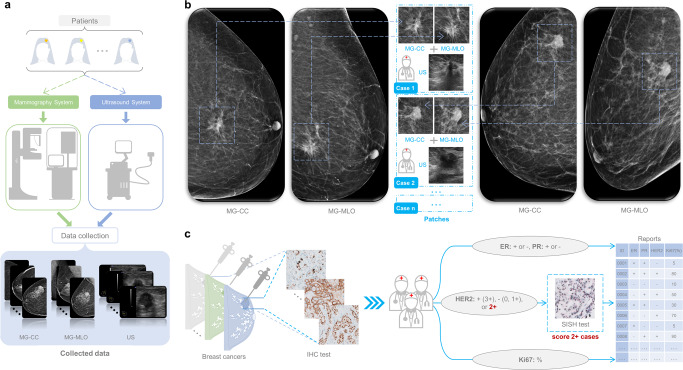
Fig. 1
Fig. 1. Workflow diagrams.
a Data collection for mammography and ultrasound. b Examples of extracting patches for the lesion locations by the dedicated breast radiologists. c Test procedure for expression levels of all indicators. MG mammography, CC craniocaudal, MLO mediolateral oblique, US ultrasound, IHC immunohistochemistry, ER estrogen receptor, PR progesterone receptor, HER2 human epidermal growth factor receptor 2, SISH silver-enhanced in situ hybridization.
Fig. 2
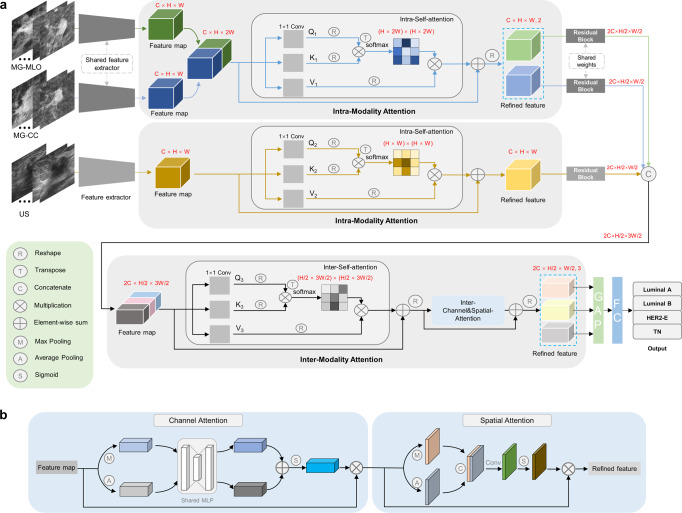
Fig. 2. The scheme for this work.
a The proposed multi-modal deep learning with intra- and inter-modality attention model. b The structure of channel and spatial attention. C channel, H height, W width, Q query, K key, V value, MG mammography, US ultrasound, MLO mediolateral oblique view, CC craniocaudal view, GAP global average pooling, FC fully-connected layer, HER2-E HER2-enriched, TN triple-negative.
Fig. 3
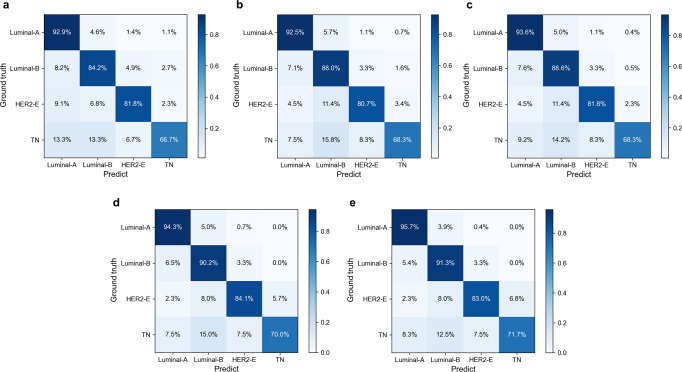
Fig. 3. The normalized confusion matrix for the prediction of 4-category molecular subtypes of breast cancer by different models in the test cohort (n = 672).
a–e Multi-ResNet, MulR-interSA, MulR-iiSA, MulR-interCSA, and proposed MDL-IIA models. MulR Multi-ResNet, SA self-attention, iiSA intra- and inter-self-attention, CSA channel and spatial attention, interSA inter self-attention, interCSA inter channel and spatial attention, MDL-IIA multi-modal deep learning with intra- and inter-modality attention modules, HER2-E HER2-enriched, TN triple-negative.
Fig. 4
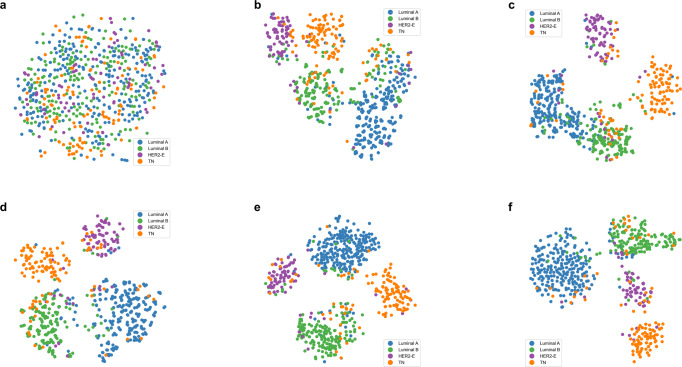
Fig. 4. The visualization results of t-SNE for the task of predicting 4-category molecular subtypes of breast cancer in the test cohort (n = 672).
a–f Original test dataset, Multi-ResNet, MulR-interSA, MulR-iiSA, MulR-interCSA, and proposed MDL-IIA models. MulR Multi-ResNet, SA self-attention, iiSA intra- and inter-self-attention, CSA channel and spatial attention, interSA inter self-attention, interCSA inter channel and spatial attention, MDL-IIA multi-modal deep learning with intra- and inter-modality attention modules, HER2-E HER2-enriched, TN triple-negative.
Fig. 5
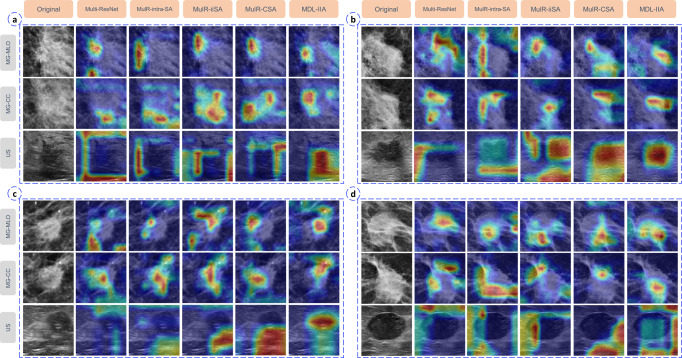
Fig. 5. The visualization based on Gradient-weighted Class Activation Mapping (Grad-CAM) method of the proposed model in predicting 4-category molecular subtypes of breast cancer.
Case ad indicate the category of Luminal A, Luminal B, HER2-enriched and Triple-negative, respectively. MG mammography, CC craniocaudal, MLO mediolateral oblique, US ultrasound, MulR Multi-ResNet, SA self-attention, iiSA intra- and inter-self-attention, CSA channel and spatial attention, interSA inter self-attention, interCSA inter channel and spatial attention, MDL-IIA multi-modal deep learning with intra- and inter-modality attention modules.
Fig. 6
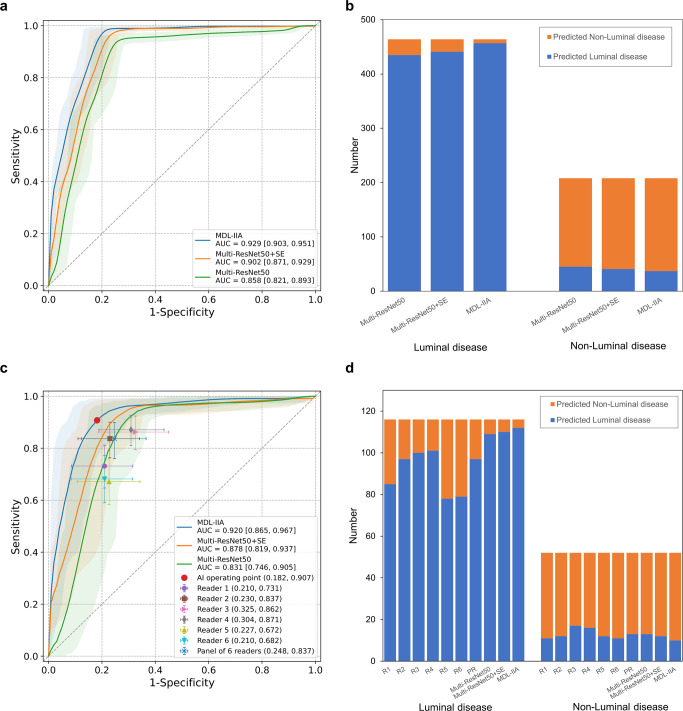
Fig. 6. Performance of the proposed MDL-IIA model and radiologists.
a The receiver operating characteristic (ROC) curve for distinguishing between Luminal disease and Non-Luminal disease by the proposed MDL-IIA model in the test cohort (n = 672). b The classification performance of the proposed MDL-IIA model in the test cohort (n = 672). c The ROC curve for distinguishing between Luminal disease and Non-Luminal disease by the proposed MDL-IIA model and the operating points of six radiologists in the observer study cohort (n = 168). d The classification performance of the proposed MDL-IIA model and six radiologists in the observer study cohort (n = 168). The 95% confidence intervals are shown as a shaded area for the ROC curve. MDL-IIA, multi-modal deep learning with intra- and inter-modality attention modules. Multi-ResNet50, multi-modal ResNet50 model. SE Squeeze-and-Excitation, PR panel of 6 readers, AI artificial intelligence, AUC area under the ROC curve.

References

    1. Sung H, et al. Global cancer statistics 2020: GLOBOCAN estimates of incidence and mortality worldwide for 36 cancers in 185 countries. CA Cancer J. Clinicians. 2021;71:209–249. doi: 10.3322/caac.21660. - DOI - PubMed
    1. Zardavas D, Irrthum A, Swanton C, Piccart M. Clinical management of breast cancer heterogeneity. Nat. Rev. Clin. Oncol. 2015;12:381–394. doi: 10.1038/nrclinonc.2015.73. - DOI - PubMed
    1. Marchiò C, et al. Evolving concepts in HER2 evaluation in breast cancer: Heterogeneity, HER2-low carcinomas and beyond. Semin. Cancer Biol. 2021;72:123–135. doi: 10.1016/j.semcancer.2020.02.016. - DOI - PubMed
    1. Sadeghalvad M, Mohammadi-Motlagh H-R, Rezaei N. Immune microenvironment in different molecular subtypes of ductal breast carcinoma. Breast Cancer Res. Treat. 2021;185:261–279. doi: 10.1007/s10549-020-05954-2. - DOI - PubMed
    1. Turner KM, Yeo SK, Holm TM, Shaughnessy E, Guan J-L. Heterogeneity within molecular subtypes of breast cancer. Am. J. Physiol. Cell Physiol. 2021;321:C343–C354. doi: 10.1152/ajpcell.00109.2021. - DOI - PMC - PubMed