


What is the impact of post-COVID-19 syndrome on health-related quality of life and associated factors: a cross-sectional analysis
- PMID: 36949439
- PMCID: PMC10031164
- DOI: 10.1186/s12955-023-02107-z
What is the impact of post-COVID-19 syndrome on health-related quality of life and associated factors: a cross-sectional analysis
Abstract
Background: After the acute phase, symptoms or sequelae related to post-COVID-19 syndrome may persist for months. In a population of patients, previously hospitalized and not, followed up to 12 months after the acute infection, we aim to assess whether and to what extent post-COVID-19 syndrome may have an impact on health-related quality of life (HRQoL) and to investigate influencing factors.
Methods: We present the cross-sectional analysis of a prospective study, including patients referred to the post-COVID-19 service. Questionnaires and scales administered at 3, 6, 12 months were: Short-Form 36-item questionnaire (SF-36); Visual Analogue Scale of the EQ5D (EQ-VAS); in a subgroup, Beck Anxiety Inventory (BAI), Beck Depression Inventory (BDI-II) and Pittsburgh Sleep Quality Index (PSQI). Linear regression models were fitted to identify factors associated with HRQoL.
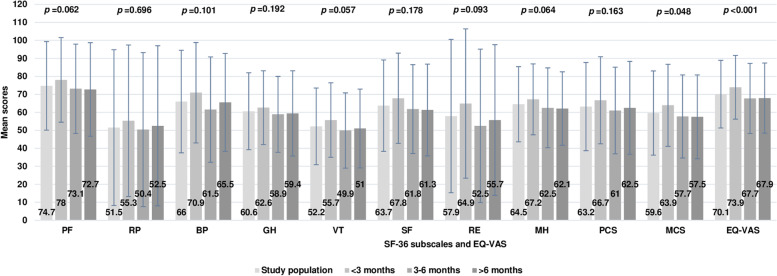
Results: We considered the first assessment of each participant (n = 572). The mean scores in SF-36 and in EQ-VAS were significantly lower than the Italian normative values and remained stable over time, except the mental components score (MCS) of the SF-36 and EQ-VAS which resulted in lower ratings at the last observations. Female gender, presence of comorbidities, and corticosteroids treatment during acute COVID-19, were associated with lower scores in SF-36 and EQ-VAS; patients previously hospitalized (54%) reported higher MCS. Alterations in BAI, BDI-II, and PSQI (n = 265)were associated with lower ratings in SF-36 and EQ-VAS.
Conclusions: This study provides evidence of a significantly bad perception of health status among persons with post-COVID-19 syndrome, associated with female gender and, indirectly, with disease severity. In case of anxious-depressive symptoms and sleep disorders, a worse HRQoL was also reported. A systematic monitoring of these aspects is recommended to properly manage the post-COVID-19 period.
Keywords: Health-related quality of life; Long COVID; Mental health; Neuropsychiatric symptoms; Physical health; Post-COVID-19 condition; Post-COVID-19 syndrome; Post-acute sequelae of COVID-19 infection (PASC); Sleep disorders; The Short-Form 36-item questionnaire.
© 2023. The Author(s).
Conflict of interest statement
The authors declare no competing interests.
Figures
References
-
- National Institute for Health and Care Excellence (NICE), Scottish Intercollegiate Guidelines Network (SIGN) and Royal College of General Practitioners (RCGP) (2022, March 01). COVID19 rapid guideline: managing the long-term effects of COVID19. Retrieved May 15, 2022, from https://www.nice.org.uk/guidance/ng188/resources/covid19-rapid-guideline... (2022).
-
- The World Health Organization Quality of Life Assessment (WHOQOL): development and general psychometric properties. Social science & medicine, 46(12), 1569–1585. 10.1016/s0277-9536(98)00009-4 (1998). - PubMed
-
- Rajan, S., et al. In the wake of the pandemic: Preparing for Long COVID. European Observatory on Health Systems and Policies. Retrieved May 15, 2022, from https://apps.who.int/iris/bitstream/handle/10665/339629/Policy-brief-39-... (2022). - PubMed
MeSH terms
LinkOut - more resources
Full Text Sources
Medical
Research Materials
