


Comment
doi: 10.1177/17588359231156393.
eCollection 2023.
Time for a lead-time definition? Author response to 'Why the length of recurrence free survival or "lead-times" can be misleading. Comment on: Callesen LB, Takacova T, Hamfjord J, et al. Circulating DNA in patients undergoing loco-regional treatment of colorectal cancer metastases: a systematic review and meta-analysis'
Affiliations
- PMID: 36950273
- PMCID: PMC10026177
- DOI: 10.1177/17588359231156393
Item in Clipboard
Comment
Time for a lead-time definition? Author response to 'Why the length of recurrence free survival or "lead-times" can be misleading. Comment on: Callesen LB, Takacova T, Hamfjord J, et al. Circulating DNA in patients undergoing loco-regional treatment of colorectal cancer metastases: a systematic review and meta-analysis'
Ther Adv Med Oncol.
.
No abstract available
Conflict of interest statement
The authors declare that there is no conflict of interest.
Figures
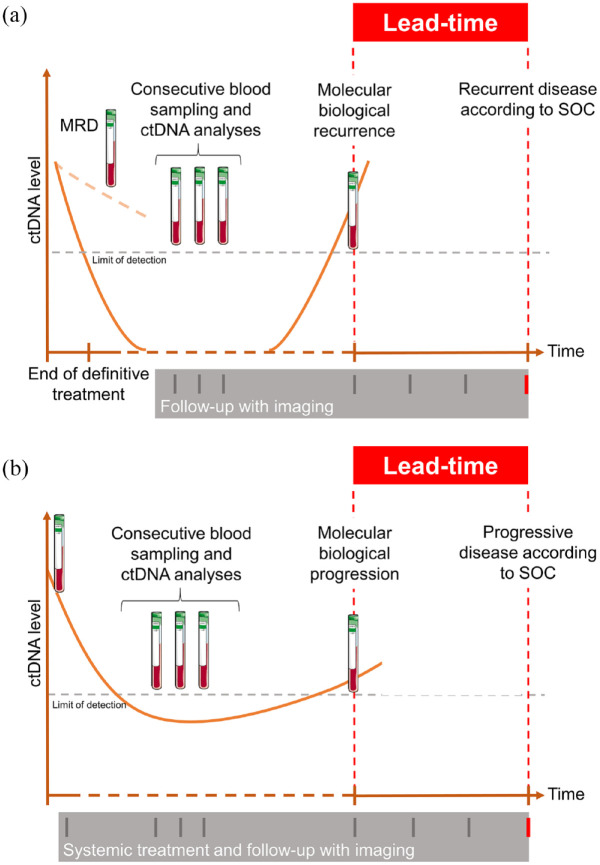
Schematic overview of definition of lead-time in the curative
(a) and palliative (b) setting. Clinical lead-time can be defined as the time between blood-based detected and
clinical-detected recurrence/progression. The biological lead-time can only be
defined if scans and blood samples are done at the same time. MRD, minimal residual disease; SOC, standard of care.
Comment on
-
Circulating DNA in patients undergoing loco-regional treatment of colorectal cancer metastases: a systematic review and meta-analysis.Ther Adv Med Oncol. 2022 Nov 2;14:17588359221133171. doi: 10.1177/17588359221133171. eCollection 2022. Ther Adv Med Oncol. 2022. PMID: 36339929 Free PMC article. Review.
References
-
- Garcia-Murillas I, Schiavon G, Weigelt B, et al. Mutation tracking in circulating tumor DNA predicts relapse in early breast cancer. Sci Transl Med 2015; 7: 302ra133. - PubMed
-
- Reinert T, Schøler L V., Thomsen R, et al. . Analysis of circulating tumour DNA to monitor disease burden following colorectal cancer surgery. Gut 2016; 65: 625–634. - PubMed
Publication types
LinkOut - more resources
Full Text Sources
