. 2023 Sep 18;108(10):2635-2642.
doi: 10.1210/clinem/dgad137.

Micronutrient Supplementation and Bone Health After Prophylactic Total Gastrectomy in Patients With CDH1 Variants

Affiliations

Micronutrient Supplementation and Bone Health After Prophylactic Total Gastrectomy in Patients With CDH1 Variants

Lauren A Gamble et al. J Clin Endocrinol Metab. .

Abstract

Introduction: Patients with germline variants in CDH1 who undergo prophylactic total gastrectomy (TG) are at risk of altered nutrient and drug absorption due to modified gastrointestinal anatomy. Bone mineral density loss and micronutrient deficiencies have not been described previously in this patient population.

Methods: In this study we included 94 patients with germline CDH1 variants who underwent prophylactic TG between October 2017 and February 2022. We examined pre- and post-gastrectomy bone mineral density (BMD); serum biomarkers including calcium, phosphorus, alkaline phosphatase, and 25 (OH)-vitamin D; and postoperative adherence to calcium and multivitamin supplementation.

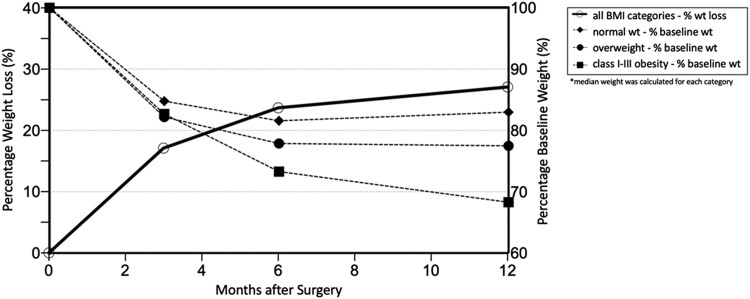
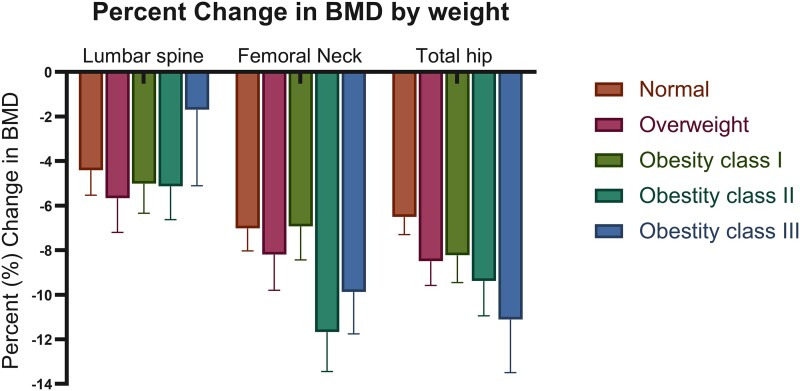
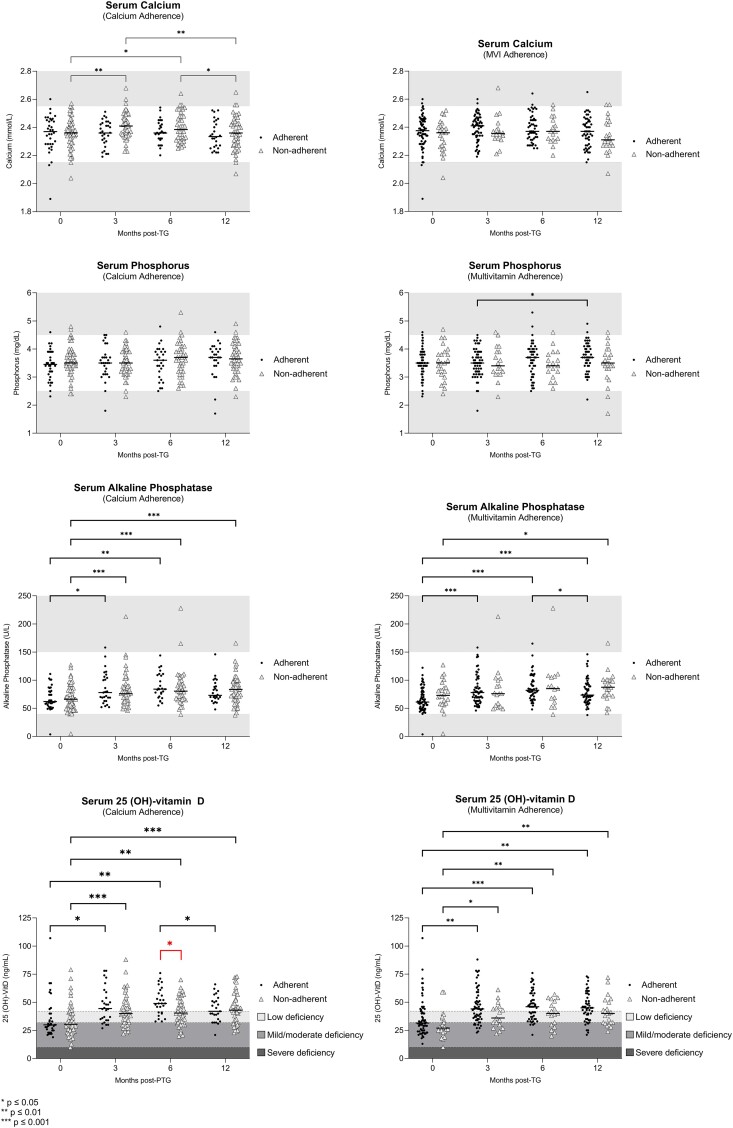
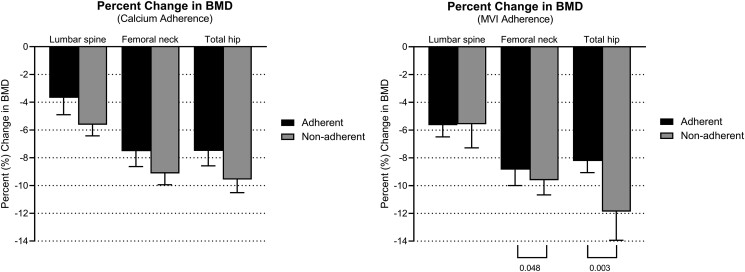
Results: Almost all patients (92/94, 98%) lost a substantial amount of weight post-TG, with an average weight loss of 26.5% at 12 months post-surgery. Serum biomarkers of mineral metabolism, namely calcium and phosphorus, did not change significantly after TG. However, average BMD was decreased in all patients at 12 months post-TG. Nonadherence to calcium supplementation was associated with a decrease in BMD. Nonadherence to multivitamin supplementation was associated with greater percent BMD loss in the femoral neck and total hip.

Conclusions: Appropriate micronutrient supplementation and nutritional counseling pre- and postoperatively in patients undergoing prophylactic TG are important to mitigate the long-term effects of gastrectomy on bone health.

Trial registration: ClinicalTrials.gov NCT03030404.

Keywords: bone health; micronutrient supplementation; prophylactic total gastrectomy.


Figures

Figure 1.
Figure 1.
Percent weight loss and percent baseline weight following prophylactic total gastrectomy.
Figure 2.
Figure 2.
Percent change in bone mineral density from baseline to 12 months post-total gastrectomy by baseline patient weight class. Number of patients varied in each weight class: patients with normal BMI (18.5-24.9 kg/m2) n = 17, overweight BMI (25-29.9 kg/m2) n = 22, obesity class I (30-34.9 kg/m2) n = 17, obesity class II (35-39.9 kg/m2), n = 11 and obesity class III (≥40 kg/m2) n = 6. BMD values are calculated as mean ± SE. Abbreviations: BMD, bone mineral density. BMI, body mass index.
Figure 3.
Figure 3.
Micronutrient serum levels for each patient at baseline, 3, 6, and 12 months following total gastrectomy according to supplementation adherence. Horizontal bars indicate median values. Grey areas represent values outside of normal range. Number of patients varied by serum biomarker and time point due to incomplete data. For serum calcium levels: patient samples were n = 92 at baseline, n = 79 at 3 months, n = 68 at 6 months, and n = 73 at 12 months. For serum phosphorus levels: patient samples were n = 92 at baseline, n = 79 at 3 months, n = 67 at 6 months, and n = 73 at 12 months. For serum alkaline phosphatase levels: patient samples were n = 92 at baseline, n = 77 at 3 months, n = 65 at 6 months, and n = 73 at 12 months. For serum 25 (OH)-vitamin D levels: patient samples were n = 92 at baseline, n = 78 at 3 months, n = 70 at 6 months, and n = 72 at 12 months.
Figure 4.
Figure 4.
Percent changes in bone mineral density from baseline to 12 months post-total gastrectomy (n = 71). BMD values are calculated as mean ± SE. Abbreviations: BMD, bone mineral density.

References

    1. Blair VR, McLeod M, Carneiro F, et al. . Hereditary diffuse gastric cancer: updated clinical practice guidelines. Lancet Oncol. 2020;21(8):e386‐e397. Doi: 10.1016/S1470-2045(20)30219-9 - DOI - PMC - PubMed
    1. Xicola RM, Li S, Rodriguez N, et al. . Clinical features and cancer risk in families with pathogenic CDH1 variants irrespective of clinical criteria. J Med Genet. 2019;56(12):838‐843. Doi: 10.1136/jmedgenet-2019-105991 - DOI - PubMed
    1. Roberts ME, Ranola JMO, Marshall ML, et al. . Comparison of CDH1 penetrance estimates in clinically ascertained families vs families ascertained for multiple Gastric cancers. JAMA Oncol. 2019;5(9):1325‐1331. Doi: 10.1001/jamaoncol.2019.1208 - DOI - PMC - PubMed
    1. Haverkamp L, Weijs TJ, van der Sluis PC, van der Tweel I, Ruurda JP, van Hillegersberg R. Laparoscopic total gastrectomy versus open total gastrectomy for cancer: a systematic review and meta-analysis. Surg Endosc. 2013;27(5):1509‐1520. Doi: 10.1007/s00464-012-2661-1 - DOI - PubMed
    1. Brocks DR, Ben-Eltriki M, Gabr RQ, Padwal RS. The effects of gastric bypass surgery on drug absorption and pharmacokinetics. Expert Opin Drug Metab Toxicol. 2012;8(12):1505‐1519. Doi: 10.1517/17425255.2012.722757 - DOI - PubMed

Publication types

Associated data