Review
. 2022 Dec 21;10(6):e2200106.
doi: 10.9745/GHSP-D-22-00106. Print 2022 Dec 21.

Living Safely With Bats: Lessons in Developing and Sharing a Global One Health Educational Resource

Affiliations
Review

Living Safely With Bats: Lessons in Developing and Sharing a Global One Health Educational Resource

Stephanie Martinez et al. Glob Health Sci Pract. .

Abstract

As part of a public health behavior change and communication strategy related to the identification of a novel ebolavirus in bats in Sierra Leone in 2016, a consortium of experts launched an effort to create a widely accessible resource for community awareness and education on reducing disease risk. The resulting picture book, Living Safely With Bats, includes technical content developed by a consortium of experts in public health, animal health, conservation, bats, and disease ecology from 30 countries. The book has now been adapted, translated, and used in more than 20 countries in Africa and Asia. We review the processes used to integrate feedback from local stakeholders and multidisciplinary experts. We also provide recommendations for One Health and other practitioners who choose to pursue the development and evaluation of this or similar zoonotic disease risk mitigation tools.


Figures

FIGURE 1
FIGURE 1
Map of One Health Collaboration for Developing Living Safely With Bats Book Included Teams From 30 Participating Countries
FIGURE 2
FIGURE 2
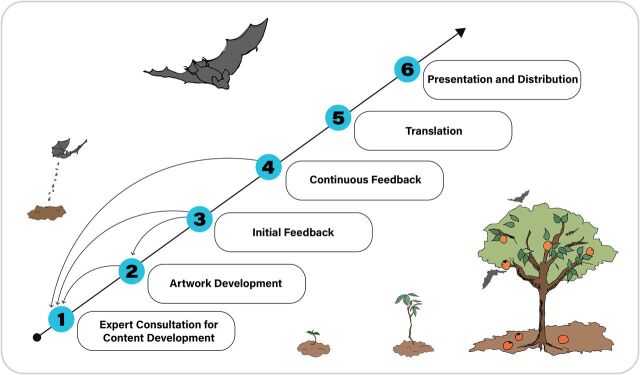
Key Steps in the Global Collaboration and Development of Living Safely With Bats Book
FIGURE 3
FIGURE 3
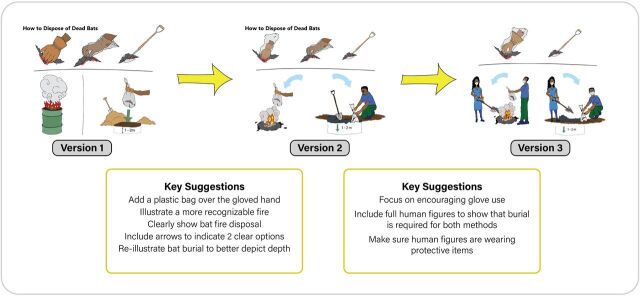
Incorporating Stakeholder Feedback Through an Iterative Content Development Process for Living Safely With Bats Book
FIGURE 4
FIGURE 4
Example of Progression From Reference Photo of Guano Harvesting Structure in Vietnama (A) to Hand-Drawn Outline (B) to Final Illustration (C) to Create Images Used in Living Safely With Bats Book aPhoto credit: 2013 PREDICT Vietnam/Wildlife Conservation Society.
FIGURE 5
FIGURE 5
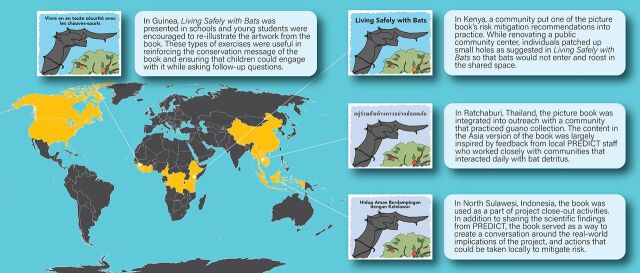
Map of Distribution of Living Safely With Bats in 20 Countries and How It Was Used in Guinea, Indonesia, Kenya, and Thailand

References

    1. Smith KM, Machalaba CC, Seifman R, Feferholtz Y, Karesh WB. Infectious disease and economics: the case for considering multi-sectoral impacts. One Health. 2019;7:100080. 10.1016/j.onehlt.2018.100080. - DOI - PMC - PubMed
    1. Taylor LH, Latham SM, Woolhouse MEJ. Risk factors for human disease emergence. Philos Trans R Soc Lond B Biol Sci. 2001;356(1411):983–989. 10.1098/rstb.2001.0888. - DOI - PMC - PubMed
    1. Morse SS, Mazet JAK, Woolhouse M, et al. . Prediction and prevention of the next pandemic zoonosis. Lancet. 2012;380(9857):1956–1965. 10.1016/S0140-6736(12)61684-5. - DOI - PMC - PubMed
    1. Plowright RK, Parrish CR, McCallum H, et al. . Pathways to zoonotic spillover. Nat Rev Microbiol. 2017;15(8):502–510. 10.1038/nrmicro.2017.45. - DOI - PMC - PubMed
    1. Narat V, Alcayna-Stevens L, Rupp S, Giles-Vernick T. Rethinking human–nonhuman primate contact and pathogenic disease spillover. EcoHealth. 2017;14(4):840–850. 10.1007/s10393-017-1283-4. - DOI - PubMed

Publication types