Risk Factors Associated With Post-COVID-19 Condition: A Systematic Review and Meta-analysis
- PMID: 36951832
- PMCID: PMC10037203
- DOI: 10.1001/jamainternmed.2023.0750
Risk Factors Associated With Post-COVID-19 Condition: A Systematic Review and Meta-analysis
Abstract
Importance: Post-COVID-19 condition (PCC) is a complex heterogeneous disorder that has affected the lives of millions of people globally. Identification of potential risk factors to better understand who is at risk of developing PCC is important because it would allow for early and appropriate clinical support.
Objective: To evaluate the demographic characteristics and comorbidities that have been found to be associated with an increased risk of developing PCC.
Data sources: Medline and Embase databases were systematically searched from inception to December 5, 2022.
Study selection: The meta-analysis included all published studies that investigated the risk factors and/or predictors of PCC in adult (≥18 years) patients.
Data extraction and synthesis: Odds ratios (ORs) for each risk factor were pooled from the selected studies. For each potential risk factor, the random-effects model was used to compare the risk of developing PCC between individuals with and without the risk factor. Data analyses were performed from December 5, 2022, to February 10, 2023.
Main outcomes and measures: The risk factors for PCC included patient age; sex; body mass index, calculated as weight in kilograms divided by height in meters squared; smoking status; comorbidities, including anxiety and/or depression, asthma, chronic kidney disease, chronic obstructive pulmonary disease, diabetes, immunosuppression, and ischemic heart disease; previous hospitalization or ICU (intensive care unit) admission with COVID-19; and previous vaccination against COVID-19.
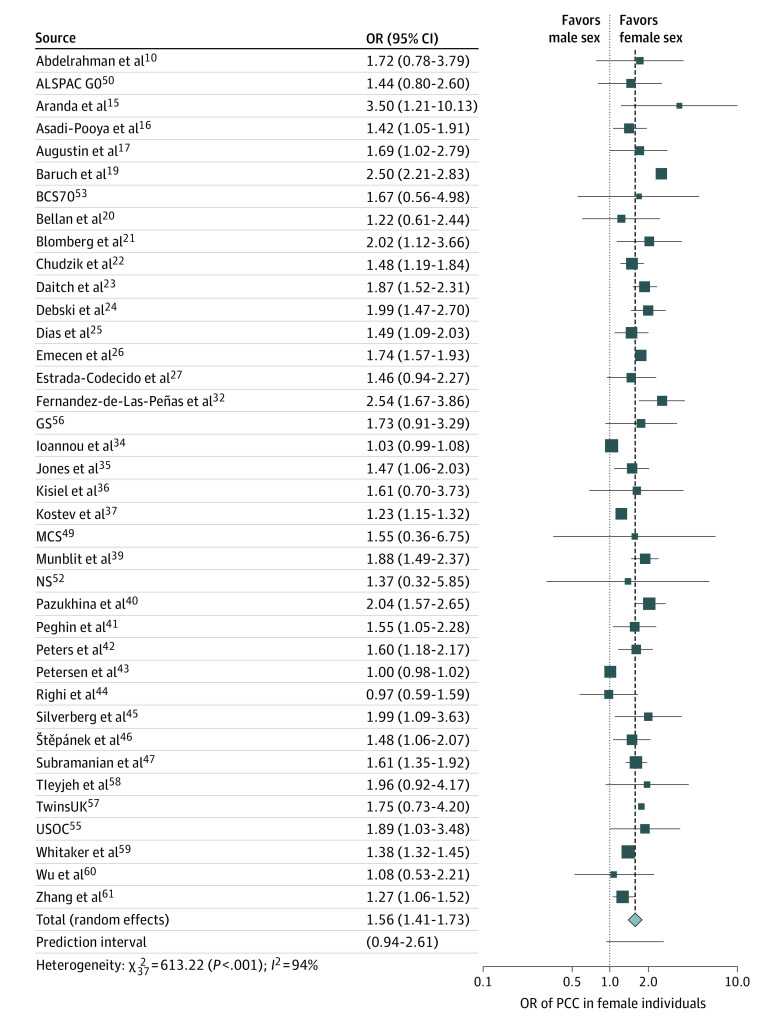
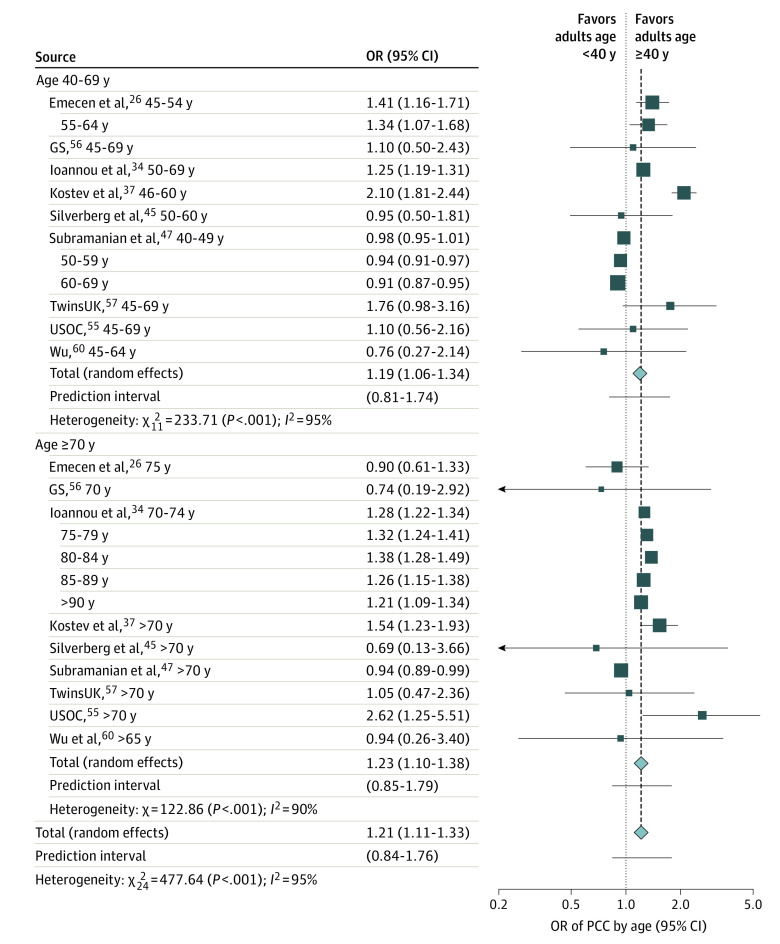
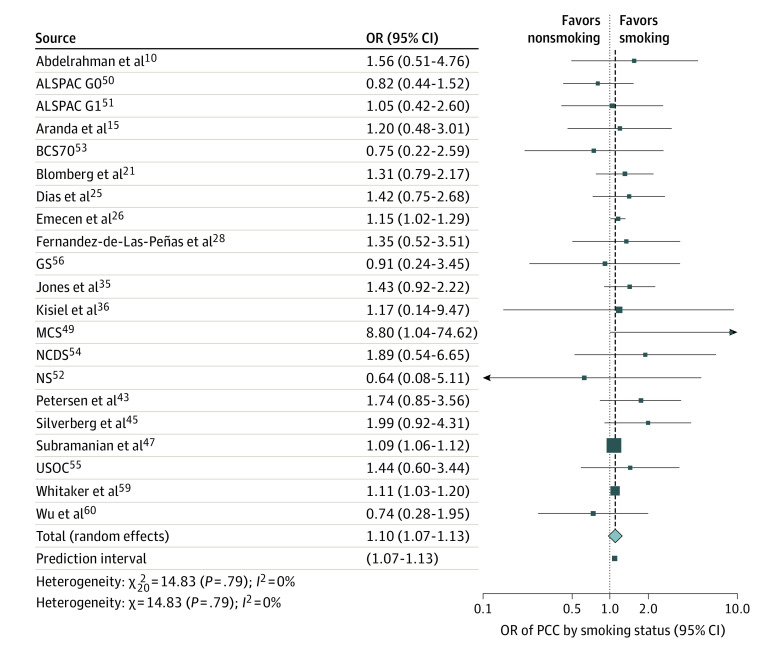
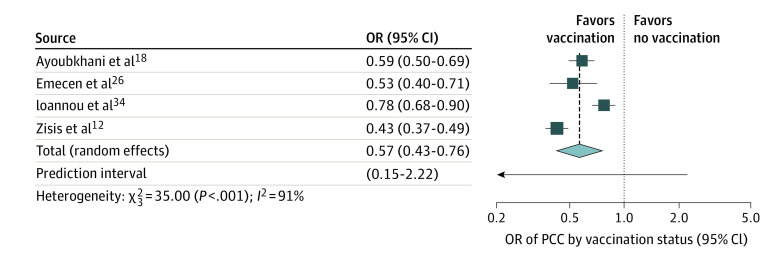
Results: The initial search yielded 5334 records of which 255 articles underwent full-text evaluation, which identified 41 articles and a total of 860 783 patients that were included. The findings of the meta-analysis showed that female sex (OR, 1.56; 95% CI, 1.41-1.73), age (OR, 1.21; 95% CI, 1.11-1.33), high BMI (OR, 1.15; 95% CI, 1.08-1.23), and smoking (OR, 1.10; 95% CI, 1.07-1.13) were associated with an increased risk of developing PCC. In addition, the presence of comorbidities and previous hospitalization or ICU admission were found to be associated with high risk of PCC (OR, 2.48; 95% CI, 1.97-3.13 and OR, 2.37; 95% CI, 2.18-2.56, respectively). Patients who had been vaccinated against COVID-19 with 2 doses had a significantly lower risk of developing PCC compared with patients who were not vaccinated (OR, 0.57; 95% CI, 0.43-0.76).
Conclusions and relevance: This systematic review and meta-analysis demonstrated that certain demographic characteristics (eg, age and sex), comorbidities, and severe COVID-19 were associated with an increased risk of PCC, whereas vaccination had a protective role against developing PCC sequelae. These findings may enable a better understanding of who may develop PCC and provide additional evidence for the benefits of vaccination.
Trial registration: PROSPERO Identifier: CRD42022381002.
Conflict of interest statement
Figures
Comment in
-
While Waiting for a Randomized Clinical Trial of Nirmatrelvir for Prevention of Post-COVID-19 Condition.JAMA Intern Med. 2023 Jun 1;183(6):565. doi: 10.1001/jamainternmed.2023.0760. JAMA Intern Med. 2023. PMID: 36951848 No abstract available.
-
Prevalence and characteristics of post COVID-19 condition five months after SARS-COV-2 infection in inpatients and outpatients.Eur J Intern Med. 2023 Oct;116:137-140. doi: 10.1016/j.ejim.2023.07.002. Epub 2023 Jul 8. Eur J Intern Med. 2023. PMID: 37429788 No abstract available.
-
Vaccination After SARS-CoV-2 Infection and Post-COVID-19 Condition-In Reply.JAMA Intern Med. 2023 Sep 1;183(9):1036. doi: 10.1001/jamainternmed.2023.3036. JAMA Intern Med. 2023. PMID: 37486646 No abstract available.
-
Vaccination After SARS-CoV-2 Infection and Post-COVID-19 Condition.JAMA Intern Med. 2023 Sep 1;183(9):1035-1036. doi: 10.1001/jamainternmed.2023.3033. JAMA Intern Med. 2023. PMID: 37486686 No abstract available.
References
-
- Chippa V, Aleem A, Anjum F. Post-Acute Coronavirus (COVID-19) Syndrome. StatPearls. Published online June 19, 2022. https://www.ncbi.nlm.nih.gov/books/NBK570608/
-
- UK National Institute for Health and Care Excellence . COVID-19 rapid guideline: managing the long-term effects of COVID-19. Published online December 18, 2020. Accessed March 1, 2023. https://www.ncbi.nlm.nih.gov/books/NBK567264/ - PubMed
-
- World Health Organization . A clinical case definition of post COVID-19 condition by a Delphi consensus, 6 October 2021. Accessed November 28, 2022. https://www.who.int/publications/i/item/WHO-2019-nCoV-Post_COVID-19_cond...
Publication types
MeSH terms
LinkOut - more resources
Full Text Sources
Other Literature Sources
Medical