Review
. 2023 Sep;33(9):803-815.
doi: 10.1016/j.tcb.2023.02.008. Epub 2023 Mar 22.

Bucket lists must be completed during cell death

Affiliations
Review

Bucket lists must be completed during cell death

Kengo Nozaki et al. Trends Cell Biol. 2023 Sep.

Abstract

Regulated cell death occurs in many forms, including apoptosis, pyroptosis, necroptosis, and NETosis. Most obviously, the purpose of these pathways is to kill the cell. However, many cells need to complete a set of effector programs before they die, which we define as a cellular 'bucket list'. These effector programs are specific to the cell type, and mode and circumstances of death. For example, intestinal epithelial cells need to complete the process of extrusion before they die. Cells use regulatory mechanisms to temporarily prolong their life, including endosomal sorting complex required for transport (ESCRT)- and acid sphingomyelinase (ASM)-driven membrane repair. These allow cells to complete their bucket lists before they die.

Keywords: ESCRT; acid sphingomyelinase; caspase-7; cell death; gasdermin; membrane repair.


Conflict of interest statement

Declaration of interests The authors declare no competing interests.

Figures
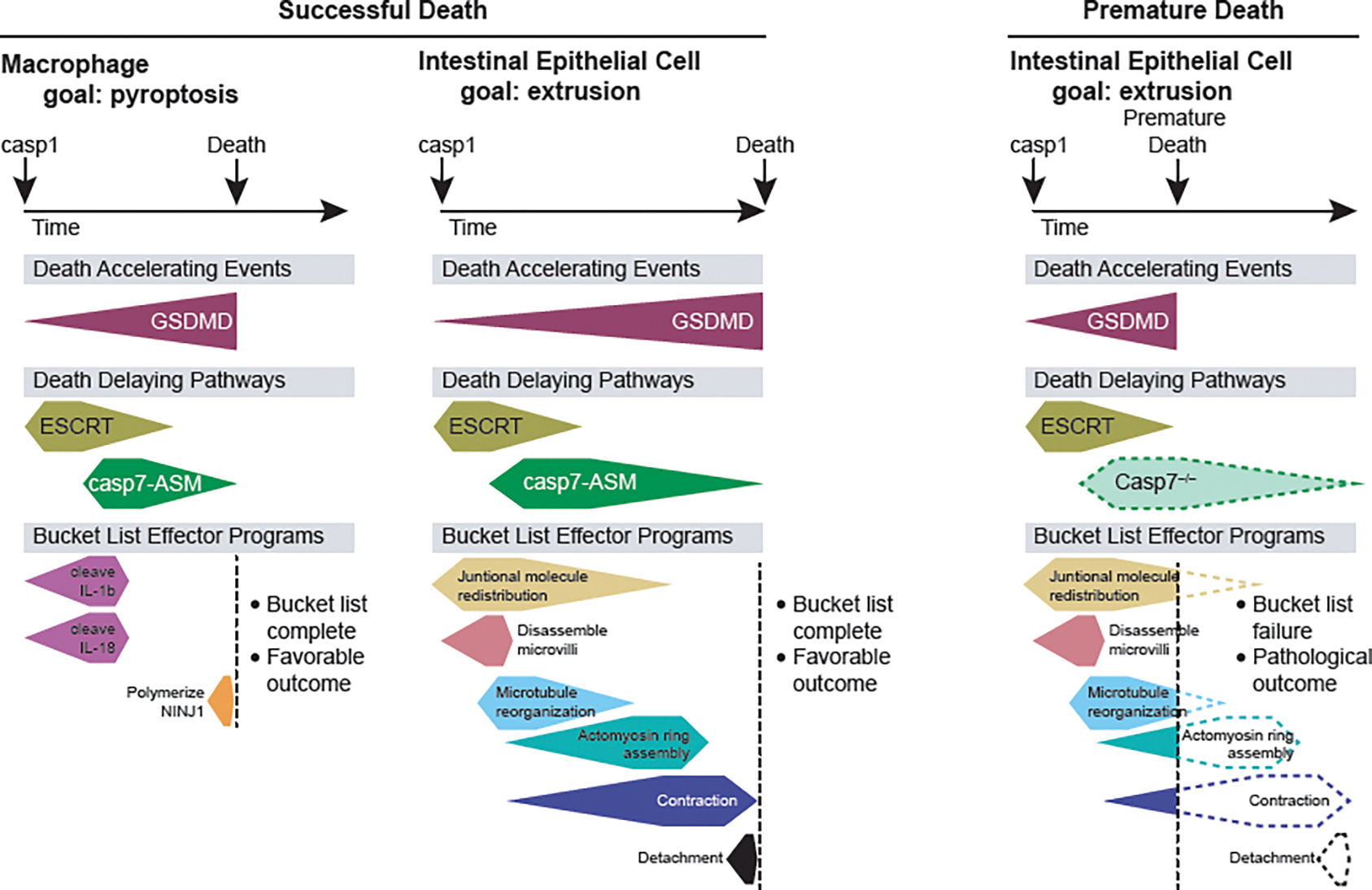
Figure 1.
Figure 1.. The cellular bucket list.
After a death trigger, events occur in three categories: 1) death-accelerating pathways, 2) death-delaying pathways, and 3) bucket list effector programs. Different cell types and even different death triggers in the same cell type will have distinct survival durations of the cell and different bucket list tasks to complete. We depict specific examples of events in each category after caspase-1 activates in either a macrophage or an intestinal epithelial cell. In both, opening of the gasdermin D pore accelerates the progression towards death of the cell. In both, membrane repair pathways should delay the death of the cell, however because caspase-7 expression is higher in intestinal epithelial cells, the delay may be slightly longer. Simultaneously, the bucket list effector pathways are initiated. In macrophages, this includes cleaving IL-1β and IL-18 to their mature forms and activating NINJ1 to rupture membranes. In intestinal epithelial cells the bucket list includes a series of tasks that, once performed in order, accomplish the extrusion of the cell into the gut lumen. When premature death occurs (depicted at right), for example in a caspase-7-deficient cell, the bucket lists remain incomplete and pathologic outcomes can occur.
Figure 2.
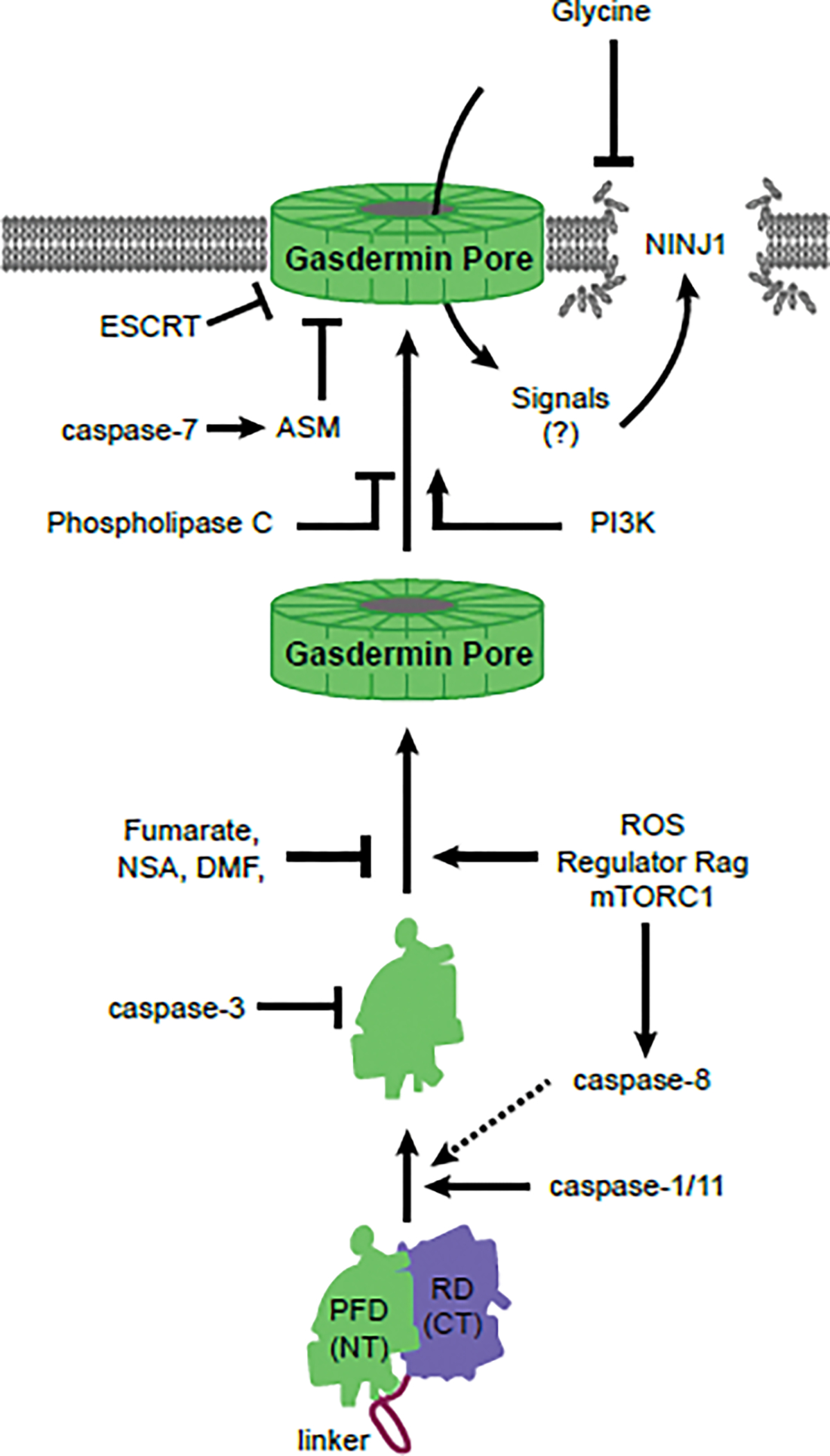
Figure 2.. Mechanisms regulating gasdermin D-mediated cell death.
The process of gasdermin D-mediated pyroptosis is strictly regulated. Before activation, the C-terminal (CT) regulatory domain (RD) of gasdermin D seal and inhibit the N-terminal (NT) pore forming domain (PFD). Caspase-1/11 (or caspase-8 slowly) can cleave gasdermin D, releasing the active PFD that oligomerizes into large pore complexes. In parallel, gasdermin D can be cleaved by caspase-3 into an inactive form. During oligomerization, active gasdermin D PFDs require a critical cysteine to remain unmodified to permit oligomerization via ROS generating activation of Regulator Rag complex-mTORC1. Several drugs (fumarate, NSA, DMF) or intrinsic metabolites such as succinate derivative inhibit the availability of this cysteine. After pore formation, ESCRT and/or ASM-driven membrane repair pathways can remove the pores form the plasma membrane. Phosphoinositide-3 kinase (PI3K) and phospholipase C can modulate membrane phosphoinositide composition to alter the pore-opening/closing dynamics. After gasdermin D pores open, ninjurin-1 (NINJ1) causes plamsa membrane rupture. Extracellular glycine applied to cells can inhibit plasma membrane rupture in a manner that is similar to the phenotype of Ninj1-deficient cells.
Figure 3.
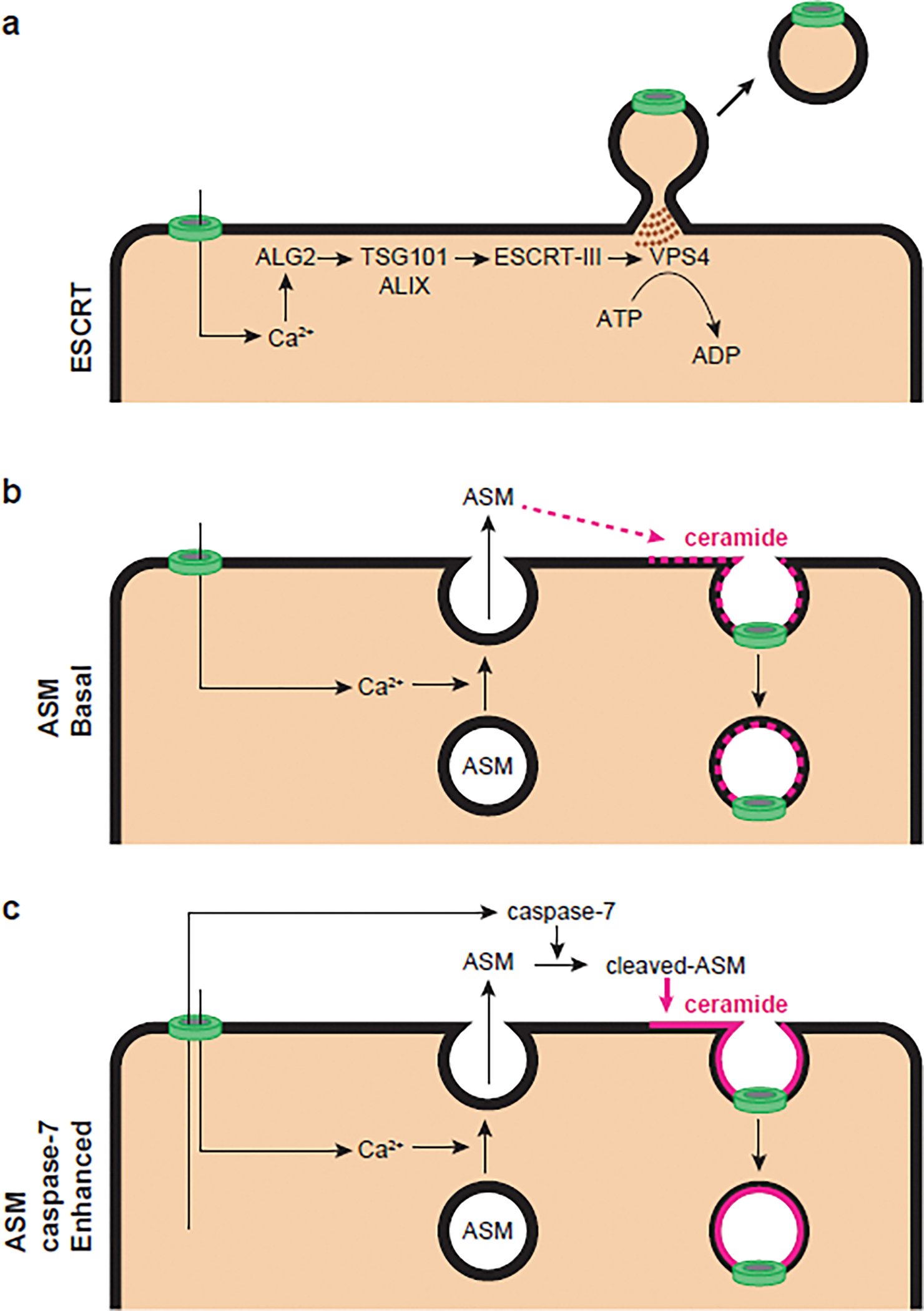
Figure 3.. Membrane repair pathways antagonize gasdermin D pores.
Gasdermin D pores (green) allow Ca2+ influx into the cytosol, which initiates ESCRTs/ASM-mediated repair pathways. In ESCRT repair (a), local increases of Ca2+ rapidly recruit ALG2, a Ca2+ sensor that bridges ALIX and TSG101. This further recruits the ESCRT-III machinery to drive repair by exocytosis. VPS4 completes the shedding by a scissors function in an ATP-dependent manner. In basal ASM repair (b), Ca2+ entry though pores rapidly drives lysosomal exocytosis, which releases lysosomal ASM onto the cell surface. ASM cleaves off the head group of sphingomyelin to generate ceramide within the outer leaflet of the plasma membrane. This ceramide drives spontaneous membrane repair by endocytosis that does not require ATP. In caspase-7-enhanced ASM repair (c), caspase-7 cleaves and activates ASM to enhance its enzymatic activity, resulting in the generation of more ceramide, thereby enhancing the endocytic repair process.

References

    1. Shi J et al. (2015) Cleavage of GSDMD by inflammatory caspases determines pyroptotic cell death. Nature 526, 660–665 - PubMed
    1. Kayagaki N et al. (2015) Caspase-11 cleaves gasdermin D for non-canonical inflammasome signalling. Nature 526, 666–671 - PubMed
    1. Zanoni I et al. (2016) An endogenous caspase-11 ligand elicits interleukin-1 release from living dendritic cells. Science 352, 1232–1236 - PMC - PubMed
    1. Nozaki K et al. (2022) Caspase-7 activates ASM to repair gasdermin and perforin pores. Nature 606, 960–967 - PMC - PubMed
    1. Nozaki K et al. (2022) Innate Sensors Trigger Regulated Cell Death to Combat Intracellular Infection. Annu. Rev. Immunol. 40, 469–498 - PMC - PubMed

Publication types

LinkOut - more resources