


The predictors of food security and dietary diversity among internally displaced persons' children (6-59 months) in Bamenda health district, Cameroon
- PMID: 36959669
- PMCID: PMC10035966
- DOI: 10.1186/s13031-023-00511-2
The predictors of food security and dietary diversity among internally displaced persons' children (6-59 months) in Bamenda health district, Cameroon
Abstract
Background: Malnutrition remains a major cause of morbidity and mortality amongst children in displaced settings. Nutrition at this stage is crucial for the growth and development of the child. It is estimated that 41 million children under 5 years are obese/overweight, 159 million are stunted and 50 million are wasted worldwide. This study aimed to determine the prevalence and predictors of food insecurity and dietary diversity among internally displaced persons' children from 6 to 59 months.
Methodology: A cross sectional community-based study was conducted on 395 children aged 6-59 months from May 2021-June 2021. A multistage cluster sampling method was used to select the study participants. A validated structured questionnaire was used to collect data on sociodemographic characteristics, food security and dietary diversity. Predictors of food insecurity and dietary diversity were identified using logistic regression. The outputs were presented using adjusted odd ratio (AOR) with 95% confidence interval (CI).
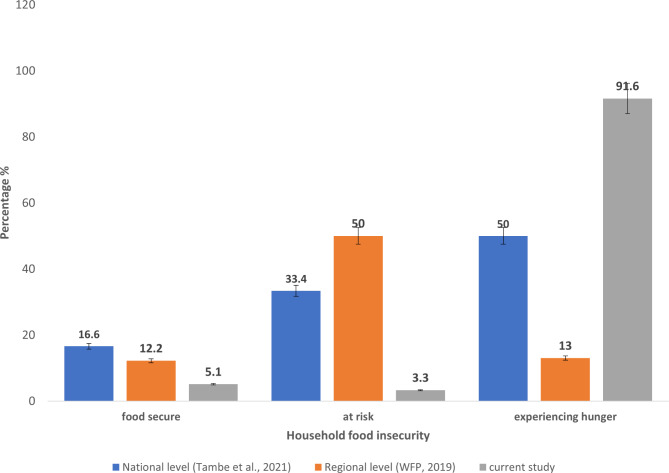
Results: The study results revealed that the level of household food insecurity was 91.6%, at risk of experiencing hunger (3.3%) and food secure (5.5%). Participants had mean dietary diversity score of 3.6 food groups, 51.6% had a low or inadequate dietary diversity and 48.4% had adequate dietary diversity. Children who were from households with monthly income of $101- $200 US dollars and had been displaced just once were 79% (AOR: 0.21, 95%CI: 0.07-0.60) and 84% (AOR: 0.16, 95%CI: 0.05-0.50) less likely to be food insecure compared to their counterparts respectively. While households with participants who Walked ≥ 10 min to fetch drinking water (AOR: 11.61 95%CI: 2.39-52.08) were more likely food insecure. In addition, household monthly income of ≥ $100 US dollars (AOR: 0.20, 95%CI: 0.07-0.56) had a reduced chance of providing low diversified food. Households that had received social grants (AOR: 2.15, 95%CI: 1.38-3.49) and walked ≥ 10 min to fetch drinking water (AOR: 2.43, 95%CI: 1.48-3.98) had a higher chance of providing low diversified food.
Conclusion: Dietary diversity and household food insecurity was unacceptably low and high respectively among internally displaced children. Policymakers should prioritize strengthening both nutrition sensitive and specific activities that contribute to reduction of food insecurity and consumption of unbalance diet.
Keywords: Associated factors; Dietary diversity; Food insecurity; Internally displaced persons.
© 2023. The Author(s).
Conflict of interest statement
The author(s) declared no potential conflicts of interest with respect to the research, authorship, and/or publication of this article.
Figures

References
-
- UNICEF. Improving Child Nutrition: The achievable imperative [Internet]. Vol. 18, NCSL legisbrief. 2013 [cited 2022 Aug 22]. 1–2 p. Available from: https://scholar.google.com/scholar?hl=en&as_sdt=0%2C5&q=Improvin...
-
- Black RE, Allen LH, Bhutta ZA, Caulfield LE, de Onis M, Ezzati M, Mathers C, Rivera J, The Lancet. Maternal and child undernutrition: global and regional exposures and health consequences [Internet]. Vol. 371,. 2008 [cited 2022 Aug 22]. p. 243–60. Available from: https://www.sciencedirect.com/science/article/pii/S0140673607616900?casa... - PubMed
-
- Unicef/ WHO/The World Bank. LEVELS AND TRENDS IN CHILD MALNUTRITION. 47 million 38 million [Internet]. 2020 [cited 2020 May 2]. Available from: https://apps.who.int/iris/bitstream/handle/10665/331621/9789240003576-en...
-
- Chiabi A, Lebela J, Kobela M, Mbuagbaw L, Obama MT, Ekoe T. The frequency and magnitude of growth failure in a group of HIV-infected children in Cameroon. Pan African Medical Journal [Internet]. 2012 [cited 2022 Sep 10];11:15. Available from: https://www.ajol.info/index.php/pamj/article/view/75451 - PMC - PubMed
LinkOut - more resources
Full Text Sources
