. 2023 Mar 7:68:1605583.
doi: 10.3389/ijph.2023.1605583. eCollection 2023.

Association Between Smoking and Pain, Functional Disability, Anxiety and Depression in Patients With Chronic Low Back Pain

Affiliations

Association Between Smoking and Pain, Functional Disability, Anxiety and Depression in Patients With Chronic Low Back Pain

Qi-Hao Yang et al. Int J Public Health. .

Abstract

Objectives: Chronic low back pain (CLBP) accounts for a majority of the disability associated with LBP, which can produce long-term negative effects. This cross-sectional study aimed to investigate the association between smoking and pain, dysfunction and psychological status in patients with CLBP. Methods: The 54 patients with CLBP were recruited and divided into smoking and non-smoking groups. Their pain, dysfunction, anxiety, depression, fear and quality of life were evaluated. The amount of cigarettes smoked daily was recorded. Results: Significant differences in VAS, ODI, RMDQ and FABQ and the impact of LBP on life and work were found between smoking and non-smoking patients. In addition, a correlation was found between the daily cigarette smoking amount and VASmax, FABQtotal, SDS and FABQ-W. Moreover, a correlation was observed between the amount of cigarettes smoked daily and the degree of impact of low back pain on work. Conclusion: The study found that smoking affected the aggravation of symptoms in patients with CLBP, which indicated that patients with CLBP and people at risk of LBP should be aware of the harm caused by smoking.

Keywords: chronic low back pain; correlation; pain management; psychological symptom; tobacco use.


Conflict of interest statement

The authors declare that they do not have any conflicts of interest.

Figures
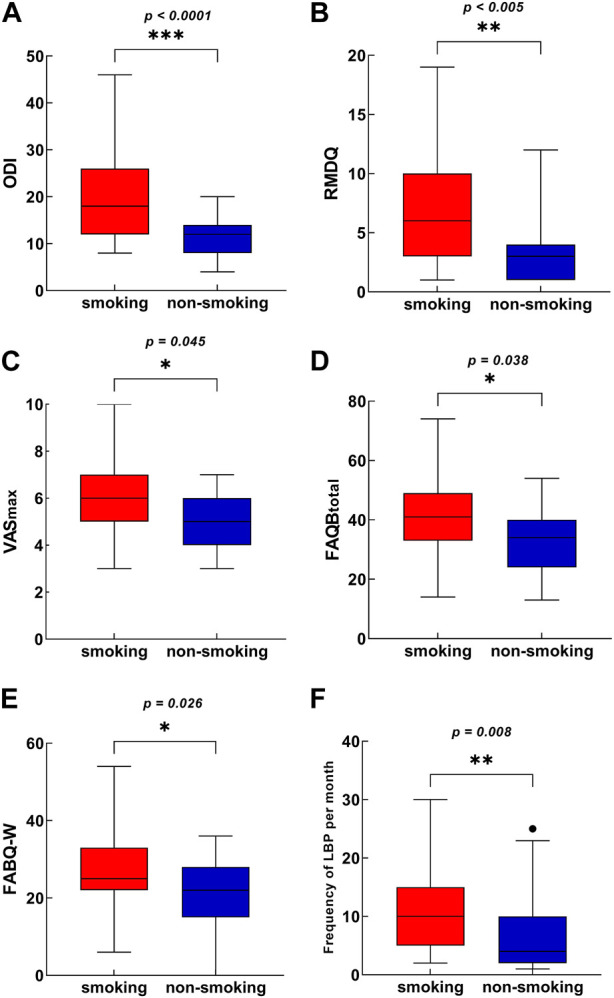
FIGURE 1
FIGURE 1
Difference in pain intensity and frequency, disability, and negative emotion outcomes between the smoking group and non-smoking group (Shanghai, China. 2018–2019). The Box-Whisker plot for each variable included the interquartile range and maximum/minimum values. (A) Difference in ODI between the CLBP smoking group and non-smoking group. (B) Difference in RMDQ between the CLBP smoking group and non-smoking group. (C) Difference in VASmax between the CLBP smoking group and non-smoking group. (D) Difference in FABQtotal between the CLBP smoking group and non-smoking group. (E) Difference in FABQ-W between the CLBP smoking group and non-smoking group. (F) Difference in the frequency of LBP last month between the CLBP smoking group and non-smoking group. Abbreviations: ODI, Oswestry disability index; RMDQ, Roland‐Morris disability questionnaire; VAS, visual analogue scale; FABQ, fear-avoidance beliefs questionnaire; FABQ-W, FABQ work.
FIGURE 2
FIGURE 2
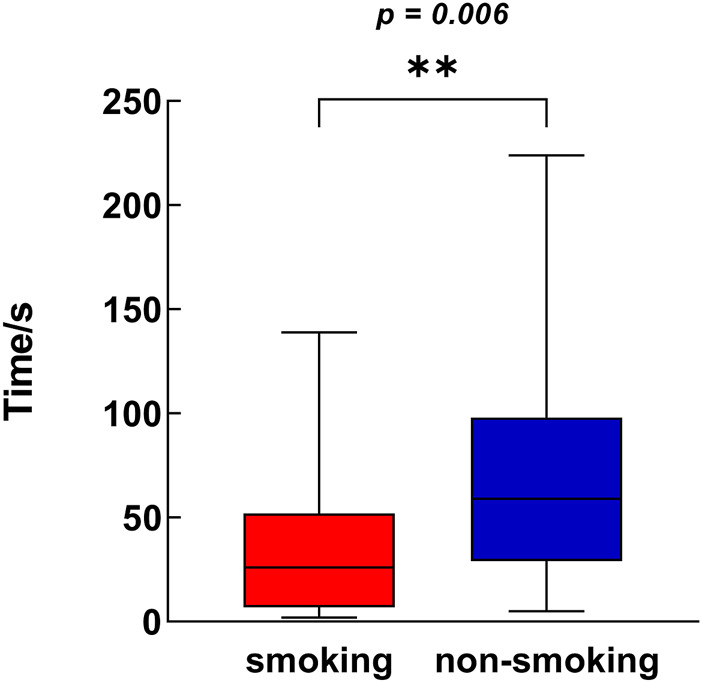
Difference in unipedal stance test with eye closed between smoking group and non-smoking group (Shanghai, China. 2018–2019). The Box-Whisker plot for each variable included the interquartile range and maximum/minimum values.
FIGURE 3
FIGURE 3
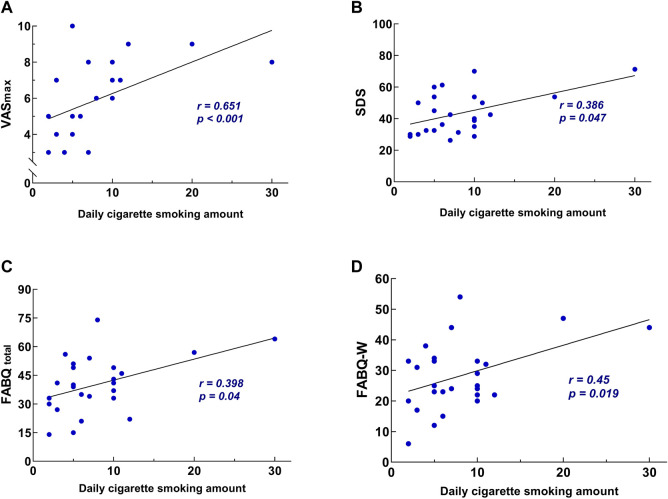
The correlation between the daily cigarette smoking amount and pain intensity, negative emotion outcomes (Shanghai, China. 2018–2019). (A) The correlation between the daily cigarette smoking amount and VASmax. (B) The correlation between the daily cigarette smoking amount and SDS. (C) The correlation between the daily cigarette smoking amount and FABQtotal. (D) The correlation between the daily cigarette smoking amount and FABQ-W. Abbreviations: SDS, Zung Self-rating depression scale; VAS, visual analogue scale; FABQ, fear-avoidance beliefs questionnaire; FABQ-W, FABQ work.

References

    1. Maher C, Underwood M, Buchbinder R. Non-specific Low Back Pain. Lancet (2017) 389(10070):736–47. 10.1016/S0140-6736(16)30970-9 - DOI - PubMed
    1. Lawrence RC, Felson DT, Helmick CG, Arnold LM, Choi H, Deyo RA, et al. Estimates of the Prevalence of Arthritis and Other Rheumatic Conditions in the United States. Part II. Arthritis Rheum (2008) 58(1):26–35. 10.1002/art.23176 - DOI - PMC - PubMed
    1. Thelin A, Holmberg S, Thelin N. Functioning in Neck and Low Back Pain from a 12-year Perspective: a Prospective Population-Based Study. J Rehabil Med (2008) 40(7):555–61. 10.2340/16501977-0205 - DOI - PubMed
    1. Vlaeyen JWS, Maher CG, Wiech K, Van Zundert J, Meloto CB, Diatchenko L, et al. Low Back Pain. Nat Rev Dis Primers (2018) 4(1):52. 10.1038/s41572-018-0052-1 - DOI - PubMed
    1. Peng MS, Wang R, Wang YZ, Chen CC, Wang J, Liu XC, et al. Efficacy of Therapeutic Aquatic Exercise vs Physical Therapy Modalities for Patients with Chronic Low Back Pain: A Randomized Clinical Trial. JAMA Netw Open (2022) 5(1):e2142069. 10.1001/jamanetworkopen.2021.42069 - DOI - PMC - PubMed