. 2023 Jan 30;10(3):uhad007.
doi: 10.1093/hr/uhad007. eCollection 2023 Mar.

CsTRM5 regulates fruit shape via mediating cell division direction and cell expansion in cucumber

Affiliations

CsTRM5 regulates fruit shape via mediating cell division direction and cell expansion in cucumber

Yang Xie et al. Hortic Res. .

Abstract

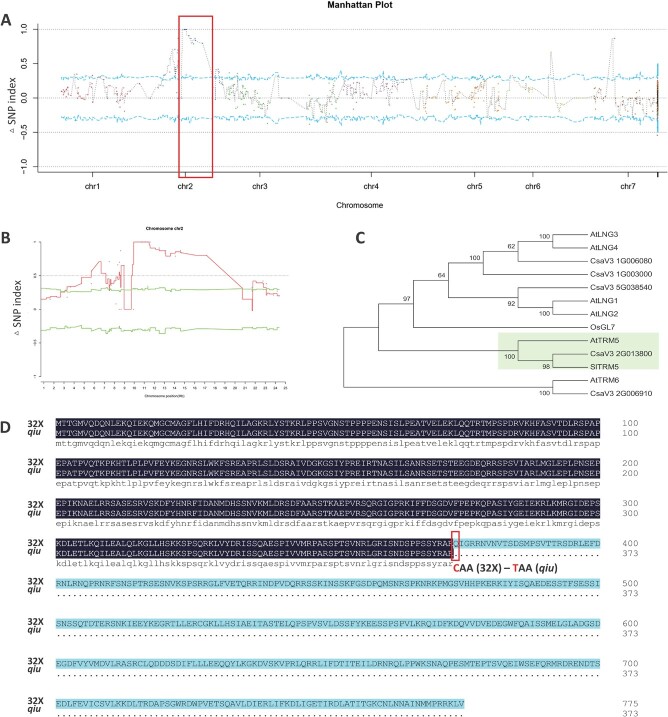
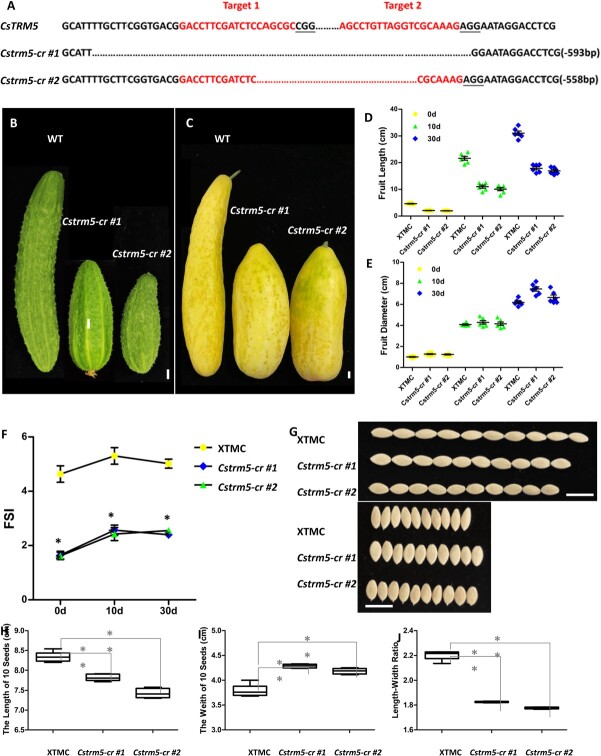
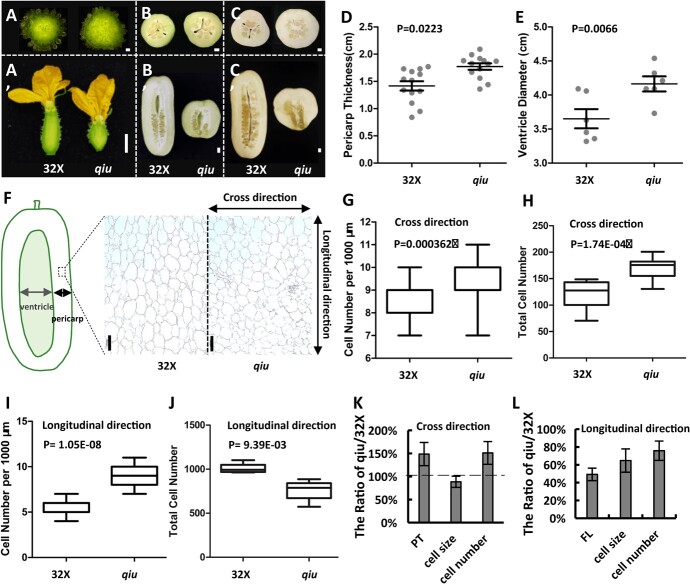
Fruit shape and size are important appearance and yield traits in cucumber, but the underlying genes and their regulatory mechanisms remain poorly understood. Here we identified a mutant with spherical fruits from an Ethyl Methane Sulfonate (EMS)-mutagenized library, named the qiu mutant. Compared with the cylindrical fruit shape in 32X (wild type), the fruit shape in qiu was round due to reduced fruit length and increased fruit diameter. MutMap analysis narrowed the candidate gene in the 6.47 MB range on Chr2, harboring the FS2.1 locus reported previously. A single-nucleotide polymorphism (SNP) (11359603) causing a truncated protein of CsaV3_2G013800, the homolog of tomato fruit shape gene SlTRM5, may underlie the fruit shape variation in the qiu mutant. Knockout of CsTRM5 by the CRISPR-Cas9 system confirmed that CsaV3_2G013800/CsTRM5 was the causal gene responsible for qiu. Sectioning analysis showed that the spherical fruit in qiu resulted mainly from increased and reduced cell division along the transverse and longitudinal directions, respectively. Meanwhile, the repressed cell expansion contributed to the decreased fruit length in qiu. Transcriptome profiling showed that the expression levels of cell-wall-related genes and abscisic acid (ABA) pathway genes were significantly upregulated in qiu. Hormone measurements indicated that ABA content was greatly increased in the qiu mutant. Exogenous ABA application reduced fruit elongation by inhibiting cell expansion in cucumber. Taken together, these data suggest that CsTRM5 regulates fruit shape by affecting cell division direction and cell expansion, and that ABA participates in the CsTRM5-mediated cell expansion during fruit elongation in cucumber.


Conflict of interest statement

The authors declare no conflict of interests.

Figures
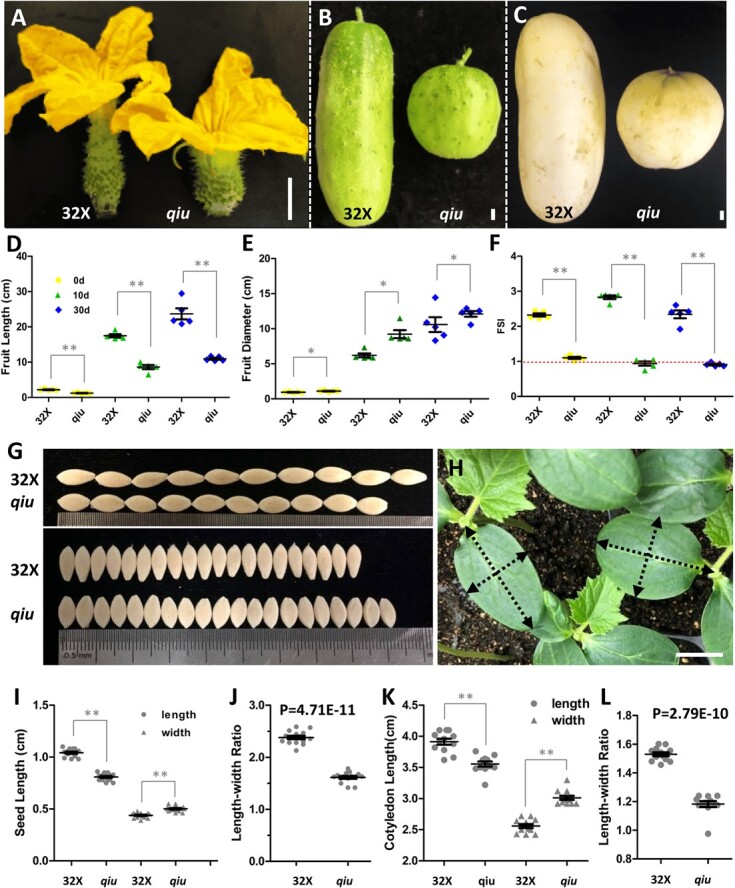
Figure 1
Figure 1
Phenotypic characterization of 32X and qiu mutant. AC Fruits of 32X and qiu mutant at 0, 10 and 30 DAA. DF Statistical data analysis of fruit length, diameter and FSI in 32X and qiu mutant. G, H Seed and cotyledon phenotypes in 32X and qiu. I, J Quantification data on seed length, width, and length/width ratio in 32X and qiu. K, L Quantification data on cotyledon length, width and length/width ratio. Scale bars: 1 cm in A–C and H.
Figure 2
Figure 2
Identification of the candidate gene in qiu mutant. A MutMap analysis identified the qiu locus (red box) in the cucumber genome. B MutMap analysis identified the qiu locus in Chr2. C Phylogenetic analysis of TRMs in cucumber, Arabidopsis, rice, and tomato. D Protein sequence information on CsTRM5 in 32X and qiu lines. The red box indicates the changed amino acid between the 32X and qiu lines.
Figure 3
Figure 3
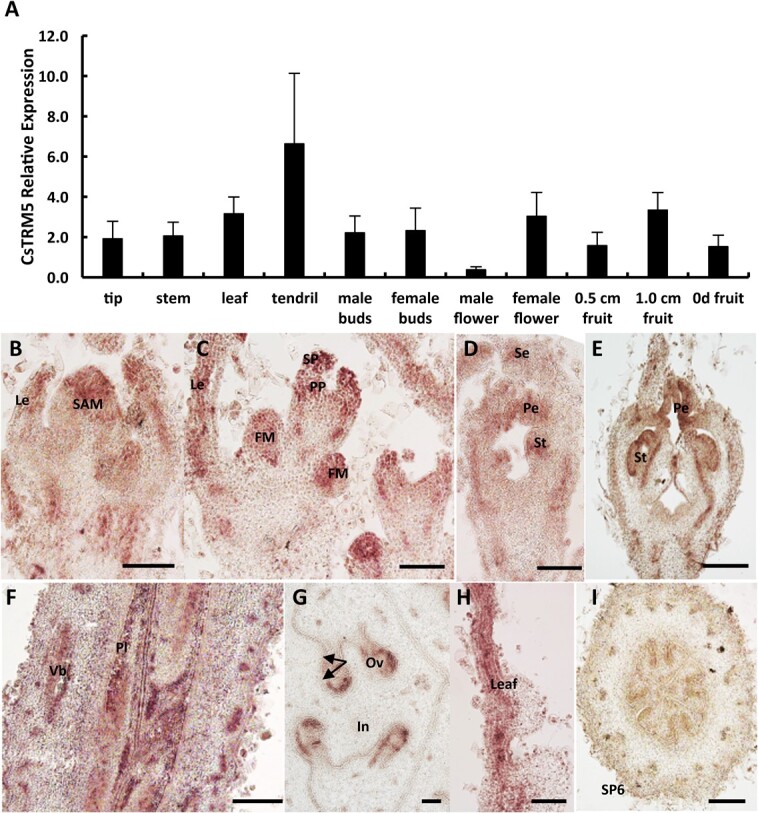
Expression pattern analysis of CsTRM5 in cucumber.A Expression levels of CsTRM5 in different organs of 32X line detected by qRT–PCR. BHIn situ hybridization of CsTRM5 in cucumber shoot tip (B), leaf (H), and floral organs (CG). I, Negative control of CsTRM5 sense probe in fruit cross-section. Le, leaf; SAM, shoot apical meristem; FM, floral meristem; SP, sepal primordium; PP, petal primordium; Se, sepal; Pe, petal; St, stamen; Vb, vascular bundle; Pl, placenta; Ov, ovule; In, integument. Scale bars: 100 μm.
Figure 4
Figure 4
Mutation forms and phenotypes of Cstrm5-cr lines. A Mutation forms of two homozygous T1 transgenic Cstrm5-cr lines obtained using the CRISPR-Cas9 system. B, C Fruits at 10 and 30 DAA in XTMC and Cstrm5-cr lines. D, E Fruit length and diameter of XTMC and Cstrm5-cr lines. F FSI in XTMC and Cstrm5-cr lines. G Seed phenotype in XTMC and Cstrm5-cr lines. HJ Seed length, width, and length/width ratio in XTMC and Cstrm5-cr lines. Scale bars: 1 cm in B,C and G.
Figure 5
Figure 5
Cell division direction and cell expansion were changed in the qiu mutant. AC Cross-sections and longitudinal sections of fruits at 0, 10 and 30 DAA in 32X and qiu mutant. D, E Pericarp thickness and ventricle diameter of fruit at 10 DAA in 32X and qiu. F Longitudinal paraffin section of fruit at 10 DAA in 32X and qiu. Gray double-headed arrow indicates ventricle diameter; black double-headed arrow indicates pericarp thickness. G, H Pericarp cell number per 1000 μm and total cell number in cross direction. I, J, Pericarp cell number per 1000 μm and total cell number in longitudinal direction. K, L PT, FL, cell size, and cell number ratio of qiu to 32X in cross (K) or longitudinal direction (L). Scale bars: 1 cm in AC, 200 μm in F.
Figure 6
Figure 6
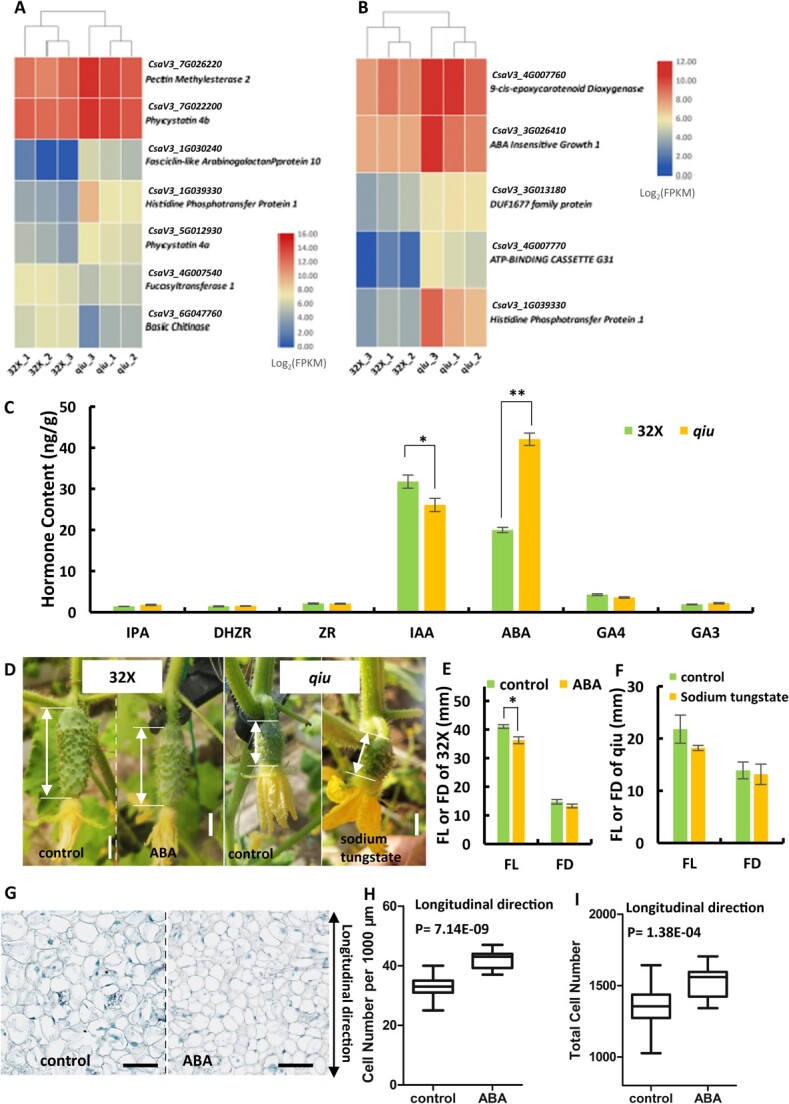
ABA plays an important role in fruit length variation in cucumber. A, B DEGs relative to cell wall development (A) and hormone (B) pathways between qiu and 32X lines. C Hormone content of young fruits in qiu and 32X lines. D Fruit phenotype of 32X and qiu lines after ABA or sodium tungstate treatment. E, F Change in FL and FD after ABA (E) or sodium tungstate (F) treatment. G Longitudinal section of fruit at 3 DAA in 32X after ABA treatment. H, I Pericarp cell number per 1000 μm and total cell number in longitudinal direction. Scale bars: 1 cm in D, 100 μm in G.

References

    1. Li S, Pan Y, Wen Cet al. Integrated analysis in bi-parental and natural populations reveals CsCLAVATA3 (CsCLV3) underlying carpel number variations in cucumber. Theor Appl Genet. 2016;129:1007–22. - PubMed
    1. Ando K, Carr KM, Grumet R. Transcriptome analyses of early cucumber fruit growth identifies distinct gene modules associated with phases of development. BMC Genomics. 2012;13:518. - PMC - PubMed
    1. Pan Y, Wang Y, McGregor Cet al. Genetic architecture of fruit size and shape variation in cucurbits: a comparative perspective. Theor Appl Genet. 2020;133:1–21. - PubMed
    1. Gillaspy G, Ben-David H, Gruissem W. Fruits: a developmental perspective. Plant Cell. 1993;5:1439–51. - PMC - PubMed
    1. Che G, Zhang X. Molecular basis of cucumber fruit domestication. Curr Opin Plant Biol. 2019;47:38–46. - PubMed