


Hypoxaemia prevalence and management among children and adults presenting to primary care facilities in Uganda: A prospective cohort study
- PMID: 36962209
- PMCID: PMC10022140
- DOI: 10.1371/journal.pgph.0000352
Hypoxaemia prevalence and management among children and adults presenting to primary care facilities in Uganda: A prospective cohort study
Abstract
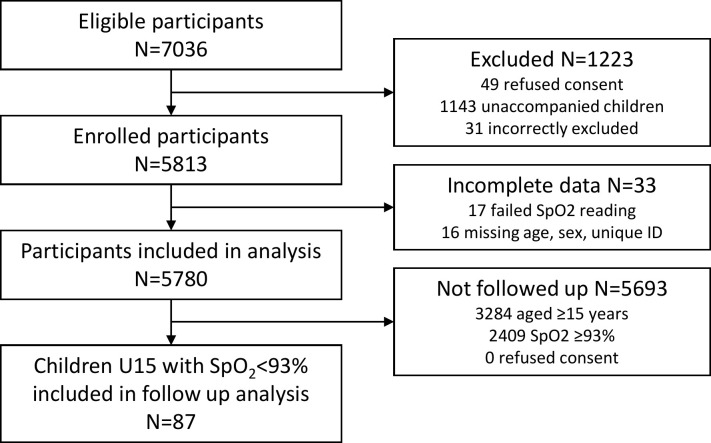
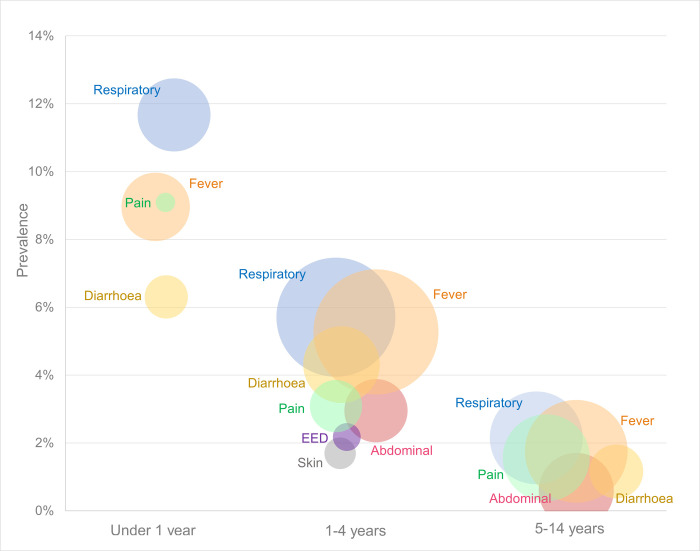
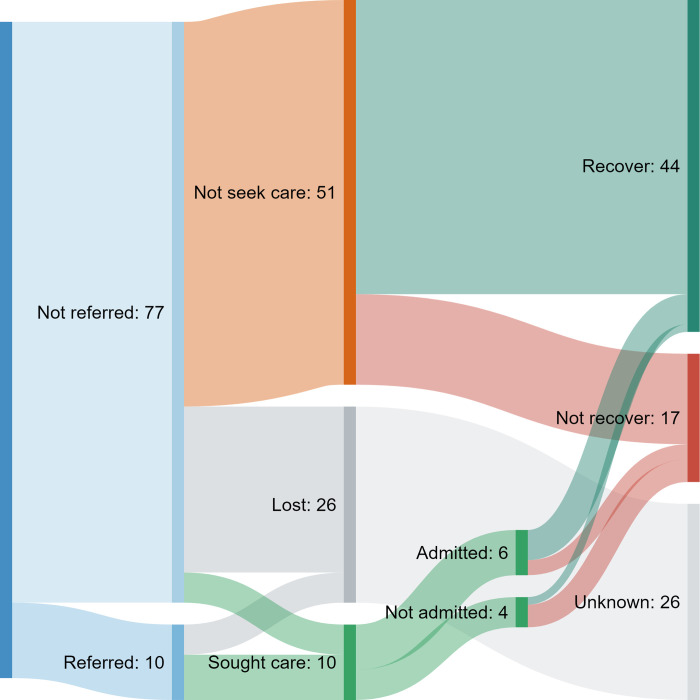
Hypoxaemia (low blood oxygen) is common among hospitalised patients, increasing the odds of death five-fold and requiring prompt detection and treatment. However, we know little about hypoxaemia prevalence in primary care and the role for pulse oximetry and oxygen therapy. This study assessed the prevalence and management of hypoxaemia at primary care facilities in Uganda. We conducted a cross sectional prevalence study and prospective cohort study of children with hypoxaemia in 30 primary care facilities in Uganda, Feb-Apr 2021. Clinical data collectors used handheld pulse oximeters to measure blood oxygen level (SpO2) of all acutely unwell children, adolescents, and adults. We followed up a cohort of children aged under 15 years with SpO2<93% by phone after 7 days to determine if the patient had attended another health facility, been admitted, or recovered. Primary outcome: proportion of children under 5 years of age with severe hypoxaemia (SpO2<90%). Secondary outcomes: severe (SpO2<90%) and moderate hypoxaemia (SpO2 90-93%) prevalence by age/sex/complaint; number of children with hypoxaemia referred, admitted and recovered. We included 1561 children U5, 935 children 5-14 years, and 3284 adolescents/adults 15+ years. Among children U5, the prevalence of severe hypoxaemia was 1.3% (95% CI 0.9 to 2.1); an additional 4.9% (3.9 to 6.1) had moderate hypoxaemia. Performing pulse oximetry according to World Health Organization guidelines exclusively on children with respiratory complaints would have missed 14% (3/21) of severe hypoxaemia and 11% (6/55) of moderate hypoxaemia. Hypoxaemia prevalence was low among children 5-14 years (0.3% severe, 1.1% moderate) and adolescents/adults 15+ years (0.1% severe, 0.5% moderate). A minority (12/27, 44%) of severely hypoxaemic patients were referred; 3 (12%) received oxygen. We followed 87 children aged under 15 years with SpO2<93%, with complete data for 61 (70%), finding low rates of referral (6/61, 10%), hospital attendance (10/61, 16%), and admission (6/61, 10%) with most (44/61, 72%) fully recovered at day 7. Barriers to referral included caregiver belief it was unnecessary (42/51, 82%), cost (8/51, 16%), and distance or lack of transport (3/51, 6%). Hypoxaemia is common among acutely unwell children under five years of age presenting to Ugandan primary care facilities. Routine pulse oximetry has potential to improve referral, management and clinical outcomes. Effectiveness, acceptability, and feasibility of pulse oximetry and oxygen therapy for primary care should be investigated in implementation trials, including economic analysis from health system and societal perspectives.
Copyright: © 2022 Graham et al. This is an open access article distributed under the terms of the Creative Commons Attribution License, which permits unrestricted use, distribution, and reproduction in any medium, provided the original author and source are credited.
Conflict of interest statement
I have read the journal’s policy and the authors of this manuscript have the following competing interests: HG is an advisor to the Lifebox Foundation, UNICEF, and Unitaid on pulse oximetry; YK, JM, BK, SE, LK, FL are employed by CHAI who are implementing the oxygen program in Uganda; CO works for the Ministry of Health which provides funding and oversight for health facilities.
Figures
References
-
- Graham H, Bakare AA, Ayede AI, Oyewole OB, Gray A, Peel D, et al. Hypoxaemia in hospitalised children and neonates: A prospective cohort study in Nigerian secondary-level hospitals. EClinicalMedicine. 2019;16:51–63. Epub 2019/12/14. doi: 10.1016/j.eclinm.2019.10.009 ; PubMed Central PMCID: PMC6890969. - DOI - PMC - PubMed
-
- Lazzerini M, Sonego M, Pellegrin MC. Hypoxaemia as a Mortality Risk Factor in Acute Lower Respiratory Infections in Children in Low and Middle-Income Countries: Systematic Review and Meta-Analysis. PLoS ONE. 2015;10(9):e0136166. doi: 10.1371/journal.pone.0136166 ; PubMed Central PMCID: PMC4570717. - DOI - PMC - PubMed
LinkOut - more resources
Full Text Sources
Miscellaneous