


Differential diagnosis of COVID-19 and influenza
- PMID: 36962332
- PMCID: PMC10021438
- DOI: 10.1371/journal.pgph.0000221
Differential diagnosis of COVID-19 and influenza
Abstract
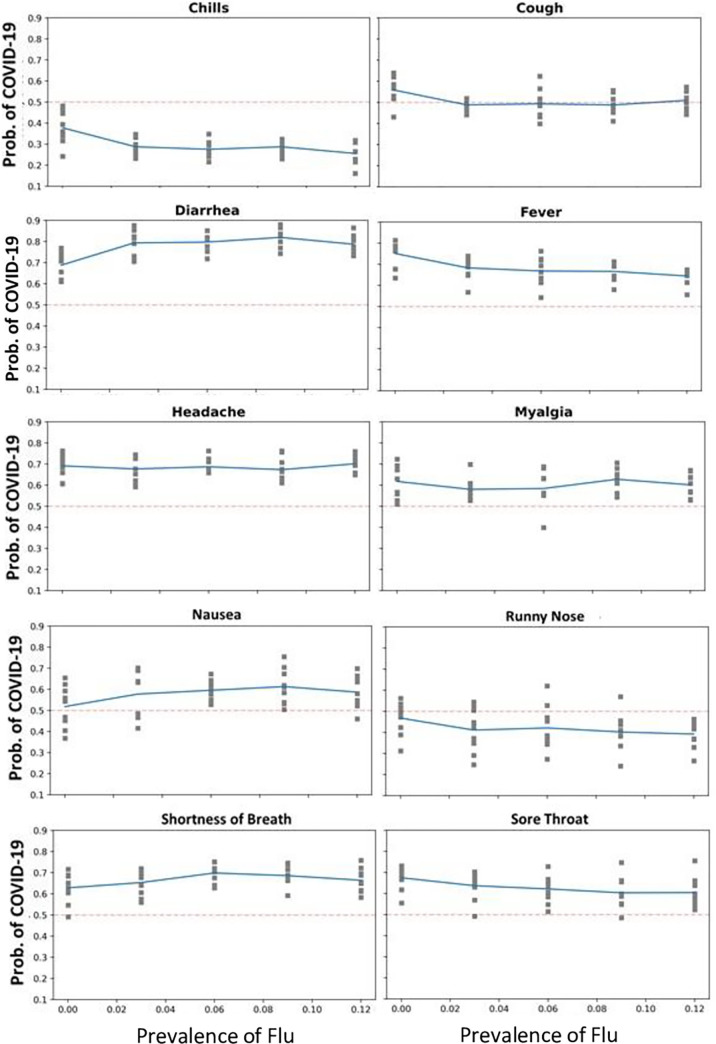
This study uses two existing data sources to examine how patients' symptoms can be used to differentiate COVID-19 from other respiratory diseases. One dataset consisted of 839,288 laboratory-confirmed, symptomatic, COVID-19 positive cases reported to the Centers for Disease Control and Prevention (CDC) from March 1, 2019, to September 30, 2020. The second dataset provided the controls and included 1,814 laboratory-confirmed influenza positive, symptomatic cases, and 812 cases with symptomatic influenza-like-illnesses. The controls were reported to the Influenza Research Database of the National Institute of Allergy and Infectious Diseases (NIAID) between January 1, 2000, and December 30, 2018. Data were analyzed using case-control study design. The comparisons were done using 45 scenarios, with each scenario making different assumptions regarding prevalence of COVID-19 (2%, 4%, and 6%), influenza (0.01%, 3%, 6%, 9%, 12%) and influenza-like-illnesses (1%, 3.5% and 7%). For each scenario, a logistic regression model was used to predict COVID-19 from 2 demographic variables (age, gender) and 10 symptoms (cough, fever, chills, diarrhea, nausea and vomiting, shortness of breath, runny nose, sore throat, myalgia, and headache). The 5-fold cross-validated Area under the Receiver Operating Curves (AROC) was used to report the accuracy of these regression models. The value of various symptoms in differentiating COVID-19 from influenza depended on a variety of factors, including (1) prevalence of pathogens that cause COVID-19, influenza, and influenza-like-illness; (2) age of the patient, and (3) presence of other symptoms. The model that relied on 5-way combination of symptoms and demographic variables, age and gender, had a cross-validated AROC of 90%, suggesting that it could accurately differentiate influenza from COVID-19. This model, however, is too complex to be used in clinical practice without relying on computer-based decision aid. Study results encourage development of web-based, stand-alone, artificial Intelligence model that can interview patients and help clinicians make quarantine and triage decisions.
Copyright: © 2022 Alemi et al. This is an open access article distributed under the terms of the Creative Commons Attribution License, which permits unrestricted use, distribution, and reproduction in any medium, provided the original author and source are credited.
Conflict of interest statement
FA, JV, EG, JW and AR have no conflicts of interest to declare. RP and PJ are employees of Vibrent Health, Inc. The data and the analysis are in public domain.
Figures
References
-
- Auvinen R, Nohynek H, Syrjänen R, Ollgren J, Kerttula T, Mäntylä J, et al. Comparison of the clinical characteristics and outcomes of hospitalized adult COVID-19 and influenza patients—a prospective observational study. Infect Dis (Lond). 2021. Feb;53(2):111–121. doi: 10.1080/23744235.2020.1840623 Epub 2020 Nov 10. . - DOI - PubMed
Grants and funding
LinkOut - more resources
Full Text Sources