


Systematic review of food insecurity and violence against women and girls: Mixed methods findings from low- and middle-income settings
- PMID: 36962559
- PMCID: PMC10021293
- DOI: 10.1371/journal.pgph.0000479
Systematic review of food insecurity and violence against women and girls: Mixed methods findings from low- and middle-income settings
Abstract
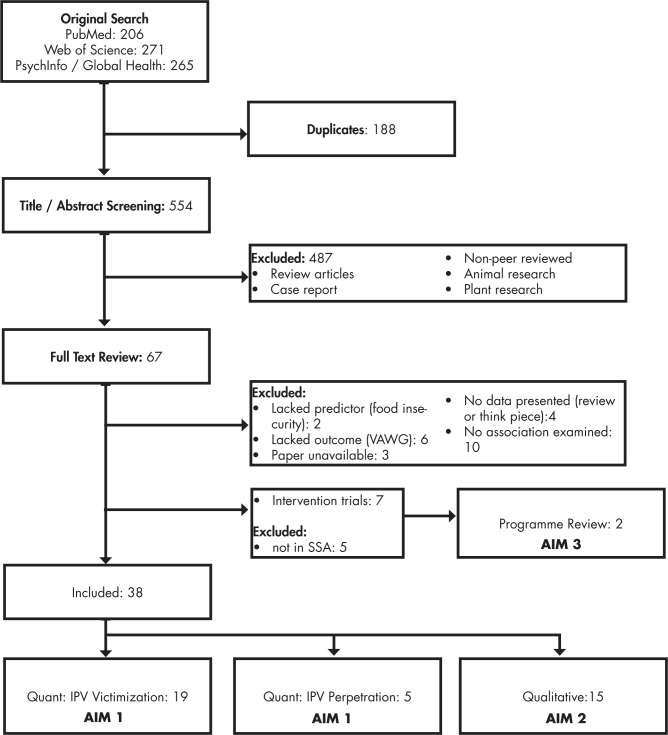
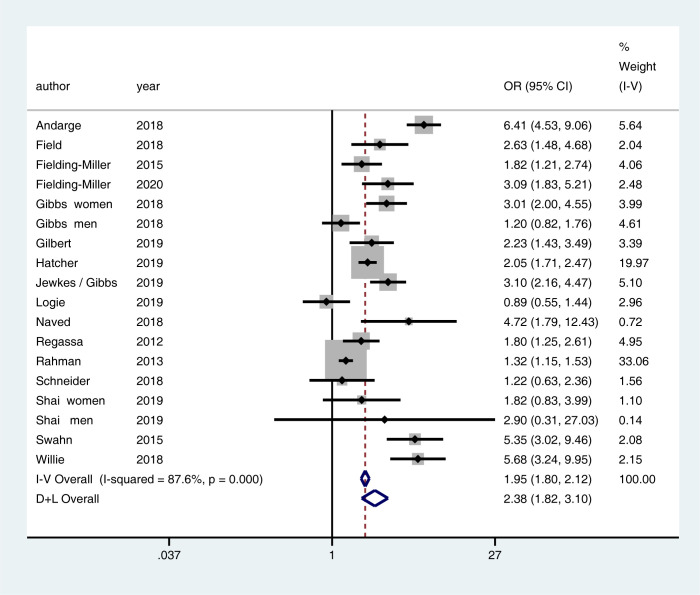
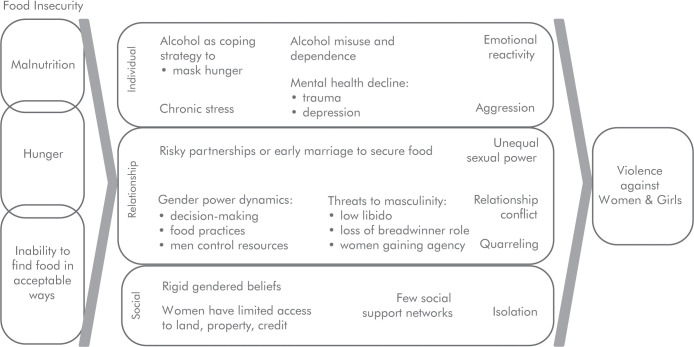
Violence against women and girls (VAWG) is a global human rights and public health concern. Food insecurity is a sign of severe poverty, and likely to heighten women's vulnerability to VAWG and men's perpetration of it. However, the extent of the association and the multiple pathways between food insecurity and VAWG are not well understood. We systematically assessed peer reviewed quantitative and qualitative literature to explore this in low- and middle-income countries. Fixed effects meta-analysis was used to synthesize quantitative evidence. Qualitative data was analyzed using thematic analysis. From a search of 732 titles, we identified 23 quantitative and 19 qualitative or mixed-methods peer-reviewed manuscripts. In a meta-analysis of 21 cross-sectional studies with 20,378 participants, food insecurity was associated with doubled odds of reported VAWG (odds ratio [OR] = 2.38, 95% confidence interval [CI] = 1.82-3.10). This finding was consistent for both women's experience or male perpetration of VAWG. Qualitative and mixed-methods papers offered insight that underlying conditions of inequitable gender norms, economic deprivation, and social isolation frame both food insecurity and VAWG. Food insecurity may trigger survival behaviors due to household stress and lack of meeting expected gender roles, which leads to VAWG. VAWG exposure may lead to food insecurity if women are more impoverished after leaving a violent household. Potential protective factors include financial stability, the involvement of men in VAWG programming, transformation of gender norms, and supporting women to develop new networks and social ties. Strong evidence exists for a relationship between food security and VAWG. Future funding should target causal directions and preventive options through longitudinal and interventional research. Strategies to ensure households have access to sufficient food and safe relationships are urgently needed to prevent VAWG.
Copyright: © 2022 Hatcher et al. This is an open access article distributed under the terms of the Creative Commons Attribution License, which permits unrestricted use, distribution, and reproduction in any medium, provided the original author and source are credited.
Conflict of interest statement
The authors have declared that no competing interests exist.
Figures
References
-
- Collaborators GBDRF. Global burden of 87 risk factors in 204 countries and territories, 1990–2019: a systematic analysis for the Global Burden of Disease Study 2019. Lancet. 2020;396(10258):1223–49. Epub 2020/10/19. doi: 10.1016/S0140-6736(20)30752-2 ; PubMed Central PMCID: PMC7566194. - DOI - PMC - PubMed