


Use of race, ethnicity, and ancestry data in health research
- PMID: 36962630
- PMCID: PMC10022242
- DOI: 10.1371/journal.pgph.0001060
Use of race, ethnicity, and ancestry data in health research
Abstract
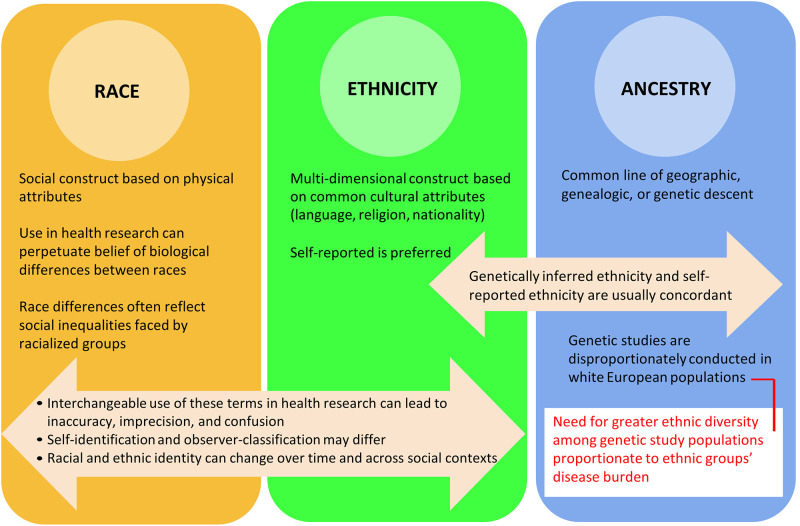
Race, ethnicity, and ancestry are common classification variables used in health research. However, there has been no formal agreement on the definitions of these terms, resulting in misuse, confusion, and a lack of clarity surrounding these concepts for researchers and their readers. This article examines past and current understandings of race, ethnicity, and ancestry in research, identifies the distinctions between these terms, examines the reliability of these terms, and provides researchers with guidance on how to use these terms. Although race, ethnicity, and ancestry are often treated synonymously, they should be considered as distinct terms in the context of health research. Researchers should carefully consider which term is most appropriate for their study, define and use the terms consistently, and consider how their classification may be used in future research by others. The classification should be self-reported rather than assigned by an observer wherever possible.
Copyright: © 2022 Lu et al. This is an open access article distributed under the terms of the Creative Commons Attribution License, which permits unrestricted use, distribution, and reproduction in any medium, provided the original author and source are credited.
Conflict of interest statement
I have read the journal’s policy and the authors of this manuscript have the following competing interests: Dr. Anand is the Associate Chair of Equity and Diversity for the Department of Medicine in McMaster University. All other authors declare no competing interests.
Figures
References
Publication types
LinkOut - more resources
Full Text Sources
Miscellaneous