


Investing in global health security: Estimating cost requirements for country-level capacity building
- PMID: 36962802
- PMCID: PMC10021513
- DOI: 10.1371/journal.pgph.0000880
Investing in global health security: Estimating cost requirements for country-level capacity building
Abstract
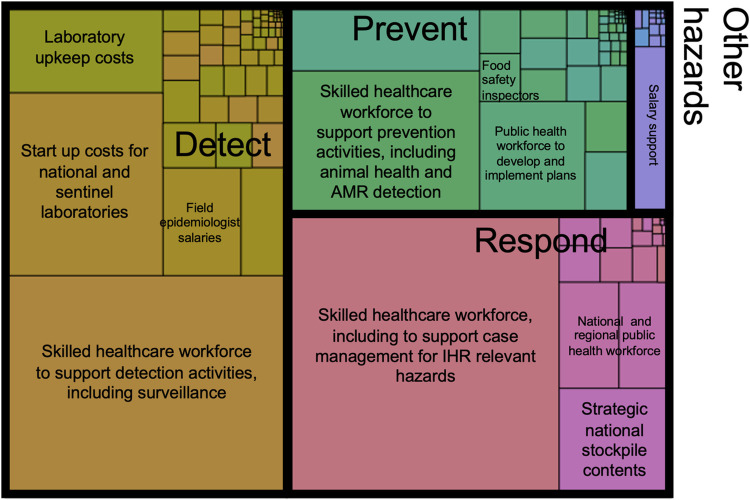
The COVID-19 pandemic has highlighted critical gaps in global capacity to prevent, detect, and respond to infectious diseases. To effectively allocate investments that address these gaps, it is first necessary to quantify the extent of the need, evaluate the types of resources and activities that require additional support, and engage the global community in ongoing assessment, planning, and implementation. Which investments are needed, where, to strengthen health security? This work aims to estimate costs to strengthen country-level health security, globally and identify associated cost drivers. The cost of building public health capacity is estimated based on investments needed, per country, to progress towards the benchmarks identified by the World Health Organization's Joint External Evaluation (JEE). For each country, costs are estimated to progress to a score of "demonstrated capacity" (4) across indicators. Over five years, an estimated US$124 billion is needed to reach "demonstrated capacity" on each indicator of the JEE for each of the 196 States Parties to the International Health Regulations (IHR). Personnel costs, including skilled health, public health, and animal health workers, are the single most influential cost driver, comprising 66% of total costs. These findings, and the data generated by this effort, provide cost estimates to inform ongoing health security financing discussions at the global level. The results highlight the significant need for sustainable financing mechanisms for both workforce development and ongoing support for the health and public health workforce.
Copyright: © 2022 Eaneff et al. This is an open access article distributed under the terms of the Creative Commons Attribution License, which permits unrestricted use, distribution, and reproduction in any medium, provided the original author and source are credited.
Conflict of interest statement
I have read the journal’s policy and the authors of this manuscript have the following competing interests: This work was funded by Resolve to Save Lives: An Initiative of Vital Strategies, and AM is an employee of Resolve to Save Lives.
Figures
References
-
- Pandemic Action Network and the Center for Global Development. Ending Boom or Bust: What Will it Cost to Pandemic-Proof the Planet? [Internet]. [cited 2022 Jan 22]. Available from: https://www.cgdev.org/event/ending-boom-or-bust-what-will-it-cost-pandem....
-
- G20 High Level Independent Panel. A Global Deal for our Pandemic Age: Report of the G20 High Level Independent Panel [Internet]. 2021. Jun [cited 2022 Jan 16]. Available from: https://pandemic-financing.org/report/annexes/list-of-institutions-and-p....
-
- Craven M, Sabow A, Van der Veken L, Wilson M. Not the last pandemic: Investing now to reimagine public-health systems [Internet]. McKinsey and Company; [cited 2022 Jan 22]. Available from: https://www.mckinsey.com/industries/public-and-social-sector/our-insight....
LinkOut - more resources
Full Text Sources