


The social media diet: A scoping review to investigate the association between social media, body image and eating disorders amongst young people
- PMID: 36962983
- PMCID: PMC10032524
- DOI: 10.1371/journal.pgph.0001091
The social media diet: A scoping review to investigate the association between social media, body image and eating disorders amongst young people
Abstract
Background: Eating disorders are a group of heterogenous, disabling and deadly psychiatric illnesses with a plethora of associated health consequences. Exploratory research suggests that social media usage may be triggering body image concerns and heightening eating disorder pathology amongst young people, but the topic is under-researched as a global public health issue.
Aim: To systematically map out and critically review the existing global literature on the relationship between social media usage, body image and eating disorders in young people aged 10-24 years.
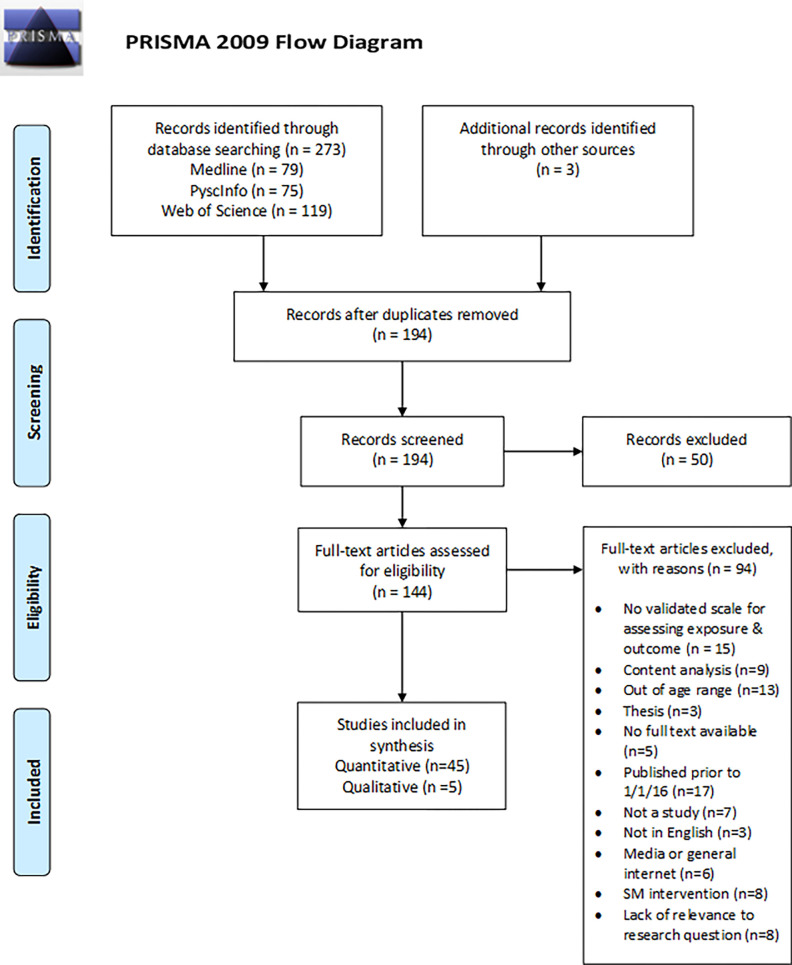
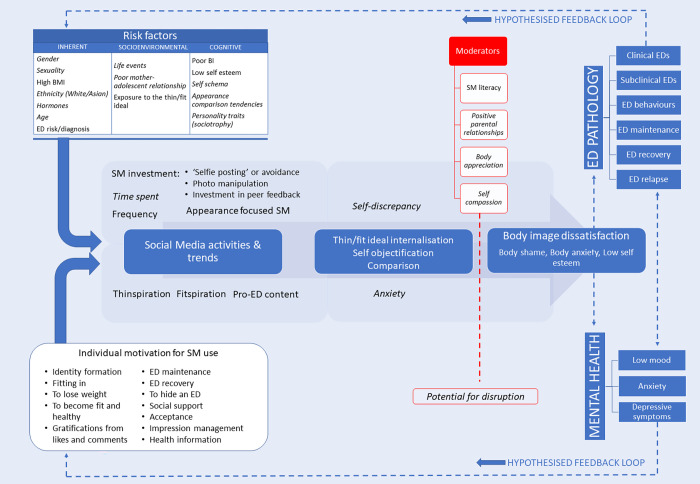
Methods: A systematic search of MEDLINE, PyscINFO and Web of Science for research on social media use and body image concerns / disordered eating outcomes published between January 2016 and July 2021. Results on exposures (social media usage), outcomes (body image, eating disorders, disordered eating), mediators and moderators were synthesised using an integrated theoretical framework of the influence of internet use on body image concerns and eating pathology.
Results: Evidence from 50 studies in 17 countries indicates that social media usage leads to body image concerns, eating disorders/disordered eating and poor mental health via the mediating pathways of social comparison, thin / fit ideal internalisation, and self-objectification. Specific exposures (social media trends, pro-eating disorder content, appearance focused platforms and investment in photos) and moderators (high BMI, female gender, and pre-existing body image concerns) strengthen the relationship, while other moderators (high social media literacy and body appreciation) are protective, hinting at a 'self-perpetuating cycle of risk'.
Conclusion: Social media usage is a plausible risk factor for the development of eating disorders. Research from Asia suggests that the association is not unique to traditionally western cultures. Based on scale of social media usage amongst young people, this issue is worthy of attention as an emerging global public health issue.
Copyright: © 2023 Dane, Bhatia. This is an open access article distributed under the terms of the Creative Commons Attribution License, which permits unrestricted use, distribution, and reproduction in any medium, provided the original author and source are credited.
Conflict of interest statement
The authors have declared that no competing interests exist.
Figures
References
-
- Santomauro DF, Melen S, Mitchison D, Vos T, Whiteford H, Ferrari AJ. The hidden burden of eating disorders: an extension of estimates from the Global Burden of Disease Study 2019. Lancet Psychiatry. 2021;8(4):320–8. Epub 2021/03/07. doi: 10.1016/S2215-0366(21)00040-7 ; PubMed Central PMCID: PMC7973414. - DOI - PMC - PubMed
-
- Beat Eating Disorders Organisation. Types of Eating Disorder 2020 [cited 2021 9 June]. Available from: https://www.beateatingdisorders.org.uk/types.
Publication types
LinkOut - more resources
Full Text Sources