. 2023 Mar 24;13(1):4847.
doi: 10.1038/s41598-023-31842-y.

In vitro hair follicle growth model for drug testing

Affiliations

In vitro hair follicle growth model for drug testing

Tatsuto Kageyama et al. Sci Rep. .

Abstract

In vitro models of human hair follicle-like tissue could be fundamental tools to better understand hair follicle morphogenesis and hair drug screening. During prenatal development and postnatal cyclic hair regeneration, hair follicle morphogenesis is triggered by reciprocal interactions and the organization of the epithelial and mesenchymal cell populations. Given this mechanism, we developed an approach to induce hair peg-like sprouting in organoid cultures composed of epithelial and mesenchymal cells. Human fetal/adult epithelial and mesenchymal cells were cultured in a medium supplemented with a low concentration of either Matrigel or collagen I. These extracellular matrices significantly enhanced the self-organization capabilities of the epithelial and mesenchymal cells, resulting in spherical aggregation and subsequent hair peg-like sprouting. The length of the hair peg sprouting and associated gene expression significantly increased in the presence of a well-known hair drug, minoxidil. This approach may be beneficial for testing hair growth-promoting drug candidates.


Conflict of interest statement

Tatsuto Kageyama, Ayaka Nanmo, and Junji Fukuda are co-founders of TrichoSeeds, a company that produces hair regeneration medicine. The authors declare that they have no known competing financial interests or personal relationships that could have appeared to influence the work reported in this paper.

Figures
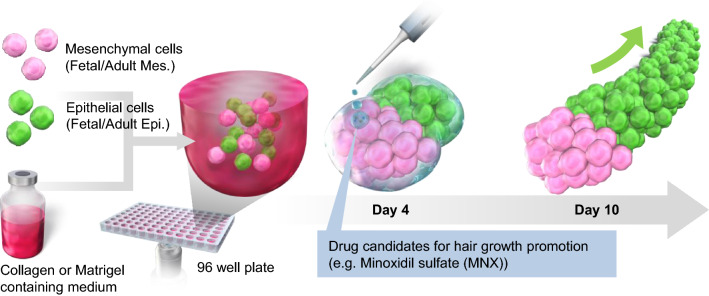
Figure 1
Figure 1
Schematic representation of the preparation of human hair follicle growth models (termed hair follicloids). Hair follicloids are formed through the self-organization of human epithelial and mesenchymal cells, which generate sprouting structures in vitro. Changes in sprouting length were investigated after exposure to hair growth-promoting drug candidates.
Figure 2
Figure 2
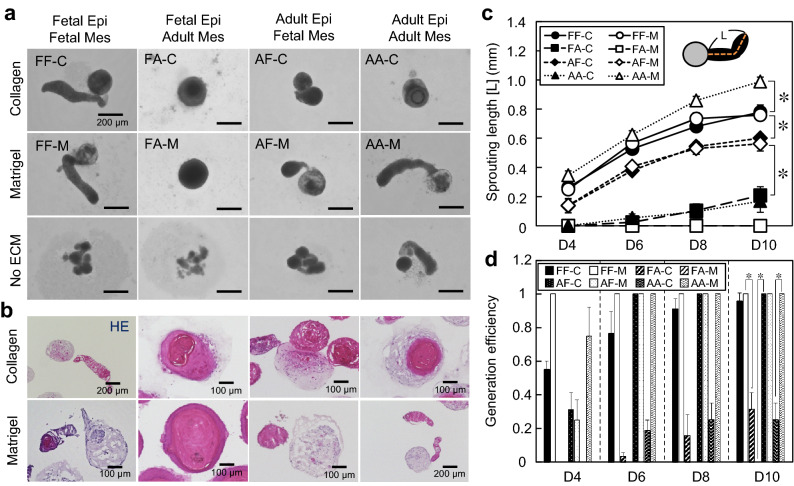
Characterization of human hair follicloids. (a) Self-organization of the epithelial and mesenchymal cells in hair follicloids. Hair follicloids were prepared by combining fetal and adult epithelial and mesenchymal cells, supplemented with or without collagen and Matrigel (Table 1). Stereomicroscope images were observed on day ten of culture. (b) Cross-sectional view of hair follicloids. On day ten of culture, hair follicloids were sectioned and stained with hematoxylin and eosin. (c) Length of the sprouting structures generated from hair follicloids prepared under different conditions (Table 2). The length was measured from the stereomicroscope images taken on days four, six, eight, and ten of culture. (d) Generation efficiency of sprouting structures after day ten of culture. The average ratio was analyzed from the results of three independent experiments.
Figure 3
Figure 3
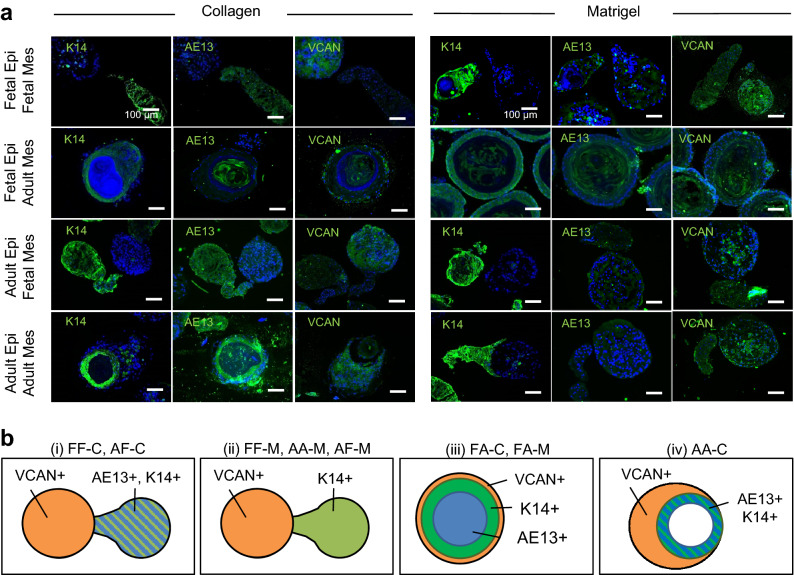
Immunostaining of hair follicloids. (a) Histological analysis of hair follicloids. Hair follicles were sectioned and stained with fluorescently labeled antibodies against K14, AE13, and versican. (b) Schematics of K14, AE13, and versican expression in hair follicloids.
Figure 4
Figure 4
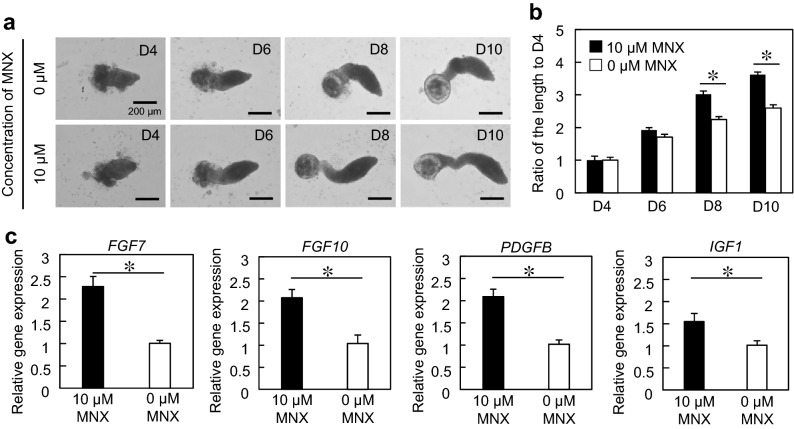
Hair growth-promoting drug testing on hair follicloids. (a) Microscope images of hair follicloids cultured with/without minoxidil (MNX) for 10 days. Hair follicloids were permeabilized and observed using a stereomicroscope. (b) The length of sprouting structures with/without MNX. The graph shows the ratio of the length on days six, eight, and ten compared to that on day four. Numerical variables were statistically evaluated using Student’s t-test; * indicates p < 0.05. (c) Relative expression of hair growth-associated genes. GAPDH was used as a reference gene to normalize expression. Error bars represent the standard error of the mean calculated from three experiments for each condition. Numerical variables were statistically evaluated using Student’s t-test; * indicates p < 0.05.
Figure 5
Figure 5
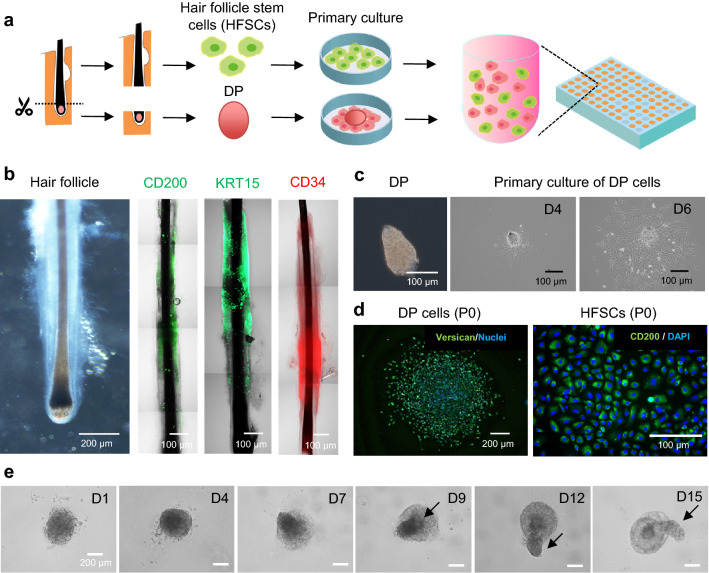
Preparation of hair follicloids using patient hair follicle-derived cells. (a) Preparation of hair follicle stem cells (HFSCs) and dermal papilla (DP) cells from hair follicles of patients with androgenic alopecia. Dissociated HFSCs and DP tissues were seeded on the dishes for primary culture. Proliferated HFSCs and DP cells were suspended in culture media containing Matrigel and cultured in a 96-well plate. (b) Native human hair follicles. Microscope and immunostaining images were taken before cell dissociation. (c) DP cell culture. Isolated DPs adhered to and proliferated on the culture dishes. (d) Expression of stem cell markers in HFSC and DP cells. Primary cultures containing HFSCs and DP cells were visualized through the immunohistochemical staining of versican and CD200. (e) Time-course of sprouting of hair follicloids.

References

    1. Phillips TG, Slomiany WP, Allison R. Hair loss: common causes and treatment. Am. Fam. Physician. 2017;96:371–378. - PubMed
    1. Lin RL, Garibyan L, Kimball AB, Drake LA. Systemic causes of hair loss. Ann. Med. 2016;48:393–402. doi: 10.1080/07853890.2016.1180426. - DOI - PubMed
    1. Santos Z, Avci P, Hamblin MR. Drug discovery for alopecia: gone today, hair tomorrow. Expert Opin. Drug Discov. 2015;10:269–292. doi: 10.1517/17460441.2015.1009892. - DOI - PMC - PubMed
    1. Ghanemi A. Cell cultures in drug development: applications, challenges and limitations. Saudi Pharm. J. 2015;23:453–454. doi: 10.1016/j.jsps.2014.04.002. - DOI - PMC - PubMed
    1. Znidaric M, Zurga ZM, Maver U. Design of in vitro hair follicles for different applications in the treatment of alopecia-a review. Biomedicines. 2021;9:435. doi: 10.3390/biomedicines9040435. - DOI - PMC - PubMed

Publication types

Substances