


Virtual excavation and analysis of the early Neanderthal cranium from Altamura (Italy)
- PMID: 36964200
- PMCID: PMC10039001
- DOI: 10.1038/s42003-023-04644-1
Virtual excavation and analysis of the early Neanderthal cranium from Altamura (Italy)
Abstract
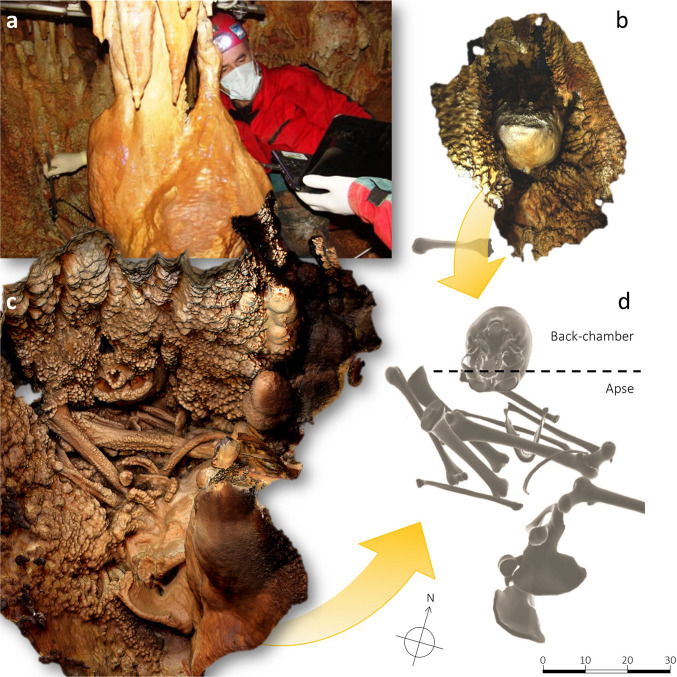
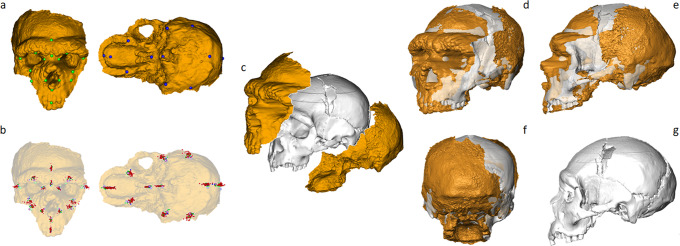
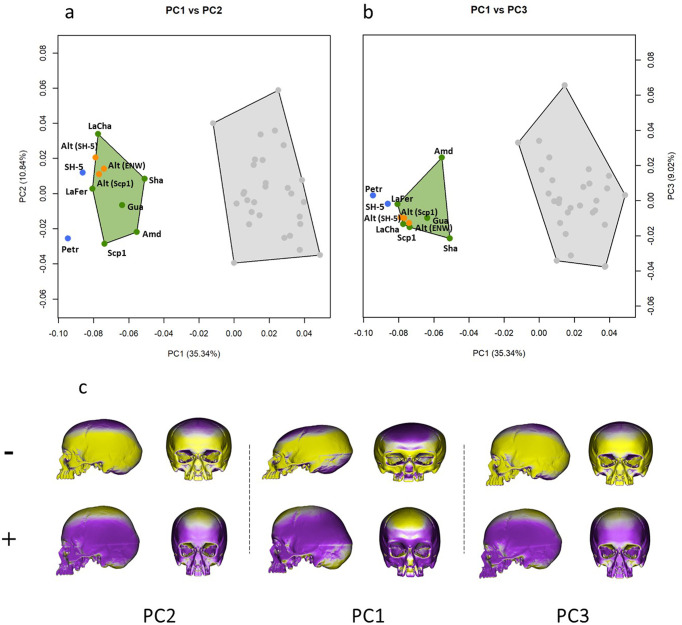
Complete Neanderthal skeletons are almost unique findings. A very well-preserved specimen of this kind was discovered in 1993 in the deepest recesses of a karstic system near the town of Altamura in Southern Italy. We present here a detailed description of the cranium, after we virtually extracted it from the surrounding stalagmites and stalactites. The morphology of the Altamura cranium fits within the Neanderthal variability, though it retains features occurring in more archaic European samples. Some of these features were never observed in Homo neanderthalensis, i.e. in fossil specimens dated between 300 and 40 ka. Considering the U-Th age we previously obtained (>130 ka), the morphology of Altamura suggests that the archaic traits it retains may have been originated by geographic isolation of the early Neanderthal populations from Southern Italy.
© 2023. The Author(s).
Conflict of interest statement
The authors declare no competing interests.
Figures
References
-
- Churchill, S. E. Thin on the Ground: Neandertal Biology, Archeology and Ecology (Wiley, 2014).
-
- Rosas, A., Bastir, M., Martinez-Maza, C., Garcia-Tabernero, A. & Lalueza-Fox, C. in Neanderthals Revisited: New Approaches and Perspectives (eds Hublin, J.-J., Harvati, K. & Harrison, T.) 37–69 (Springer, 2008).
Publication types
MeSH terms
LinkOut - more resources
Full Text Sources
