. 2023 Mar 25;13(1):4905.
doi: 10.1038/s41598-023-32173-8.

Unraveling the importance of fabrication parameters of copper oxide-based resistive switching memory devices by machine learning techniques

Affiliations

Unraveling the importance of fabrication parameters of copper oxide-based resistive switching memory devices by machine learning techniques

Suvarna M Patil et al. Sci Rep. .

Abstract

In the present study, various statistical and machine learning (ML) techniques were used to understand how device fabrication parameters affect the performance of copper oxide-based resistive switching (RS) devices. In the present case, the data was collected from copper oxide RS devices-based research articles, published between 2008 to 2022. Initially, different patterns present in the data were analyzed by statistical techniques. Then, the classification and regression tree algorithm (CART) and decision tree (DT) ML algorithms were implemented to get the device fabrication guidelines for the continuous and categorical features of copper oxide-based RS devices, respectively. In the next step, the random forest algorithm was found to be suitable for the prediction of continuous-type features as compared to a linear model and artificial neural network (ANN). Moreover, the DT algorithm predicts the performance of categorical-type features very well. The feature importance score was calculated for each continuous and categorical feature by the gradient boosting (GB) algorithm. Finally, the suggested ML guidelines were employed to fabricate the copper oxide-based RS device and demonstrated its non-volatile memory properties. The results of ML algorithms and experimental devices are in good agreement with each other, suggesting the importance of ML techniques for understanding and optimizing memory devices.


Conflict of interest statement

The authors declare no competing interests.

Figures

Figure 1
Figure 1
Statistical analysis of copper oxide-based RS devices. Bar plot of (a) type of materials used to fabricate RS layer and (b) synthesis methods used to deposit switching layer. Bar plot of types of (c) TE and (d) BE used to fabricate RS devices and their respective counts. (e) Thickness variation in TE, BE, and SL. Distribution of (f) switching voltages (VSET and VRESET) and (g) endurance, retention, and memory window properties of RS devices. Bar plot of (h) type of resistive switching and (i) possible conduction and resistive switching mechanisms of RS devices.
Figure 2
Figure 2
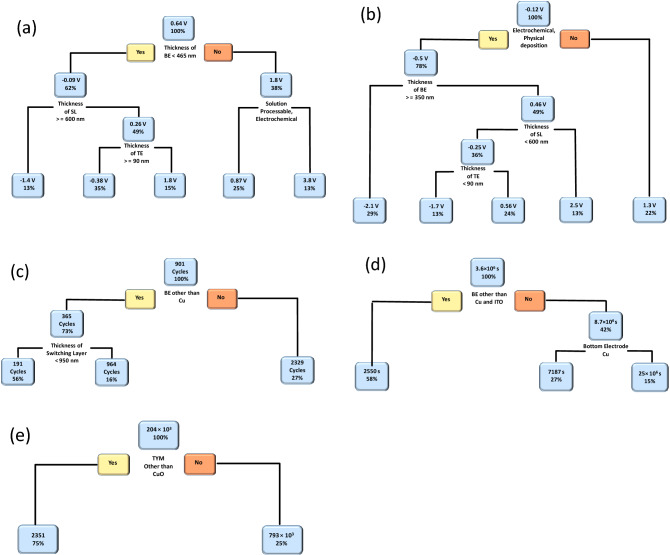
CART algorithm-based ML predictive model for copper oxide-based devices. The performance parameters such as (a) VSET (V), (b) VRESET (V), (c) endurance (cycles), (d) retention (s), and (e) memory window (unitless) are modeled using the CART-based ML algorithm.
Figure 3
Figure 3
The DT model of the type of switching (analog, digital, or both). The present model suggests an impact of device fabrication parameters on the type of switching (analog, digital, or both) of copper oxide-based RS devices.
Figure 4
Figure 4
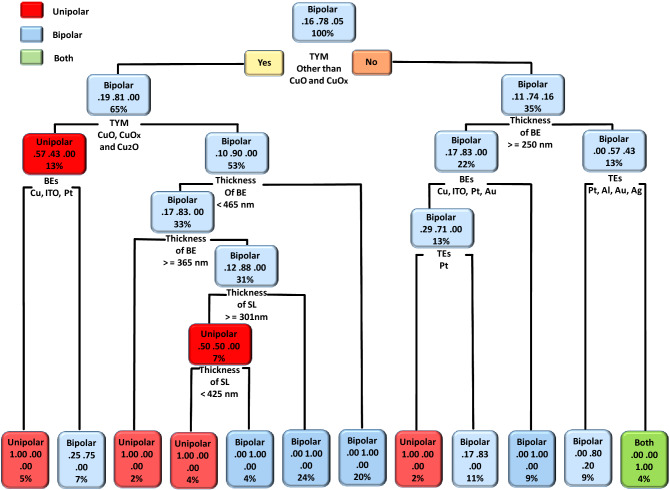
The DT model of the type of switching (unipolar, bipolar, or both). The present model suggests an impact of device fabrication parameters on the type of switching (unipolar, bipolar, or both) of copper oxide-based RS devices.
Figure 5
Figure 5
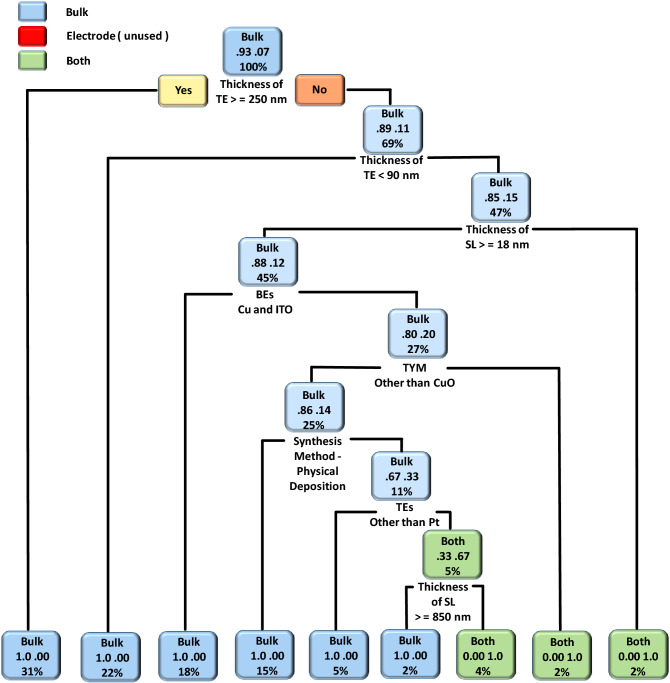
The DT model of the type of conduction mechanism (bulk limited, electrode limited, or both). The present model suggests an impact of device fabrication parameters on the type conduction mechanism of copper oxide-based RS devices.
Figure 6
Figure 6
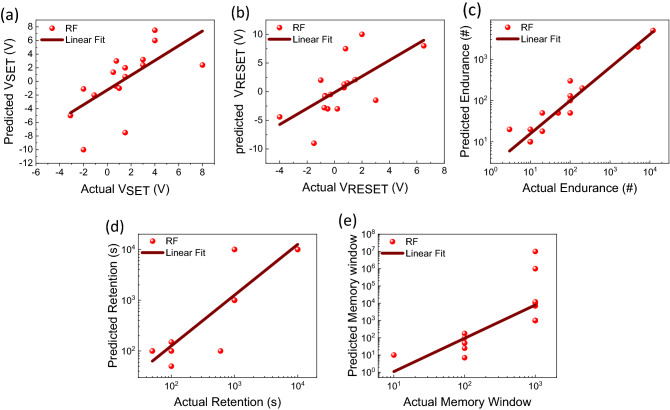
RF-based predictions of output performance features of the copper oxide-based RS devices. Predictions of (a) VSET, (b) VRESET, (c) endurance, (d) retention, and (e) memory window. The data are fitted by a linear fitting method.
Figure 7
Figure 7
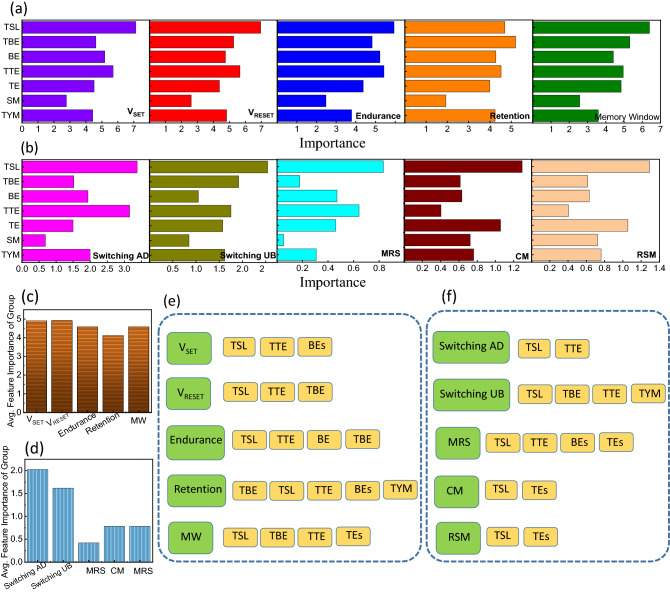
Feature importance score of the continuous and categorical output features. (a) Feature importance of continuous features (VSET, VRESET, EC, RT, and MW) and (b) categorical features (TSUB, TSAD, MRS, CM, and RSM). Average feature importance of (c) continuous features and (d) categorical features and (e,f) corresponding significant device fabrication parameters.
Figure 8
Figure 8
(a) XRD pattern, (b) Raman spectrum, and (c) FESEM image of fabricated CuO thin film. (d) I–V, (e) endurance, and (f) retention properties of CuO RS device.

References

    1. Lanza M, Wong HSP, Pop E, Ielmini D, Strukov D, Regan BC, Larcher L, Villena MA, Yang JJ, Goux L, Belmonte A. Recommended methods to study resistive switching devices. Adv. Electron. Mater. 2019;5:1800143. doi: 10.1002/aelm.201800143. - DOI
    1. Guo T, Pan K, Jiao Y, Sun B, Du C, Mills JP, Chen Z, Zhao X, Wei L, Zhou YN, Wu YA. Versatile memristor for memory and neuromorphic computing. Nanoscale Horiz. 2022;7:299–310. doi: 10.1039/D1NH00481F. - DOI - PubMed
    1. Abunahla H, Mohammad B, Mahmoud L, Darweesh M, Alhawari M, Jaoude MA, Hewitt GW. Memsens: Memristor-based radiation sensor. IEEE Sens. J. 2018;18:3198–3205. doi: 10.1109/JSEN.2018.2808285. - DOI
    1. Vourkas I, Sirakoulis GC. Emerging memristor-based logic circuit design approaches: A review. IEEE Circuits Syst. Mag. 2016;16:15–30. doi: 10.1109/MCAS.2016.2583673. - DOI
    1. Butler KT, Davies DW, Cartwright H, Isayev O, Walsh A. Machine learning for molecular and materials science. Nature. 2018;559:547–555. doi: 10.1038/s41586-018-0337-2. - DOI - PubMed