Review
. 2023 Mar 25;16(1):29.
doi: 10.1186/s13045-023-01424-6.

Recent advances in targeted therapies in acute myeloid leukemia

Affiliations
Review

Recent advances in targeted therapies in acute myeloid leukemia

Rahul S Bhansali et al. J Hematol Oncol. .

Abstract

Acute myeloid leukemia (AML) is the most common acute leukemia in adults. While survival for younger patients over the last several decades has improved nearly sixfold with the optimization of intensive induction chemotherapy and allogeneic stem cell transplantation (alloHSCT), this effect has been largely mitigated in older and less fit patients as well as those with adverse-risk disease characteristics. However, the last 10 years has been marked by major advances in the molecular profiling of AML characterized by a deeper understanding of disease pathobiology and therapeutic vulnerabilities. In this regard, the classification of AML subtypes has recently evolved from a morphologic to a molecular and genetic basis, reflected by recent updates from the World Health Organization and the new International Consensus Classification system. After years of stagnation in new drug approvals for AML, there has been a rapid expansion of the armamentarium against this disease since 2017. Low-intensity induction therapy with hypomethylating agents and venetoclax has substantially improved outcomes, including in those previously considered to have a poor prognosis. Furthermore, targeted oral therapies against driver mutations in AML have been added to the repertoire. But with an accelerated increase in treatment options, several questions arise such as how to best sequence therapy, how to combine therapies, and if there is a role for maintenance therapy in those who achieve remission and cannot undergo alloHSCT. Moreover, certain subtypes of AML, such as those with TP53 mutations, still have dismal outcomes despite these recent advances, underscoring an ongoing unmet need and opportunity for translational advances. In this review, we will discuss recent updates in the classification and risk stratification of AML, explore the literature regarding low-intensity and novel oral combination therapies, and briefly highlight investigative agents currently in early clinical development for high-risk disease subtypes.

Keywords: Acute myeloid leukemia; Combination therapy; FLT3; IDH1; IDH2; Novel treatments; TP53; Targeted therapy.


Conflict of interest statement

RSB receives consultancy fees from Alva10. CL serves on advisory boards for BMS, Jazz Pharma, Genentech, Novartis, Abbvie, Daiichi, Astellas, Macrogenics, Servier, and Taiho. Previous but not current speakers bureau: Astellas, Jazz KP has received research funding from AbbVie, Agios, Daiichi Sankyo, Millennium; served as an advisory board member for AbbVie, Astellas, Astra Zeneca, Boston BioMedical, Bristol-Myers Squibb, Celgene, Novartis, Jazz Pharmaceuticals, and Servier.

Figures

Fig. 1
Fig. 1
Approach to frontline treatment of AML with FDA-approved therapies in 2022. Treatment algorithm of AML induction and maintenance therapy is shown. AML Acute myeloid leukemia, GO Gemtuzumab ozogamicin, MIDO Midostaurin, HMA Hypomethylating agent, VEN Venetoclax, ENA Enasidenib; IVO Ivosidenib, LDAC Low-dose cytarabine, alloHSCT Allogeneic stem cell transplantation, MRD Measurable residual disease, CR Complete remission
Fig. 2
Fig. 2
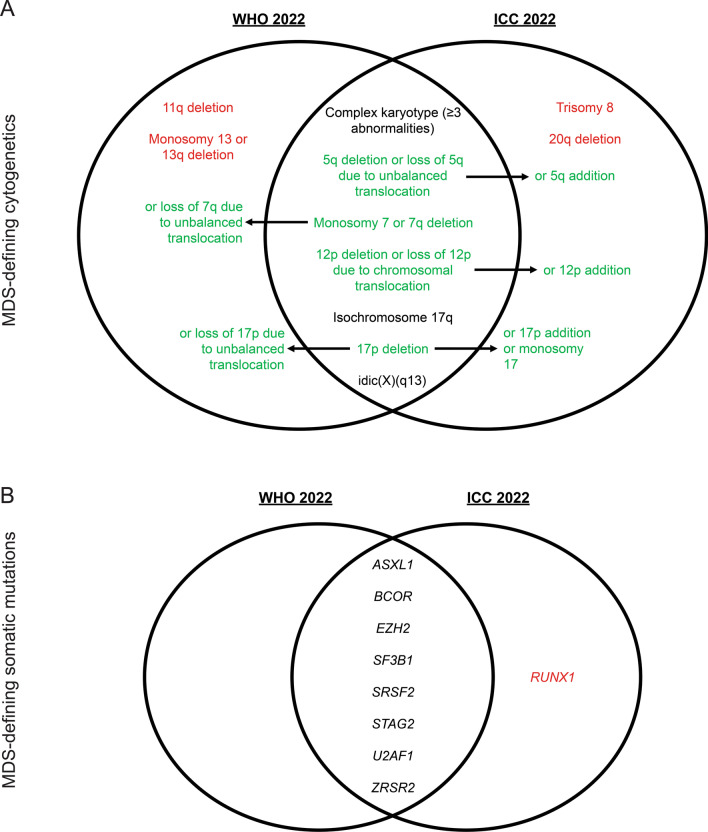
Updates in WHO/ICC MDS-defining genetic alterations in AML. Venn diagrams depict overlapping and distinct MDS-defining cytogenetic alterations A and somatic mutations B determined by the WHO [23] and ICC [24] Green text with arrows denotes overlapping entities with minor differences, black text denotes completely overlapping entities, and red text denotes completely distinct entities. MDS Myelodysplastic syndrome WHO World Health Organization, ICC International Consensus Classification
Fig. 3
Fig. 3
Updates in ELN risk stratification of AML. A Sankey plot depicts changes in the 2017 [65] and 2022 [35] ELN risk stratification of AML. Prognostic groups are groups by color (favorable—green, intermediate—yellow, adverse—red) and changes are tracked by dashed arrows. bZIP Basic leucine zipper domain, ELN European LeukemiaNet
Fig. 4
Fig. 4
Mechanisms of novel targeted therapies in AML in later-stage clinical development. A Mutations in TP53 lead to altered conformation of p53 leading to a subtype of AML characterized by treatment resistance, high relapse rates, and poor overall survival. Novel agents such as eprenetapopt are metabolized into MQ which covalently modifies the mutant p53 protein leading to a wild-type-like conformational change and restoration of normal p53 activity [155]. Recent reports have demonstrated that MQ can drive p53-independent cell death through ROS accumulation [156, 157] and ferroptosis [158]. B Leukemic cells can evade immune surveillance by upregulation of CD47, which binds SIRPa; this emits a “don’t eat me signal” to macrophages [–165]. Antibodies targeting CD47 can block this inhibitory signal and allow for phagocytosis of leukemic cells [–167]. C Certain types of AML are characterized by mutated NPM1c or oncogenic fusion partners associated with MLL [173, 174, 179]. These lead to complex formation with menin and LEDGF, ultimately resulting in transcriptional activation of leukemia stem cell promoting genes [–177]. Blocking this pathway with menin inhibitors such as KO-539 or SNDX-5613 can repress this transcriptional program allowing for differentiation of granulocytes [178, 180, 181]. AML Acute myeloid leukemia, MQ Methylene quinuclidinone, ROS Reactive oxidative species, SIRPa Signal regulatory protein alpha, NPM1c Cytoplasmic NPM1 (mutant NPM1), MLL Histone lysine N-methyltransferase 2A (KMT2A), LEDGF Lens epithelium-derived growth factor, MI Menin inhibitor

References

    1. Bejar R, Stevenson K, Abdel-Wahab O, Galili N, Nilsson B, Garcia-Manero G, et al. Clinical effect of point mutations in myelodysplastic syndromes. N Engl J Med. 2011;364(26):2496–2506. doi: 10.1056/NEJMoa1013343. - DOI - PMC - PubMed
    1. Busque L, Patel JP, Figueroa ME, Vasanthakumar A, Provost S, Hamilou Z, et al. Recurrent somatic TET2 mutations in normal elderly individuals with clonal hematopoiesis. Nat Genet. 2012;44(11):1179–1181. doi: 10.1038/ng.2413. - DOI - PMC - PubMed
    1. Jan M, Snyder TM, Corces-Zimmerman MR, Vyas P, Weissman IL, Quake SR, et al. Clonal evolution of preleukemic hematopoietic stem cells precedes human acute myeloid leukemia. Sci Transl Med- 2012;4(149):14918. doi: 10.1126/scitranslmed.3004315. - DOI - PMC - PubMed
    1. Welch JS, Ley TJ, Link DC, Miller CA, Larson DE, Koboldt DC, et al. The origin and evolution of mutations in acute myeloid leukemia. Cell. 2012;150(2):264–278. doi: 10.1016/j.cell.2012.06.023. - DOI - PMC - PubMed
    1. Genovese G, Kahler AK, Handsaker RE, Lindberg J, Rose SA, Bakhoum SF, et al. Clonal hematopoiesis and blood-cancer risk inferred from blood DNA sequence. N Engl J Med. 2014;371(26):2477–2487. doi: 10.1056/NEJMoa1409405. - DOI - PMC - PubMed

Publication types

MeSH terms