Trends of Ovarian Cancer Incidence by Histotype and Race/Ethnicity in the United States 1992-2019
- PMID: 36968229
- PMCID: PMC10035532
- DOI: 10.1158/2767-9764.CRC-22-0410
Trends of Ovarian Cancer Incidence by Histotype and Race/Ethnicity in the United States 1992-2019
Abstract
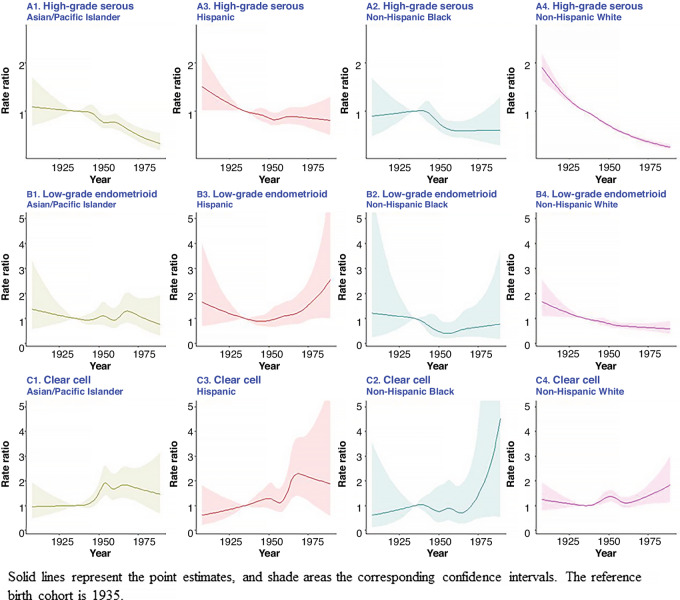
The effect of risk factors on ovarian cancer differs by histotype, and the prevalence of such risk factors varies by race/ethnicity. It is not clear how ovarian cancer incidence has changed over time by histotype and race/ethnicity. We used the Surveillance, Epidemiology, and End Results Program (SEER-12) 1992-2019 data to examine the trend of ovarian cancer incidence for three histotypes (high-grade serous N = 19,691, endometrioid N = 3,212, and clear cell N = 3,275) and four racial/ethnic groups (Asian/Pacific Islander, Hispanic, non-Hispanic Black, and non-Hispanic White). Joinpoint and age-period-cohort analyses were conducted to analyze ovarian cancer incidence trends. High-grade serous cancer was the most common histotype, but its incidence has significantly decreased over time for all racial/ethnic groups; the decrease was largest for non-Hispanic White women (average annual percent change AAPC during 2010-2019 = -6.1; 95% confidence interval (CI), -8.0 to -4.2). Conversely, clear cell cancer was most common in the Asian/Pacific Islanders, and its incidence has increased over time, particularly among Hispanic and Asian/Pacific Islander women (AAPC during 2010-2019 = 2.8; 95% CI, 0.8 to 4.7, and AAPC = 1.5; 95% CI, 0.7 to 2.2, respectively). Endometrioid cancer incidence has decreased in non-Hispanic White but increased in Hispanic women (AAPC during 2010-2019 = -1.3; 95% CI, -1.9 to -0.8, and AAPC = 3.6; 95% CI, 1.0 to 6.3, respectively). The differential incidence trends by histotype and race/ethnicity underscore the need to monitor incidence and risk factor trends across different groups and develop targeted preventive interventions to reduce the burden of ovarian cancer and disparity by race/ethnicity.
Significance: During 1992-2019, high-grade serous ovarian cancer incidence has decreased while clear cell cancer incidence has increased regardless of race/ethnicity. Endometrioid cancer incidence has decreased in non-Hispanic White but increased in Hispanic women. Differential ovarian cancer incidence trends highlight the need for targeted preventive interventions by histotype and race/ethnicity.
© 2023 The Authors; Published by the American Association for Cancer Research.
Conflict of interest statement
C.L. Pearce reports grants from NCI during the conduct of the study. No disclosures were reported by the other authors.
Figures

References
-
- Siegel RL, Miller KD, Jemal A. Cancer statistics, 2020. CA Cancer J Clin 2020;70:7–30. - PubMed
-
- American Cancer Society. Cancer facts & figures 2018; 2018.
Publication types
MeSH terms
Grants and funding
LinkOut - more resources
Full Text Sources
Medical