


Sex-specific seasonal variations in the fatty acid and carotenoid composition of sea cucumber gonads and implications for aquaculture
- PMID: 36968429
- PMCID: PMC10024008
- DOI: 10.1007/s00227-023-04198-0
Sex-specific seasonal variations in the fatty acid and carotenoid composition of sea cucumber gonads and implications for aquaculture
Abstract
Fatty acids and carotenoids are known to have roles in embryonic and larval development of sea cucumbers, but their changes in gonads during gametogenesis have not yet been studied. To improve our knowledge of the reproductive cycle of sea cucumbers in an aquaculture perspective, we collected 6-11 individuals of the species Holothuria (Panningothuria) forskali Delle Chiaje, 1823 approximately every 2 months from December 2019 to July 2021 east of the Glenan Islands (Brittany - France; 47.710°N, 3.948°W) at a depth of 8-12 m. Our results show that soon after spawning, sea cucumbers take advantage of an increased food availability in spring to rapidly and opportunistically accumulate nutrients in the form of lipids in their gonads (from May to July) and then slowly elongate, desaturate and probably rearrange fatty acids within lipid classes for the next reproductive season according to the specific requirements of both sexes. In contrast, acquisition of carotenoids occurs synchronously with gonads filling and/or through the reabsorption of spent tubules (T5), thus revealing little seasonal variations at the scale of the entire gonad in terms of relative abundance in both sexes. All results suggest that gonads are fully replenished with nutrients by October and that broodstock for induced reproduction could be captured at this moment and kept until the production of larvae is required. Maintaining broodstock for consecutive years would probably be a higher level challenge as the dynamics of tubule recruitment are not fully understood and seem to last for several years.
Supplementary information: The online version contains supplementary material available at 10.1007/s00227-023-04198-0.
Keywords: Gonad index; Holothuria forskali; Holothurians; Lipids; Xanthophylls.
© The Author(s), under exclusive licence to Springer-Verlag GmbH Germany, part of Springer Nature 2023, Springer Nature or its licensor (e.g. a society or other partner) holds exclusive rights to this article under a publishing agreement with the author(s) or other rightsholder(s); author self-archiving of the accepted manuscript version of this article is solely governed by the terms of such publishing agreement and applicable law.
Conflict of interest statement
Conflict of interestThe authors declare that they have no conflict of interest.
Figures

 ) and male (
 ) Holothuria forskali sampled in the Glénan Islands, France, from December 2019 to July 2021. n = 2–6 females and 1–6 males for each sampling event. Error bars: ± SD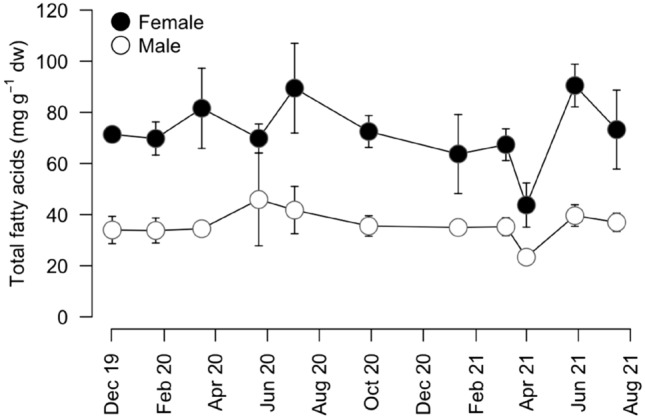
 ) and male (
 ) Holothuria forskali sampled in the Glénan Islands, France, from December 2019 to July 2021. n = 3–5 females and 1–5 males for each sampling event. Error bars: ± SD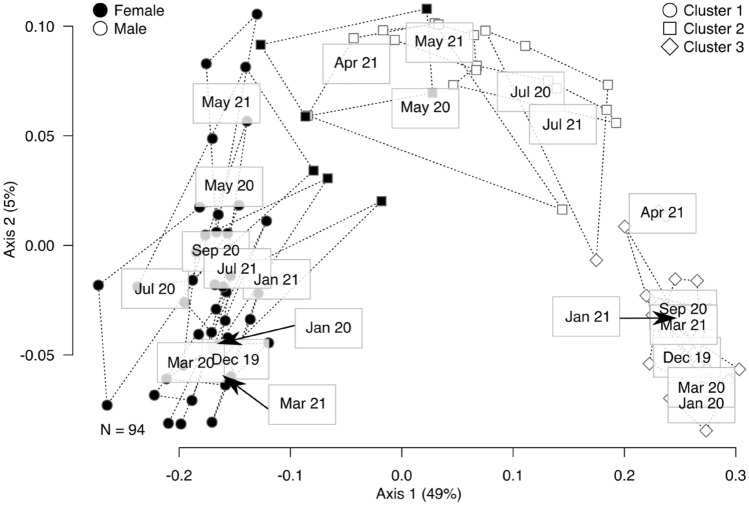
 ) and male (
 ) Holothuria forskali sampled in the Glénan Islands, France, from December 2019 to July 2021. Clusters were agglomerated according to the Ward method on a Bray–Curtis dissimilarity matrix. n = 3–5 females and 1–5 males for each sampling event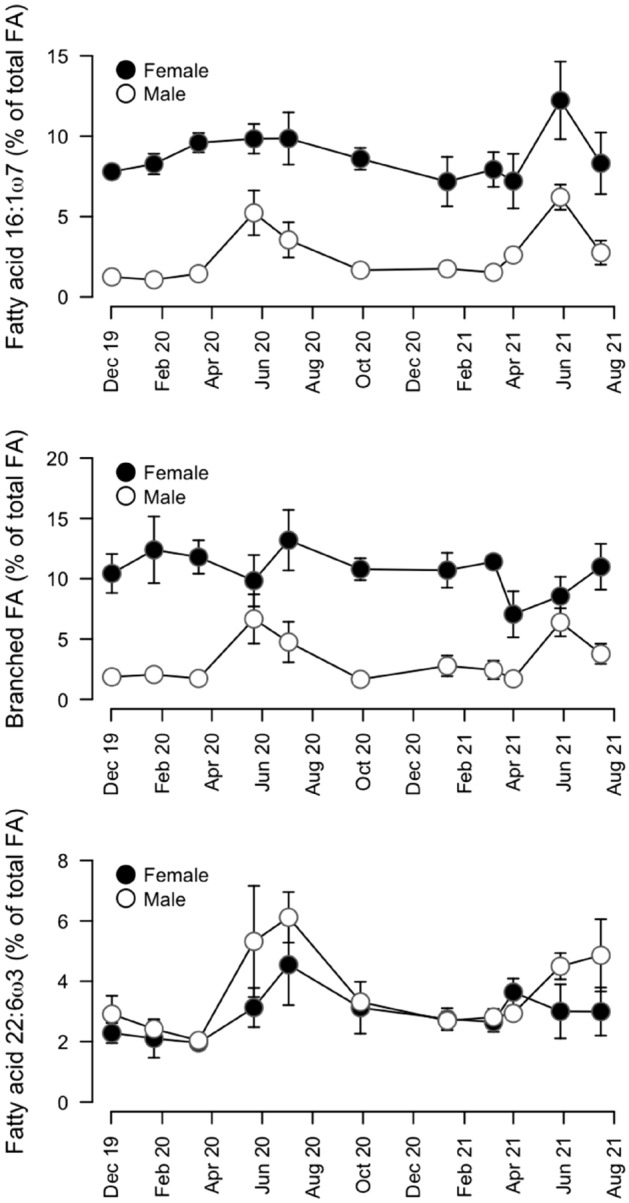
 ) and male (
 ) Holothuria forskali sampled in the Glénan Islands, France, from December 2019 to July 2021. n = 3–5 females and 1–5 males for each sampling event. Error bars: ± SD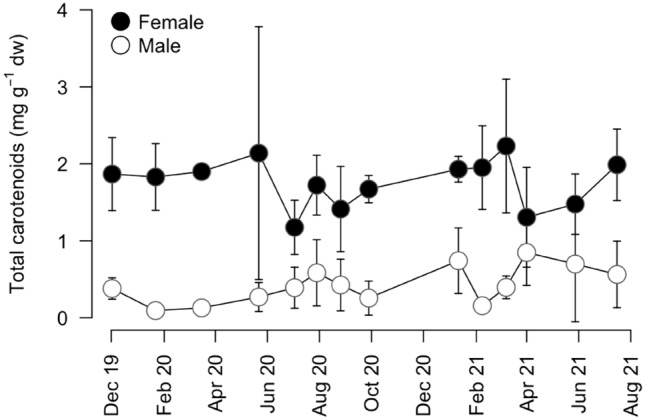
 ) and male (
 ) Holothuria forskali sampled in the Glénan Islands, France, from December 2019 to July 2021. n = 2–6 females and 1–6 males for each sampling event. Error bars: ± SD
 ) and male (
 ) Holothuria forskali sampled in the Glénan Islands, France, from December 2019 to July 2021. n = 2–6 females and 1–6 males for each sampling event. Error bars: ± SD
References
-
- Ballesteros T, Tubío A, Rodríguez R, Hernández A, Costas D, Troncoso J. Reproductive cycle of the sea cucumber Holothuria forskali (Holothuriida: Holothuriidae) in the Ría de Vigo (NW of Spain) RBT. 2021;69:101–117. doi: 10.15517/rbt.v69iSuppl.1.46331. - DOI
-
- Bandaranayake WM, Rocher AD. Role of secondary metabolites and pigments in the epidermal tissues, ripe ovaries, viscera, gut contents and diet of the sea cucumber Holothuria atra. Mar Biol. 1999;133:163–169. doi: 10.1007/s002270050455. - DOI
-
- Brotas V, Plante-Cuny M-R. The use of HPLC pigment analysis to study microphytobenthos communities. Acta Oecologica. 2003;24:S109–S115. doi: 10.1016/S1146-609X(03)00013-4. - DOI
LinkOut - more resources
Full Text Sources
Miscellaneous